
Can you tell you a little about yourself?
Born and bred outside London, suburbia land, escaped as soon as poss and moved to Truro, Cornwall in my mid-twenties. I’ve gradually been moving westward across the county ever since, and am now 8 miles west of Penzance, if I go any further I’ll fall off the cliff (though the Scillies are tempting!). I’ve worked as a primary school teacher, paediatric nurse and then in a Woman’s Refuge. A few years ago, I returned to London to help my dad during his last years, which were difficult for him. He transitioned at 103 years old. Back home now and enjoying a simple life which suits me best.
How would you describe your spiritual pathway?
I’m all for the Great Melting Pot myself, I like to meld past and present, draw from different branches within Paganism and from other spiritual traditions. Spiritual beliefs are so individual – what resonates with us, what we find meaningful and helpful for living the actual life we’re in, is so idiosyncratic. (Which is why I’ve always thought a standardised state religion will only really work if you have a standardised human…)
But the label I do feel very happy with is that of nature-oriented Pagan. Paganism is where Spirit and Nature meet, and for myself that is very literal as it tends to be when I’m out in nature that I most experience the spiritual. And I’ve always found Witchcraft provides a very useful structure for spiritual work, offering practical tools that get results.
I think the first Pagan book I came across was The Spiral Dance, which sent me bombing down this pathway – thanks Starhawk!
How and when did your spiritual journey begin?
In my early teens, thanks to my mum who was a Spiritualist, healer and clairaudient at a time when it was considered bizarre at best. A religious family war ensued, with my evangelical older sister and brother insisting she was heading for hell, while my poor father tried to avoid taking sides by clinging desperately to the agnostic fence (no chance dad!). Between battles, I read all my mum’s literature which opened me up to alternative spiritual ideas.
From then on, I joined everything going – Buddhist, Rosicrucian, Theosophist, Spiritualist, you name it I tried it – and enrolled on all sorts of complementary healing courses, but Paganism drew me most and on a heart level. Also for many sound reasons, not least that it seeks to works with nature (a no brainer as we are part of nature!). It was the old conquer and exploit attitude (I believe the biblical phrase is “And man shall have dominion over the Earth”), which got us into the mess we’re in. The world so needs the Pagan paradigm right now!
Additionally, and it was a very welcome addition, Paganism embraces the Divine Feminine. I started Sunday school when more or less just out of nappies, and it was all God the Father, God the Son, Jesus and his merry men (no whiff of female disciples) and women weren’t even allowed to be vicars! (Not until 1994). They simply had no voice in religion. Crazy! Whereas the Pagan faith has priestesses and even uses the word ‘Goddess’. Hallelujah!
Not only that, but by honouring the Triple Goddess, the Crone has at long last been brought back from the back burner. Quite a radical idea for our society! The beginning of the modern witchcraft movement was all about reclaiming ‘witch’ as a positive archetype of the strong, independent woman. By reversing the old gender put-down of ‘wicked old hag’ living outside the respectable community, it was making some bold statements: it’s ok not to follow the herd, to choose our own beliefs, we don’t judge ourselves by outer appearance, and old age is valued as a worthwhile final spin of the life cycle!
Witchcraft is empowering as a woman but it’s also empowering full stop. It offers a way to affect our reality – to shape and bend. All in all, finding Paganism was a BIG BREATH OF FRESH AIR!
I’ve belonged to various covens, full and new moon groups over the years but one in particular was very impactful. An all-women’s group, we met every month for ten years or so, and established a strong level of trust which enabled much deep spiritual and psychological delving. These days though, I’m pretty much a solitary witch, it just suits the stage I’m at, living quietly and finding a very personal way to connect with the Mystery.
What prompted you to start writing?
Embarrassingly, the initial impetus was probably extreme angst! I wrote the first 3 sections (very badly I must say) when I was in my thirties. Then I shelved it as life took up my time, but dug it out again during lockdown 2020 – I didn’t catch covid but did get the writing bug…
When I was young, I took a sociology degree and under the ‘social history’ section of the course we studied the witch persecutions of the sixteenth and seventeenth centuries (and I carried on researching the topic forever after). This was a dark period of history for women. Although some men and quite a few unsung moggies met sticky ends, women made up about 80% of those convicted. I guess in my own little way I wanted to try to tell the story of these wronged women, who had suffered such atrocities, in the way that they might say it.
So you could say I originally wrote from the Collective wound. Of course, there’s always the piddling personal niggling away at us too. From teenage years onwards you come face to face with the real world – a bit corrupt, a lot unfair and sadly full of suffering. And that all takes a couple of decades to come to terms with (if ever). At the same time, you’re finding your place in the various pecking orders with which society abounds. Moira Box, the main character of my novel, is right at the bottom of the pile of social crap, the sort of woman everyone overlooks, and I didn’t want to do the same.
Consequently, A Westerly Wind Brings Witches visits some grim places but ultimately her story is an uplifting one, a journey to spiritual Meaning, a healthy sense of self and a humorous take on the tricksy business of living. I use a light hearted, tongue in cheek tone in the contemporary sections to this end. (Not in the historical half – the stakes for being called a witch then were too high for jokes, literally stakes as in tied to over a bonfire.) But in this mad modern era, I think it’s ok to lighten up a little and laugh at ourselves as well as at everyone else! At the end of the day, we’re just human, warts and all.
Do you draw inspiration from the landscape?
The Land is really the backcloth to the novel. Only partially revealed – although Gaia, the Earth Mother, is quite vocal on occasion. The nature spirits also like to have their say – rather mischievous, not particularly comforting, but that’s the Fey for you!
The landscape around where I live can be very evocative of the mystical. Certain places at certain times – in the moonlight, when the sea mists roll in – it’s then that the Unseen draws close. Always elusive though, you just catch a glimpse before it slips away, back to the other realms beyond everyday perception, but leaving a lasting impression.
I also write about the historical which is very visible in West Cornwall, reminders of our ancestors are dotted all over the place. Neolithic and Bronze Age standing stones, quoits and burial mounds, the Iron Age settlements of Chysauster and Carn Euny with their roundhouses and fogous, and the mining chimneys and crumbling engine houses of the last few centuries.
We actually have some of the country’s oldest stone structures here, several drystone walls (Cornish hedges) date back to 5000 BC, that’s 2000 years older than the stone circles! Some days it feels as if the distant past is breathing down the back of your neck.
How did you plan out the characters for your book A Westerly Wind Brings Witches?
I always start with the question “What makes us who we are?”
There are generally two elements flagged up in answer to that, and I wanted to add a third factor which is often missed out as having no credence in current thinking.
On the one hand, there’s our physical inheritance: our body, genes, innate qualities, natural characteristics, etc. I.e. what you’re born with. On the other hand, there’s what we’re born into. Your surroundings, the family you’re plonked in, the upbringing dished out to us, and all our circumstances including social, financial, cultural, geographical, national, ad infinitum.
The biologists and sociologists have been arguing for decades as to which has most impact in shaping us. We all know it’s both. But I think there’s a third ingredient to add to the mix, that of soul inheritance. I don’t believe we are born with an empty soul any more than we’re born with a blank sheet in terms of genetics or environment.
Moira’s character arc spans three lives, the present and two past lives (in addition to an individual arc for each incarnation). The lives appear in reverse chronological order so it takes a while to piece the connections together. At its most simplistic, each starts with a different soul input, as every life creates soul growth which she carries over to the next one, and with each gain in resilience she takes on more challenging circumstances. (And I say ‘she takes on’ as I’d like to think we have a big say in any pre-life planning that occurs, we are the main character in our own story after all!)
So back to your question, I planned each character in the novel by placing myself in their shoes. Once the three ingredients of nature, nurture and soul had been well stirred into the brew, each individual personality sprang up out of the cauldron, as perhaps do we all.
Did you have the whole story parts decided right from the beginning?
Not at all. There’s a wonderful description by Terry Pratchett as to how he begins a novel. You start by standing beneath a tree at the foot of a valley obscured in fog, unable to see anything except perhaps the top of another tree sticking up further along. So you walk from the near tree towards the distant, and as you do so the fog lifts and the lay of the land (plot) reveals itself.
The ‘tree’ I had my back up against was Moira’s sorry lot and her spiritual odyssey, while the far landmark I had my sights on was the history of witch mania. They may seem two quite disparate topics but the path between them became clear remarkedly quickly, and gave rise to a whole load of interconnected issues needing to be covered. It was never going to be a small book, in fact I ended up with a whole forest.
Did any of the characters surprise you as you were writing?
What really surprised me was how soon the characters arose fully formed, living and breathing. The storyscape becomes so real and vivid to the writer, you begin with an idea and end up in a whole world! This is why writing fiction is so compelling, but also its potential downfall. So complete is this world of imagination that a single sentence brings it into your mind’s eye in full technicolour, but you have no way of judging if you have conveyed any of this to the reader. Have you led them with you into this wonderful alternative reality (where you hang out most of the time these days) or have you left them outside the gates, cold and bored?
I guess this is why beta readers are recommended but I didn’t really become au fait with the novel-writing process having never attended a course or even read a book on the subject. Bit stupid really, learning from your mistakes is a long-drawn-out process. I have my moon in Capricorn – when it comes to picking a path up a mountain I’m pretty much guaranteed to end up on the longest, most arduous route…
Your main character, Moira experiences past life regression, is that something you work with personally?
Yes, I have done so. I used to meet up regularly with a few friends to explore past lives using the Christos method of regression which puts you into a light trance. I have to say it was very convincing watching friends talking from a previous existence, not just what they said but how they said it, their facial expression and tone of voice. To site one example, I remember Coral describing her life as a maid servant in the early 1700s, and while describing the relentless drudgery she was actually grinding her teeth in frustration!
I only got snippets myself, I think my sceptical mind got in the way, but I have accessed past lives in other ways. The one relating to A Westerly Wind brings Witches concerns an exceptionally realistic dream which has stayed with me over time. I dreamt of a teenage girl, poor and illiterate, in prison for witchcraft having got caught up in the community politics as a result of her healing abilities, and who was bewildered and terrified. I awoke feeling convinced that this was me in another life. Maybe this might account for my obsession with that period of history? Perhaps in writing Hannah’s story I was in part laying my own ghosts to rest?
Another came to me during a rebirthing session. I started choking on nothing and couldn’t get any air in my lungs, even the practitioner was looking a tad worried, but before I keeled over a past life as my (now) dead grandmother hit me like a thunderbolt. (She had died of a backstreet abortion very young, leaving my dad as a small boy to the care of an abusive father.) Not something that had ever occurred to me, but again it goes some way to explaining certain circumstances of my current life. Does the past sometimes bleed into the present and for good reason?
Certainly, the concept of reincarnation changes our perspective. It levels the playing field for one thing, we’ve probably all had easy and difficult lives, it’s not just a matter of the luck of the draw as with the one man/one life lottery belief. Things shift when we find ourselves placed in the wider context of a bigger picture.

What prompted the opposite characters of Moira and Hannah?
One glaring difference is that Hannah is exceptionally beautiful while Moira is very plain. This has an enormous impact on their lives as society (past and present) holds up physical beauty as a feminine ideal. Humans can be a shallow species; we live in a world of Pretty Privilege exactly because people are apt to make a whole bunch of dubious deductions based upon appearance and treat you accordingly. Countless studies show how we correlate attractiveness with somebody being more trustworthy, intelligent, better fit for the job on offer, and possessing many other more desirable attributes, in addition to the obvious physical desirability factor.
In A Westerly Wind Brings Witches however, there are curve balls at both ends of the fair/foul continuum. It’s not much fun being continually disregarded but standing out from the crowd isn’t always such an advantage either.
A second theme, which plays out in both Moira’s and Hannah’s lives, is the link between our ancestors’ practice of folk magic (Hannah is apprentice to a traditional Wise Women) and today’s witchcraft practice.
There is also a feel of mixing Wicca and folk magic, do you lean towards one or the other or do you like to meld traditions and pathways together?
I love to pull the threads of past and present together; recognising commonalities between Wicca and the magical practitioners of pre-industrial society hints at the spirals within history. The age-old use of healing abilities, herbal remedies, protective and seeking spells, talismans, omens, divination and scrying, harnessing powerful properties of land and waters, honouring fairy lore, the gift of second sight, following the festivals and customs of the agricultural year (when the majority of the population were rural), and the list goes on.
Many of us are disillusioned with the current somewhat sterile and restricted thinking, and Pagans are at the forefront of bringing Enchantment back into the world and our lives. The old ways of the countryside may still have something to offer. Besides, who doesn’t love folklore?
Can you tell us about the Fairy woman of Bodmin jail?
Cornwall has always been big on fairies, especially the piskies (sometimes still caught in unsuspecting photo taken in Tehidy Woods!), or the goblin Knockers who make themselves heard down the tin mines.
Anne Jefferies was born in 1626 near Camelford in north Cornwall. Of humble peasant stock, she was farmed out as a child, and was described as a dreamy, rather preoccupied young woman, somewhat ‘away with the fairies’ – an accurate statement in her case as she claimed her supernatural healing abilities were gifted by her fairy friends. It was said she could mend bones with touch alone, and that she accepted no payment or reward.
Although doing no harm, she was thrown into Bodmin jail by the infamous magistrate and Cornish witch persecutor, John Treagle. After leaving her to languish in this notorious hellhole for a period, he then scooped her up to incarcerate her in his own home. Pretty unorthodox behaviour for a magistrate! He then proceeded to starve her in order to test if she was truly receiving fairy food. There’s a charming description of Anne from that time: “the girlie lives off sweetmeats and almonds brought to her by the small people clad in green.”
When I first heard this intriguing tale, the plotline of my novel shot off in an entirely new direction, there was just no stopping it.
What does Cornwall mean to you and why?
This is where I’ve sunk my roots. I’m not Cornish (they say you have to be at least third generation for that!), but I’ve lived here for decades, one of the many emmets (Cornish for roving ants) who have migrated down here. There’s a local joke that we ended up around Penzance as that’s as far as the train goes. Possibly so as city life was not for me, but maybe there’s more to it than just geographical escapism. There’s something about remote places, small islands, the furthest edges, outer fringes that calls to us.
There’s the whole mythology about the far west as the place to where the dead flee. I worked as Abbey guide for a few months on the tiny island of Iona, off Mull in the Western Isles of Scotland, where sixty kings from the Dark Ages are buried. Their last place on land before the final journey across the mysterious western sea. Here in Cornwall, we have the fabled lost land of Lyoness sunk somewhere out there in the western waters.
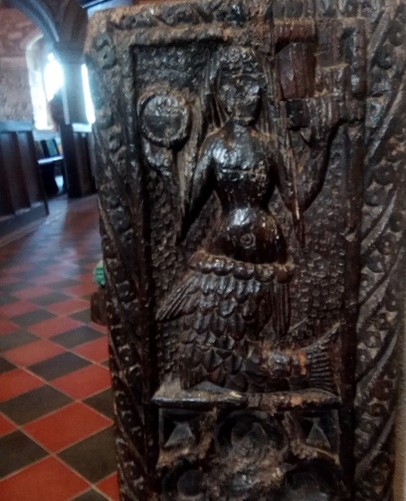
I have to say, I love all the legends of this ancient land: Jack the giant slayer, the mermaid of Zennor, giant Comoran throwing rocks around, Tintagel and King Arthur, Tristam and Iseult, Dozmary Pool and the Lady of the Lake, the haunted Jamaca Inn and Bodmin Moor with its ghosts, smugglers and big cats! It feels like there’s a definite pagan flavour here.
Cornwall is also beautiful in wildlife. You take an evening stroll and bump into a badger, and then the bats come out of the mineshafts. It’s at it’s most abundant in Spring; in April and May everything is out all at once – the violets and primroses are still flowering, the hawthorn is in bloom and the first foxgloves spring up before the bluebell season has ended – floral overload!
But there’s another face, a grittiness to Cornwall and the Cornish. Having lived both in Wales and Durham, I associate this with mining districts where survival has been harsh. This is still a poor county, most of us live in damp terraced small mining cottages. My first house was originally a one up one down with outside lav (still there) in Redruth, with cob walls and dating from the 1700s, and would have housed a whole family. My elderly neighbours told me that, when they were young, it was common to see children barefoot in the streets of Redruth and Camborne as people couldn’t afford shoes.
I live in a modern terraced box now but the radon gas levels are still through the roof due to the granite bedrock it’s built upon. The ground’s riddled with old mining tunnels and every so often a road will be closed due to it falling down an undisclosed mineshaft. We just cross our fingers when we go to bed at night!
You mention a number of particular places in Cornwall, do you have a favourite spot?
I often walk over the moors to Tregeseal stone circle, passing a lily pond, beneath skylarks singing overhead and ablaze with purple heather in the summer. A bit squelchy underfoot in the winter, best not to forget your wellies especially as the light’s fading…
Nearby is Madron Holy Well, a very ancient magical place, once boasting more pilgrims than Lourdes. I also find it an extremely uncanny place, particularly at night, you don’t want to turn your back there – you can just feel something behind you! Plenty of scope for the imagination here abouts…
The advantage of living in a place for a long time is that you get to know all the hidden nooks. There’s a secret creek where I swim, hardly anyone ever goes there and the only other swimmer is an old grey seal who I’ve seen on and off for years. He normally darts underwater and fins it in outrage when he sees me, but a couple of weeks ago he swam right up to me and floated on the surface within an arm’s reach. It was a little scary (he’s a big boy, with enormous head and magnificent whiskers), but also so rare and amazing to have that prolonged eye contact with such a wild creature. Unfortunately, I don’t speak selkie so I sung some sea songs to him instead. We hung out together for an hour or so until my chattering teeth forced me ashore. Definitely my new favourite place!

You reference a lot of different and some more unusual goddesses in the book, do you work with the goddess yourself? And any in particular?
Gaia, the Earth Goddess. I run with animism in that I believe that a spiritual essence permeates all of nature, including the planet as a whole. When we work ritually on the land Her presence is almost tangible.
Like most Pagans I’ll honour different goddesses for different purposes at particular times of the year, such as Brigit at Imbolc for inspiration, dear old Hecate at Samhain when I wish to speak to my ancestors, Inanna maybe for shadow work at the winter solstice, Ceres for gratitude and blessings at Lammas, and so forth.
Recently, I’ve been very drawn to the goddesses after whom the newly discovered Kuiper belt dwarf planets have been named. I believe these have specific significance for our times, e.g. Eris the goddess of discord, Haumea the Hawaiian goddess of nature and fertility, and Sedna the Inuit goddess with her tragic myth of betrayal (cast overboard by her father, who then chopped her fingers off when she tried to cling onto the boat, hence having to surrender to the sea but from her severed fingers new marine life grew).
There’s also something about the very long orbits of these far-out dwarf planets which links us in some unfathomable way to the far distant past. Sedna, for instance, takes over eleven thousand years to complete one circuit of the sun, opposed to our single year, recalling the long gone back to us. The Goddess is far older than the gods after all.
It seems that alongside the Pagan faith, the goddesses are slipping back into our culture through backdoors such as astronomy and astrology. A welcome return. And you can’t banish Lilith forever!
There is a real feel for the elements and the seasons in the book, do you work closely with the turning of the wheel?
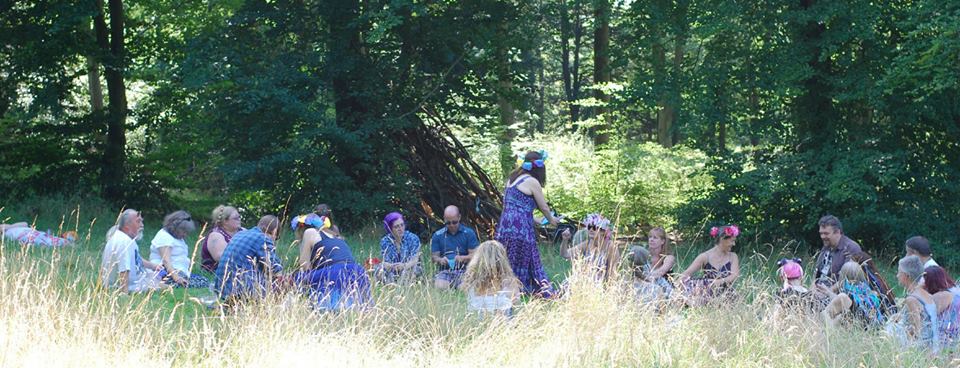
Very much. A dear friend Geraldine, and her colleague Marg, held celebrations on her land for each of the eight sabbats over the course of many years. These were open to the public so they were large gatherings. (My little contribution was behind the scenes, where I’m happiest, decorating the barns or helping them build the labyrinth or set up the maypole.) After the ritual, a massive bonfire, sparklers and fireworks were lit, a mega feast eaten and much revelling abounded!
Even outside the active Pagan community, Cornwall has resurrected many of the traditional festivals, such as the fertility rituals of Obby Oss Day in Padstow at Beltane, and bonfires are set alight on certain hilltops on Midsummer’s Eve. Here in Penzance, my nearest market town, we have Golowan and Maisy Day at the summer solstice, with processions and the serpent dance. Also the Montol festival, marking the winter solstice, when we dress in ‘rags and ribbons’, wear masks or cross-dress, before burning the Yule log. These are some of the same old customs which would have celebrated in the town before the authorities clamped down on the festivities for ‘unruly behaviour’.
Are you working on any new projects?
Currently on a collaborative project with an artist/photographer friend. We’re hoping to get it out there next year, but will post the date on my website nearer the time.

Sally Walker lives on the most westerly windswept tip of England – a wild ancient land of moor and shore, where magic still lingers.
A Westerly Wind brings Witches is her debut novel, having been tied down with all the muggle business of life – working over the long years as a schoolteacher, nurse, family support at a Women’s Refuge, playbus worker with traveller and gypsy children (that one was fun!) amongst such other jobs which keep us sensibly on the ground.
But she writes from a secret life of her own experiences as a Cornish witch – in one of the many covens of a thriving local pagan community, unseen by the summer holiday makers, lurking in shadows cast by a full moon!
Writing about the cycles of history, telling and retelling our stories over and over, delving into a time when women lost their role in folk religion, hung or burnt all across Europe and America in their thousands, this novel honours The Burning Times lest we ever forget. Digging up old roots, the author is passionate to unearth the lost voices of those who have been silenced and have almost disappeared into a smothered herstory. Peering past the acceptable tales of our time, pulling the threads together to weave our way into another story altogether.
For more information: https://www.collectiveinkbooks.com/moon-books/authors/sally-walker

 The Pagan Collective
Leave a comment