
by Morgan Daimler
These Pagan Portals are all current works in progress, serialised here on the Pagan Collective blog with each chapter being open for comment. In due course the entire script will be published as a Pagan Portal book.
Introduction
This work is personal for me, an exploration of a deity that I have honoured for decades and who inspired me to begin writing nonfiction and to take risks on my own spiritual path. I have written about Macha before, but only in bits and pieces, each focused on one particular thing or one story. Here for the first time all of my research and all of my love for Macha will be pulled together and expanded to offer others both a historic and personal look at her, from our oldest sources to today. I hope that readers will appreciate the blend of both fact and personal thoughts, and will find this work useful in their own explorations of Macha, as we dive past the surface material into the layers of her stories, archaeology of her sacred site at Emhain Macha, pre-Christian Irish culture, and the wider views of her found now.
Many people think of the Morrigan when they hear Macha’s name, as she is widely understood to be one of the three Morrigans, but not as many may understand that Macha was a powerful being in her own right. RAS MacAlister, a 20th century Irish archaeologist, suggested in his notes on volume 4 of the Lebor Gabala Erenn that originally the Morrigan and Badb formed a divine duo and it was only later that Macha, the main goddess of Ulster, was added in and the duo became a trio. This idea is supported by looking at both place names and stories which suggest that Macha was a dominant figure in Ulster, particularly around Armagh – Ard Macha, literally Macha’s Height – while Badb was well known in the northwest and the Morrigan in central Ireland. Over time the three war goddesses came to be connected and eventually understood as three sisters who often acted together. However even then Macha remained somewhat autonomous, not appearing with the other two as often as they appeared together and having a place within stories without them.
I have always been a believer in the importance of looking at the etymology and meaning of names to gain a better understanding of the being. This is true of Macha as well, because her name can show us a layer to her that is often ignored or overlooked. The word macha in older Irish means a milking field or yard, a place where cows are milked; in modern Irish it has lost the milking connation but is still used for a cattle field generally and also for a herd of cows. It is important to understand in context that cows have historically played a huge role in Irish culture, representing both sustenance as well as wealth. For an example of this, a cumal was a term for an amount of value, generally understood as three milk cows or 35 acres of land, while another term of value, sét, represented ½ a milk cow (eDIL, 2024). Cows were units of currency, the value further set by the type and age of the cow, and so wealth and social status hinged on cows as well (Sherwood, 2009). The meaning of Macha and the word’s connection to milk cows would have indicated that the goddess’s name was intrinsically connected to those same concepts.
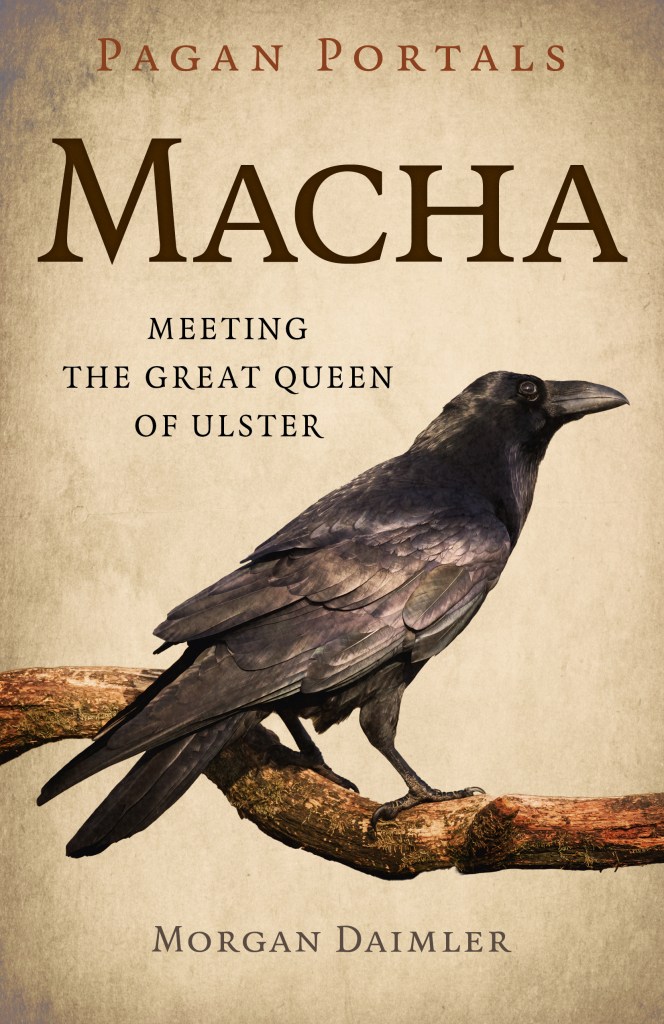
Macha is an intriguing but also complex figure and one who is often misunderstood today. To begin, even deciding which stories Macha is in is more difficult than one might expect. There are 5 different appearances of figures named Macha across Irish myth and it is unclear whether these 5 are identical or merely share a name. This is further complicated by the already convoluted and often contradictory genealogies we have for the Irish Gods and the fluid nature of both myth and belief. Each iteration of Macha is said to die within their stories, and yet death never stops an Irish deity from reappearing later, sometimes again within the same story, so even this doesn’t necessarily preclude one Macha who reappears in different contexts. On the other hand, it isn’t uncommon for beings with the same name to be clearly different individuals who simply share a common name. MacCana describes Macha explicitly as an Irish war goddess, but avoids discussing Macha of the Tuatha De Danann/the Morrigan, instead focusing on Macha the wife of Nemed, Macha Mong Ruadh, and Macha the Fairy Woman, suggesting that each of those represent versions of a single sovereignty goddess. Toner adds Macha of the Tuatha De Danann as a fourth option but argues that Macha the Fairy Woman and Macha wife of Nemed are later literary inventions, in contrast to the more genuine Macha Mong Ruadh and Macha of the Tuatha De who are associated with war. ÓhÓgáin chooses to focus primarily on only two Machas, Mong Ruadh and the Fairy Woman, while simultaneously declaring Macha another name for the Morrigan, rather than one of the three. There is no wide consensus about Macha in academia, only a range of theories and opinions. Whatever view someone may have about these 5 Machas and their connections – or lack thereof – can be as easily supported as contradicted leaving it open to each individual to decide how they feel about the topic.
For myself, I tend to treat all five as versions or iterations of the same being. I think that to understand any particular Macha one needs to look at all of them, to see the patterns between the stories and study the differences. I am acknowledging that bias upfront, but will strive to present the information as neutrally as possible so that everyone can draw their own conclusions. One of the most beautiful things about this goddess, in my opinion, is her complexity and the way that everyone understands her slightly differently; there is no single ‘correct’ way to understand her but rather a multitude of possibilities.
This book will look at each appearance of Macha across mythology, with the first five chapters looking at one particular Macha, the sources we have for her, her story, and what we might learn from this. It will be for the reader to decide if these 5 are all the same being or not, as that is something even academics disagree on. Each chapter will also include a discussion of a related subject that adds context to understanding Macha in that story, so that for example chapter 4, Macha of the Sidhe, will also look at beliefs around the Tuatha De Danann and Aos Sidhe and the connection to fairy beliefs. By understanding the cultural context and some of the deeper symbolism of the stories we can come to a deeper understanding of Macha herself. Further chapters will dig into Macha’s symbols and associations, how to connect to her, common misunderstandings around her, and ways that she has and does appear in the modern world. Each chapter will also include a short section at the end called ‘Macha in my life’ where I will relate a personal story of my own experience with the goddess. Ideally a reader will see the complexity around Macha and the ways that her themes and purviews weave across the various stories into a cohesive whole, so that the confusion can be removed.
Macha was, and still is, the pre-eminent goddess of Ulster, a figure who represents the sovereignty of the land as well as the power of battle, justice, magic, and prophecy. Each face of Macha, each appearance within a tale, reveals another piece of who she is and what she can do, and within Pagan Portals Macha we will explore as much of this material as possible, introducing readers to this goddess or perhaps offering a deeper understanding for those already familiar with her.
For more information: https://www.collectiveinkbooks.com/moon-books/authors/morgan-daimler
References:
- eDIL (2024) Electronic Dictionary of the Irish Language
- Macalister, R., (1944) Lebor Gabala Erenn volume 4
- MacCana, P., (1970) Celtic Mythology
- ÓhÓgáin, D., (2006) The Lore of Ireland
- Sherwood, A., (2009) An Bó Bheannaithe: Cattle Symbolism in Traditional
- Irish Folklore, Myth, and Archaeology
- Toner, G., (2010). “Macha and the Invention of Myth“. Ériu. 60
Image by NakNakNak from Pixabay
 The Pagan Collective
Leave a comment