
Papa Westray or Papay as its known to residents, is a tiny island, four miles long and one mile wide – (quite similar in size to Iona. Which is featured in my book, A guide to Pilgrimage.) The island is adjacent to its larger sibling, Westray in the Orkney archipelago of roughly seventy islands. Visitors can access Papay by ferry from Kirkwall, as a foot passenger from Westray, or you can take the short flight from Kirkwall airport.

The population of Papay is ninety, many of whom either work or are connected to agriculture. There is a strong sense of community, the community hall is the social hub and the centre of island life . Events are regular, including weekly coffee mornings, and get-togethers, which ensures that no-one is alone, if they don’t want to be. The recently released highly regarded film, ‘Outrun’ is predominantly set on Papay, and based on the best -selling memoir by Amy Liptrot, of her recovery from alcoholism. Community is what ultimately saves “Rona,” and her gradual recovery is shown with remarkable candour and poignance. The film was largely shot in situ and has brought the island to the public attention. When we visited on a perfect summer’s day earlier this year, (In stark contrast, I should add, to the film which was shot in several mighty storms during the last winter,) we were told endless stories and anecdotes of what the film crew got up to and how they were treated as part of the family when staying on the island. Seeing how friendly and helpful everyone we met was, we could understand this. The film’s production company even held a special preview screening in the local hall. Incidentally, this is the very same hall featured in the film as the setting for the cèilidh. Indeed when we visited, a production crew were filming preparations for a wedding for a local TV show.

Papay, although only a small island has many intriguing sites and in this post, I am going to concentrate on the fascinating story of St. Treadwell and the pilgrimage site of her chapel. Its hard to believe today, that this rather remote little windswept island was once a significant centre of pilgrimage. During medieval times, thousands of visitors would flock to the chapel, which is situated next to St. Treadwell’s loch, itself significant in the story.
Treadwell, Triduana or Trøllhaena in Old Norse was an early Christian who lived somewhere between the 4th and 8th centuries CE. One account states that she was born in Greece and with another saintly woman, brought the bones of St. Andrew, (the patron saint of Scotland,) to Scotland. Another tale is associated with St Boneface, (who also has a chapel on Papay.) In around 710CE a mission set out to Pictland (part of Scotland,) to bring Christianity to the Picts. Legends says that Nechtan, king of the Picts, fell in love with Triduana, praising her beautiful eyes. Triduana, was not interested in marriage, and to stem his courtly behaviour, she plucked out her eyes and sent them to Nechtlan in response to one of his many advances. St Treadwell is, therefore, associated with the healing of eye conditions. In the Orkneyinga Saga, Earl Of Orkeny, Harald Maddadsson blinded the prophet, known as Jon of Caithness for refusing to collect taxes on his behalf. Jon prayed to Trøllhaena and his sight was miraculously restored.
Today the chapel is little more than a ruin in an overgrown field surrounded by sheep. The remains stand on a small mound close to St Treadwell’s loch along with the remains of an Iron Age broch. When standing there on a peaceful summer’s day enjoying the cool breeze from the nearby sea, the sun was dancing on the loch waters, and it was impossible to imagine that In 1700, minister John Brand described the scene before him:
“People used to come to it from other isles; before the chapel door was a heap of small stones, into which the Superstitious People when they come, do cast a small stone or two for their offering, and some will cast in Money. The loch is held by the People as Medicinal. such as are able to walk use to go so many times about the Loch, as they think will perfect the cure before they make any use of the water, and that without speaking to any.(other person.)
People walked around the loch up to six times in silent contemplation after leaving a donation at the chapel.

We decided to follow their example and walk in silence as far around the loch as we could. The stillness had a sense of agelessness to it – a feeling of being part of something greater than us. We were becoming part of the history of this pilgrimage centre. The footsteps we walked in, had been taken thousands of times before, and hopefully a thousand more pilgrims would follow.
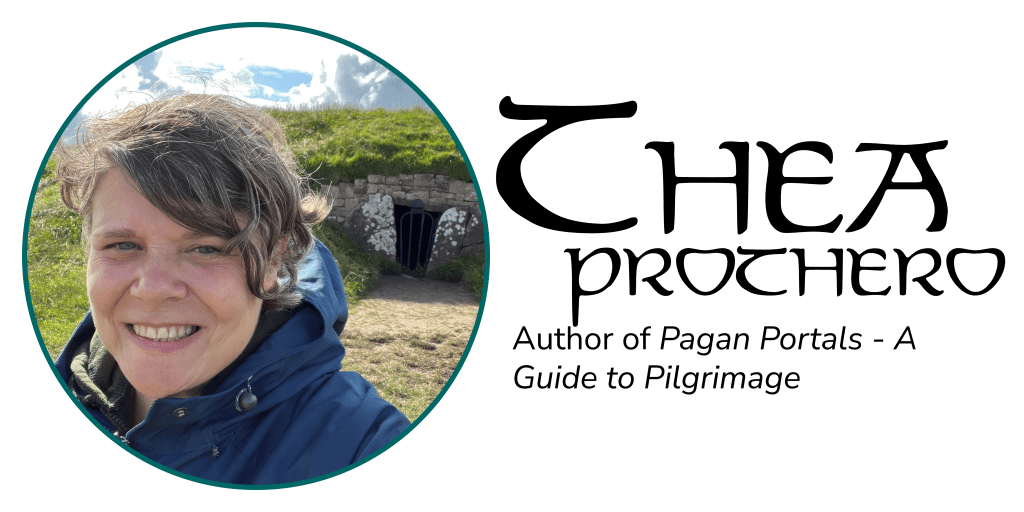
Thea is a Heathen and a pilgrim. She likes to think of herself as a Nemophilist, which means a ‘haunter of woods’. She spends most of her free time walking in the wildest remotest lands, places that still make the gods tremble, and she loves the challenge of finding connection through nature to the divine. She writes prolifically, read equally, has a passion for learning, taking photos, grow things, and spend time with her family. she works in education and lives in the south of the UK.
For more details, see: https://www.collectiveinkbooks.com/moon-books/authors/thea-prothero
 The Pagan Collective
Leave a comment