

Part 2 of a serialisation by Ness Bosch
These Pagan Portals are all current works in progress, serialised here on the Pagan Collective blog with each chapter being open for comment. In due course the entire script will be published as a Pagan Portal book.
Who is Ataegina? Iconography
To answer the question, Who is Ataegina? we are going to explore different aspects of the Goddess starting with her iconography. In a way I propose to the seeker a line of exploration about Ataegina, but that they can also use to explore other deities. When we study ancient deities, one of the most important parts to investigate is the iconography. To begin this exploration, it is important to emphasize that Ataegina is a very ancient indigenous Iberian deity and that no anthropomorphic figure has been found that clearly represents the goddess. Different scholars come to the same conclusion that the various goat-shaped votive offerings found could be a representation of the goddess, in her character as a cathonic and agricultural goddess, therefore ruler over beasts, or she herself an animal, in this case, a goat, in its most archaic form.
If we think about it, making a comparison of other cults to zoomorphic deities in antiquity, we have in Egypt, a clear example of how deities that are initially totally zoomorphic, naming Het Her (Hathor), in her form of sacred cow, her oldest form, is humanized through the dynasties until becoming a woman with slight zoomorphic features, such as her ears or cow horns. And like Het Her, there are many others of the Egyptian pantheon. If we accept that Het Her is a cow, proven by her abundant representations, we should not be surprised that Ataegina was a goat as a first manifestation.
The goat, along with the horse or rabbit, is a representative animal in Iberia. I am not referring to the majestic mountain goat (Iberian Ibex), I am talking about the domestic goat. The tradition of goat herding is deeply rooted in Iberia and the cult of Ataegina could well have arisen as a cult to the goat, as an animal of utmost importance to the inhabitants of the Turobriga area before the arrival of the Romans. The goat is a tough animal, with incredible resistance, it feeds on almost everything in the countryside and mountains. The goat grazes and gives you its sweet and abundant milk, that milk is life for the one who drinks it (In fact, goat milk is much easier to assimilate due to the smaller size of its protein and is easier for humans to digest than cow milk. I myself have fed my children with goat milk, to supplement the milk I gave them as babies and toddlers). The goat feeds its young, it is a rich and abundant mother in that sense, and here I emphasize its aspect as Mother Goddess. The goat is one of the first animals that were domesticated and the expansion of its livestock, along with the ram, was very important for our ancestors. Could the votive offerings of goats found in Iberia be representations of Ataegina? Very possibly.
As I said, although there is no official anthropomorphic figure of the goddess Ataecina with any epigraph that designates her as such, there is a statue of a goddess holding what they call rams, which to me seem to be goats, was found in the Cerrillo Blanco site in Porcuna, Jaen, dating from the 5th century BC and which has been related to the Goddess Ataecina. In my introduction, I already mentioned that I think that the Ataegina cult travelled beyond Extremadura’s steppes and ravines to reach Andalusia and beyond to the east. For me, the figure of this Goddess (which is exhibited at the Iberian Museum in Jaen and by the way, has no head), reinforces that personal feeling. Although this would be semi-officially her only anthropomorphic representation to date (we never know what lies underground), I would like to talk about a curious finding that could also be related in some way to Ataegina and another goddess, Astarte.
Although I will talk about the relationship between Astarte and Ataegina later, speaking about her morphology, I would like to mention a figure they have named the “Lady of Almeirim” (relating her to the Iberian ladies found in Spain). Although I am not sure that this news is not an invention or a hoax, it is at least curious for several reasons. In the online blog, O Noticias de Almeirim shared about the appearance in the hands of a collector of a very old female figure, made of ivory with goat horns. The figure, which still retains part of its polychromy, represents a clearly orientalized woman, with classic sandals, a dress that on the belly has what seems to be the head of a gorgon as decoration, a kind of triskele on the chest and she wears various ornaments on her head and some large goat horns, as well as some bull or cow heads on a chronon, on her forehead and also one on her arm. And if I’m not sure if it’s fake or not, why do I mention it? Because it’s curious, very much so. Not only because of the orientalized features of her face and her dress with floral motifs and suns? Even what seems to be a lion or bear head in the centre of her neck, the bulls, the gorgon, somehow speak to me of syncretism and speak to me of Astarte as mistress of the beasts. In fact, there are already scholars who think that Ataegina, as a goat, could be a composite deity and that Astarte, Goddess of animals, and also related to goats, could be one of the components of Ataegina, something that I will be exploring later on this Pagan Portal. Be that as it may, there she is, that strange lady with goat horns that we still don’t know if she is real or not or a hoax from someone who was bored during the COVID-19 pandemic.
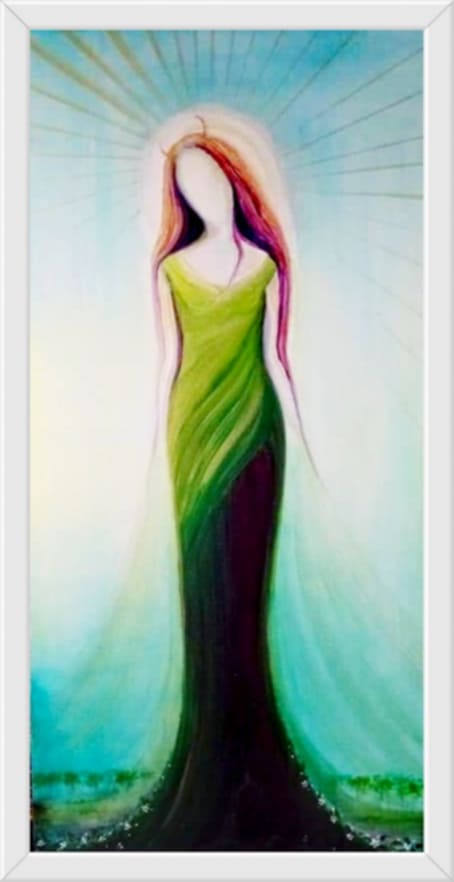
I found a statue of the Goddess Tanit found in Ibiza, (the Punic Astarte) with traits somewhat similar to the Lady of Almeirim. The reader may want to check it out by doing a little Google search. It is interesting, to say the least. When a few years ago I contacted an artist to commission a painting to represent the Goddess for my Temple, I specifically asked her to give her goat horns on her head because I do not conceive of Ataegina if she is not linked to the figure of the goat. Perhaps that is the biggest clue for those who wish to connect with her. Find elements that have to do with goats. Whether decorative, goat horns (I have some), or even goat bones for your altar. Also, my grandfather made goat bells for his animals, and I also have a shepherd’s staff that belonged to my grandfather. I would also use goat milk. I have to confess that although kid meat was often consumed at the farm, I never wanted to eat it. Although thinking about it, it would be a way of making an embodiment of the Goddess, I think I would lean towards goat cheese, which I do eat, to commune with her energy at a more energetic level.
For more details: https://www.collectiveinkbooks.com/moon-books/authors/ness-bosch
 The Pagan Collective
Leave a comment