

by Kelle Bandea
These Pagan Portals are all current works in progress, serialised here on the Pagan Collective blog with each chapter being open for comment. In due course the entire script will be published as a Pagan Portal book.
Chapter One – The Story of Airmid
Airmid is less popular as an Irish deity among modern neopagans and spiritual practitioners, but she does have a presence. She is often listed in modern neopagan glossaries as a pre-Christian Irish goddess, or as a fairy woman, and as a goddess of healing, particularly herbal healing, and is generally described as a benevolent and kind figure. As a result, she is often invoked and honoured by Irish/Celtic practitioners, green witches and those who work in alternative forms of healthcare.
To me, via my own personal gnosis, Airmid is the ‘Green Woman;’ a figure who represents the life-giving aspects of nature and the connection between humans and the plants with whom we share an ecosystem. A keeper of indigenous knowledge and an ally to all those who heal and need healing. Before we look at how to forge a personal connection to Airmid in later chapters, let’s dive into her presence in Irish myth and folklore.
We first meet Airmid, daughter of the healer god Dian Cecht, in the Cath MaigeTuired, or Battle of Moytura, a medieval Irish text featuring the Tuatha de Danann.
The Tuatha de Danann are a tribe of Otherworldly, magical beings who come to Ireland and defeat the Fomorians and Fir Bolgs, people who settled the land before them according to Irish myth and legend. The Tuatha are later defeated by the Milesians, the mythical version of the Irish Celts. The Tuatha do not really die but instead retreat to the si – magical hollow hills – and become, in folklore and the medieval texts, the fairy nobility known today as the Sidhe. Some later scholars believed the stories of the Tuatha were drawn from native Irish oral traditions about the pre-Christian deities of Ireland. Because the stories were written down in medieval times, largely by Christian clergy, we can’t be certain how much is authentic pre-Christian myth, how much is Christian allegory, and how much was simply invented by the authors. Academic opinion varies between the nativists – those who see the stories as containing a lot of echoes of pre-Christian myth about the old gods – and anti-nativists – who believe the medieval texts can tell us very little, if anything, about pre-Christian belief. Some figures such as Mananaan mac Lir are more likely to be accepted as being pre-Christian deities due to an abundance of evidence whereas others, such as Airmid herself, don’t have much evidence for their existence outside of one or two texts and so may well be medieval inventions. It’s hard to be sure today on the evidence that we have, but generally neopagans accept the figures in the Irish myths as either deities or fairy beings who are very much relevant today, and many, such as the Morrigan, have hugely popular followings and committed devotees. Airmid is less well-known, at least in mainstream Irish paganism.
The Cath Maige Tuired tells the story of how the Tuatha de came to be ruled by the wicked Bres, whose mother is of the Tuatha but whose father is from the Fomorians. It is considered a central text in the ‘Mythological Cycle’ of Irish legends, and has been interpreted in various ways by scholars, clergy and neopagans alike. An enduring theme across interpretations is that the Fomorians represent all that is wicked, tyrannical and/or out of balance, while the Tuatha are noble and live in a more harmonious way. The battle between the Fomorians and the Tuatha de Danann is thus often compared to the battle between the Greek gods of Olympus and the chthonic, almost monstrous Titans; indeed, it’s a possibility that the medieval Irish scribes were inspired by the Classical texts, just as another Irish medieval text, the Lebor Gabala Erenn, or Book of Invasions, is clearly inspired by Biblical myths.
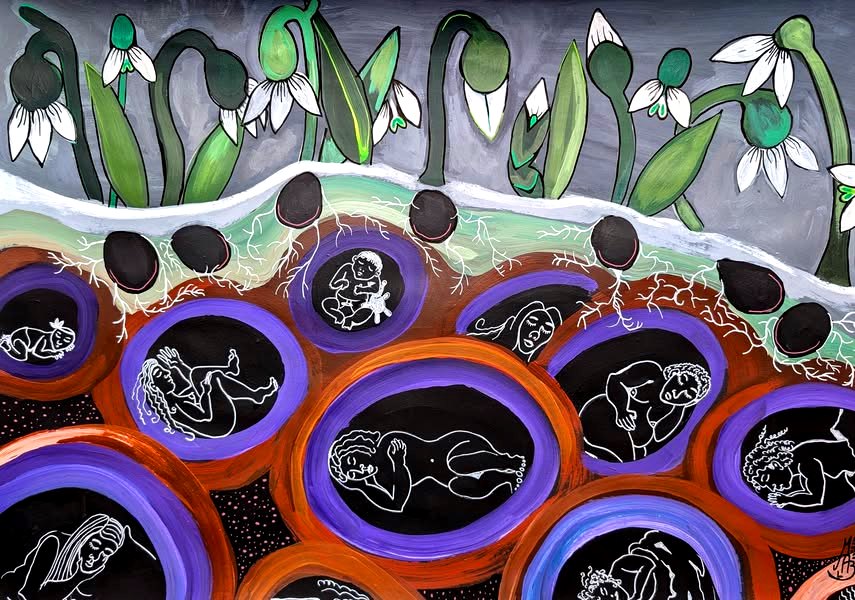
Nuada (also spelled Nuadu) the current king of the Tuatha, loses an arm in the battle, and has it repaired by Dian Cecht, the healer deity/figure of the Tuatha, and his children Miach and Airmid. Dian Cecht gives Nuada a prosthetic hand made of silver, but Miach goes one better and magically reattaches and regrows the original hand. Seeing this, Dian Cecht flies into a fit of rage and murders his son. Where he is buried, herbs spring up and his sister Airmid sorts them according to their healing properties. Dian Cecht doesn’t like this either, presumably because herbal knowledge will make Airmid a better healer than he is, and scatters the herbs so that some are lost.The tale is often told in modern times as a sort of ‘Just So’ story to explain why our herbal healing knowledge is still incomplete. It is also often interpreted as a feminist allegory of the way in which rural healers, often women, are believed to have had their knowledge repressed by the (then entirely male) medical establishment, particularly after the Enlightenment.
The original story in the text reads;[1]
Now Nuada was in his sickness, and Dian-cecht put on him a hand of silver with the motion of every hand therein. That seemed evil to his son Miach. He went to the hand which had been struck off Dian-cecht, and he said ‘joint to joint of it and sinew to sinew,’ and be healed Nuada in thrice three days and nights. The first seventy-two hours he put it over against his side, and it became covered with skin. The second seventy-two hours he put it on his breasts. The third seventy-two hours he would cast white of black bulrushes when they were blackened in fire.
That cure seemed evil to Dian-cecht. He flung a sword on the crown of his son’s head and cut the skin down to the flesh. The lad healed the wound by means of his skill. Dian-cecht smote him again and cut the flesh till he reached the bone. The lad healed this by the same means. He struck him the third blow and came to the membrane of his brain. The lad healed this also by the same means. Then he struck the fourth blow and cut out the brain, so that Miach died, and Dian-cecht said that the leech himself could not heal him of that blow.
Thereafter Miach was buried by Dian-cecht, and herbs three hundred and sixty five, according to the number of his joints and sinews, grew through the grave. Then Airmed opened her mantle and separated those herbs according to their properties. But Dian-cecht came to her, and he confused the herbs, so that no one knows their proper cures unless the Holy Spirit should teach them afterwards. And Dian-cecht said ‘If Miach be not, Airmed shall remain’.
A little later Airmed again crucially helps out at a healing well. I will discuss that part of her story in Chapter Two.
This first part of the tale is also briefly mentioned in the Book of Invasions, an 11th century text which details the waves of migrations to Ireland of the various peoples mentioned above. The story here reads:
Nuada’s arm was healed at the end of seven years…Dian Cecht the physician, helped by Creidne the artisan, put a silver arm on him, with the full vigour of an arm in every finger and in every joint.
Here, Airmed is not mentioned in connection with Nuada’s arm, but she is mentioned a little later in the text:
Dian Cecht had three sons, Cu and Cethen and Cian – and Miach was the fourth son, although many do not include him – and his daughter Etan the woman poet, and Airmed the woman physician.[2]
This mention of the fourth son Miach not being everywhere included is a hint that his story was in some doubt or was not known everywhere, perhaps being a regional version of a more general myth. Some scholars question the authenticity of the story involving Miach and Airmid. Sanas Cormaic or Cormac’s Glossary, is a tenth century glossary which lists the pre-Christian gods of Ireland, some of which are mentioned in the mythological texts, some not. Dian Cecht is there, listed as ‘the god of health’ although his children are not.
Scholar Edward Pettit[3] provides evidence that the story of Miach and Airmed is a medieval creation, not one that originated in pre-Christian myth. Mark Williams, author of Ireland’s Immortals, suggests that the tale was intended to show the sins of pride and revenge via Dian Cecht’s actions. He further suggests that the figure of Miach is based on a separate (and potentially later) tale featuring the Morrigan’s son, Mieche, who is also described as being killed by Dian Cecht, although in a different form and for different reasons. Williams goes further still, speculating that Miach and Airmid are intentionally invented, symbolic figures, as their names mean ‘bushel of grain’ and ‘a dry measure’ respectively. This doesn’t take into account however, or at least it seems to me, the fact that Airmid and Miach are also mentioned later in connection with the healing well, or that the Book of Invasions doesn’t call Airmid’s relationship to Dian Cecht into question the way it does Miach’s.
Most publications I have seen that discuss the story of Airmid, whether academic or pagan, leave mentions of her, and details of her story, there. Airmid’s story doesn’t seem to be a popular or well-known one, although she is often cited as a goddess of healing, and/or seen as the archetype of the woman healer or herbalist, in neopagan and/or alternative healing resources. Other than these mentions in the medieval texts, she is assumed to drop from the historical and folkloric record.
This is an oversight, however. Native Irish Traveller voices and tales have long been missing from the folkloric record and this is only recently starting to be addressed. As someone of Traveller heritage, I knew the oral tradition of a fairy woman (or sometimes a whole group of fairies) teaching the Travellers their herbal knowledge, but didn’t have a name for her, and hadn’t made any connection with the story of Miach and Airmid. Then I came across the work of Oein de Bhairduin, and discovered that the original version of this story is in fact the story of Airmid. In his collection of Traveller folklore, Why the Moon Travels, de Bhairduin tells our indigenous version (or one of them, as oral tales often have regional and even familial versions) of Airmid’s tale. In this version, Airmid loses her voice with grief while searching for Miach’s body and the herbs. Seven herbs are mentioned and are corresponded with a specific body part; sage for the head to bring peaceful dreams, red clover for the chest, cowslip over the heart, purple burdock for the bowels, starwort for the reproductive organs, nettles for the legs at yarrow at the feet. When Dian Cecht scatters the herbs, Airmid manages to save four plants in her cloak; onion, garlic, horseradish and sugar beets, which when combined in a stew will ensure no-one else loses their voice. She then goes travelling to regather the herbs and comes across the ancestors of the Traveller people. She then teaches them her herbal knowledge and skills of healing.
This is potentially designed as an origin story, as Irish Travellers have long been known as herbalists and practitioners of both folk medicine and folk magic, and rural folk in particular would often seek ‘cures’ for various minor ailments from Traveller physicians. It may also have functioned as a teaching tale for transmitting basic herbal knowledge, particularly in a time and subculture when access to medical healthcare was scant. It even clearly contains a remedy for sore throats! In a later chapter we’ll look at the folklore of the specific herbs that are mentioned as corresponding to certain body parts.
Airmid wouldn’t have been viewed by the very Catholic rural Irish – Traveller or otherwise – as a deity or goddess but rather as a fairy woman. The fairies, even the Sidhe, were not popularly considered gods until the nineteenth century Celtic Revival, but rather a different species, sometimes akin to angels or demons or sometimes the souls of the dead, or ancestral spirits.
The Celtic Revival marked a renewed fascination with the history, mythology, and folklore of the Celtic regions, including Ireland, Scotland, Wales, Cornwall, Brittany, and the Isle of Man. In Ireland, this cultural resurgence was championed by writers like Augusta Gregory, George Russell, and W.B. Yeats and their works played a significant role in reviving the myths of the Tuatha Dé Danann and bringing them to a broader audience. This revival was, in part, a reaction to rapid industrialization and was fueled by a growing interest in national identity and independence movements. Unfortunately some of these authors, such as Yeats, were both from the Anglo-Irish elite and heavily influenced by Western esoteric traditions such as theosophy, and viewed Irish folklore through these lenses. Yeats’ versions of folklore and fairylore are often at odds with the actual traditions of the Irish people who practiced them. The Celtic Revivalists were highly influential on modern neopaganism, especially early Wicca and Druidry, and as a result much popular neopagan writings on the Tuatha and Celtic paganism unwittingly owes more to the Revivalists than to the actual folklore of the people. In recent years, interest in folk practices and folk magic has grown and we are now learning more about these traditions through the eyes of those who practiced them.
In the Traveller story Airmid is often very much seen as both an ancestral ally and a woman of Fairy. Just how old this version of her story is and whether it was influenced by the medieval texts and the Revival is open to debate. Irish Travellers, including my own grandparents, are a traditionally nomadic community indigenous to Ireland, recognized as a distinct ethnic group. Recent genetic studies confirm that Travellers diverged from the settled Irish population centuries ago, possibly as far back as the era of Cromwell. During this time, widespread land seizures and forced evictions drove many Irish families into a life on the road. However, historical records hint at the presence of itinerant communities in Ireland as early as the twelfth century. Though deeply rooted in Irish soil, Travellers have cultivated their own unique cultural identity, complete with distinct traditions, social customs, and languages. One such language, Shelta, bears a strong linguistic resemblance to Old Irish, reflecting the community’s deep historical ties. Despite their indigenous status, Travellers have often been marginalized, facing centuries of social exclusion and persecution from the broader Irish population. This legacy of prejudice continues today, with Travellers experiencing significant discrimination both within Ireland and in the diaspora, particularly in the UK, where anti-Traveller sentiments remain widespread even when they, like my family, abandon the nomadic lifestyle and ‘settle,’ often into poorly maintained housing.
Recently there has been a surge of interest by outsiders in the traditional craft and storytelling customs, and so traditional folklore which was previously unknown to the mainstream has come to light. How or when Airmid’s story became a part of Traveller lore seems to be currently unknown. It’s possible the medieval story of Airmid blended with a separate tale centred around herbal knowledge, or that a different, folkloric version of the tale was preserved for centuries by what was a predominantly oral culture. Either way, this version offers us an expanded story of Airmid and a greater understanding of her lore, as well as her specific connection to an indigenous people. Of course Airmid as a deity/herbal ally does not belong to Irish Travellers but please, if you retell this part of her story be sure to credit it as a Traveller tale and not simply as a universal part of Irish myth, as to do so would be to appropriate and erase indigenous knowledge once again.
I do believe it is important these stories are shared however, and not just to promote native Traveller storytellers such as de Bhairduin (though that too is crucial) but because indigenous stories often have important things to say about humanity’s relationship with the land and how to restore it. Scholars have often seen threads of this in ‘Celtic’ myth but it is often overshadowed by more heroic exploits, and so the oral traditions that have been preserved may offer us wisdom that we have forgotten. As Irish researchers Anne Marie Kavanagh and Catriona Ni Cassaithe[4].state:
historically, indigenous people “always knew to take only what they needed” and replace what they could. A similar profound respect for nature and close relationship to the land is found in Mincéir (Traveller) culture in Ireland, particularly in regard to the healing qualities of herbs and plants.
Before we dive deeper into the further implications of this story, herbal traditions and Airmid’s herbs in particular, I want to first turn to the rest of Airmid’s tale as told in the Cath Maige Tuired, which looks at healing beyond the herbal.
[1] Second Battle of Moytura (trans 1891) https://celt.ucc.ie/published/T300011.html
[2] Carey, John and Koch, John T. (trans) The Celtic Heroic Age (2003) CSP
[3] Pettit, Edward Miach’s Healing of Nuadu (2013) Celtica 27 pp167-171
[4] https://public-history-weekly.degruyter.com/10-2022-2/
For more information: https://www.collectiveinkbooks.com/moon-books/authors/kelle-ban-dea
 The Pagan Collective
Leave a comment