

by Irisanya Moon
These Pagan Portals are all current works in progress, serialised here on the Pagan Collective blog with each chapter being open for comment. In due course the entire script will be published as a Pagan Portal book.
Chapter 2 – Goddess of Wisdom & War
Practice: Journey to Athena
Whether you have been called by Athena or called out to her, getting to know a deity is not simple. Similar to how you might make friends with a human, it takes time, effort, and consistency. What I have found to be true is that building relationships with divine beings requires trust too. Not just trust in yourself or the deity, but also trust that you may learn things that don’t show up in books or museums.
Each deity relationship is unique, as what you bring to the relationship differs from another devotee. I recommend starting from a place of curiosity, always curiosity.
I encourage you to meet Athena in another realm before you turn the page. You can journey to this wise one with the following trance practice and see what she might share. All you need for this practice is a space where you will be undisturbed, an audio recording of the following trance (or someone willing to lead you by reading this section aloud)[1], and a journal and pen to write down your thoughts when complete.
I invite you to settle into the space, permitting yourself to be comfortable and safe. Depending on your body’s needs and preferences, this might mean you lay, sit, walk, or even stand. You can choose to close your eyes or keep them half-open. Begin to notice how you feel and what your breath is like. Do you notice yourself slowing down? Speeding up? Do you need anything to feel prepared to sink into another level of consciousness?
Allow your breath to be as it is, without feeling a need to change it or fix it. Perhaps begin to call back any threads of attention that might have wandered off before now. Collect them into an energy ball in front of your heart and let that ball sink into your body, as though melting into a liquid that can flow down your body.
Allow that energy to flow down the front of your body or within your body until it reaches the place where you make contact with the floor, perhaps with your feet or legs. From there, allow the energy to begin to swirl and surround your feet and ankles. Notice what lives in these places right now, without needing to change or fix. Just notice and if there is anything that doesn’t need to be here right now, allow it to drop, to sink, to fall away.
Next, allow the energy to travel up to your calves, knees, and thighs. Notice what lives in these places, without needing to change or fix. Just notice, and if there is anything that doesn’t need to be here right now, allow it to drop, to sink, to fall away.
Notice how easily the energy travels up to your hips and pelvic bowl, swirling around and around. Notice what lives here, no need to change or fix. If there is anything that doesn’t need to be here right now, allow it to drop, to sink, to fall away.
The energy can travel to the space of your will and digestion, surrounding your organs and following the stretch of your ribcage. Notice what lives in these places without needing to change or fix. Just notice, and if there is anything that doesn’t need to be here right now, allow it to drop, to sink, to fall away.
This energy ball can travel along your lungs and into your courageous, wise heart. Notice what lives in this place, without needing to change or fix. If there is anything that doesn’t need to be here right now, allow it to drop, to sink, to fall away.
Again, allow the energy to travel along the space of your collarbone, down your arms from shoulder to elbow to wrist, fingers, and thumbs. Notice what lives in these places without needing to change or fix. Just notice, and if there is anything that doesn’t need to be here right now, allow it to drop, to sink, to fall away.
The energy can easily travel to your head, along your jaw, around your eyes, and across your forehead. Notice what lives here too, without needing to change or fix. Just notice, and if there is anything that doesn’t need to be here right now, allow it to drop, to sink, to fall away.
Once you arrive at the top of your head, that space that was soft when you were born, allow your inner knowing, this energy ball, your wisdom to expand out to the furthest places. You can imagine this energy unfolding to the edges of the horizon, like a blanket unfolding. Or you might open your forehead wide to step out into a new place, a new world. Open and trust. Open and trust. Open and trust.
Trust that even if you don’t see things, you can sense them and know this place as different and safe. Even if you don’t have a clear image, you can travel along a path that leads you right to Athena, where she waits for you and wants you to visit her. How you travel to find her is up to you. You might talk, you might fly, you might swim, or something else entirely. Allow the way you travel to be the way of ease and safety. You are on your way to a goddess.
Take your time in the travel and stay alert to shifts in energy. You may begin to feel the call to stop at a temple or a field. You may begin to feel your breath change as you enter the space of the divine. You may begin to sense Athena or see her in the sparkle of light from her armor. Or you may begin to feel a warmth that often arrives when deities do.
Trust in the moment to reveal itself, for Athena to reveal herself. You might stand before her or sit or do something else that feels perfect for the moment. No matter what you decide or what chooses you, trust it is the right thing for this time. And take the time you need to be with Athena. You may have questions. She may have things to tell you. You may feel her presence fill you up. Take time here to be with Athena and for her to be with you.
(Pause here for at least five minutes or until it feels right to move on.)
As you feel your time is coming to a close, you can begin to thank Athena or ask any other questions of her. Know that while you can not stay in the trance space forever, you can always return.
(Pause for a minute or two.)
If there are more things to do with Athena, this is the time to do them. You might offer gratitude or a gift. You might receive a gift from her. Once this is complete, turn and return to the path or way you took to arrive here. You can trust in this path to allow you to move more easily and confidently. You can trust that all you need to remember will come back with you.
As you return to where this path opened up, where you expanded your reach or vision, come back to your head. Remember the flow that brought you here, the energy ball of your attention.
Allow this ball to melt and flow down your body, down your forehead, cheeks, and neck, back back. Allow the energy to travel down your arms and chest and heart, back back. Allow the energy to travel down your ribs, your organs, your belly button, and swirl around your pelvic bowl, back, back. Down the stretch of your legs and to your feet, back back.
Open your eyes. Become still. You might tap the edges of your body and look around the room. Drink a little water or have a snack. Take out your journal to collect any images or ideas from this journey. And even if you’re not sure what you experienced and what it meant, collect what you experienced and save it for another day.
For myself, sometimes the gifts of a trance will not arrive for days when I say something out loud and realize it’s about the trance journey. If you didn’t have the trance experience you wanted, then you can return to this practice again at another time. There is no rush to get to know Athena. Relationships take time. And this is a patient goddess.
Chapter 2: The Birth & Family of Athena
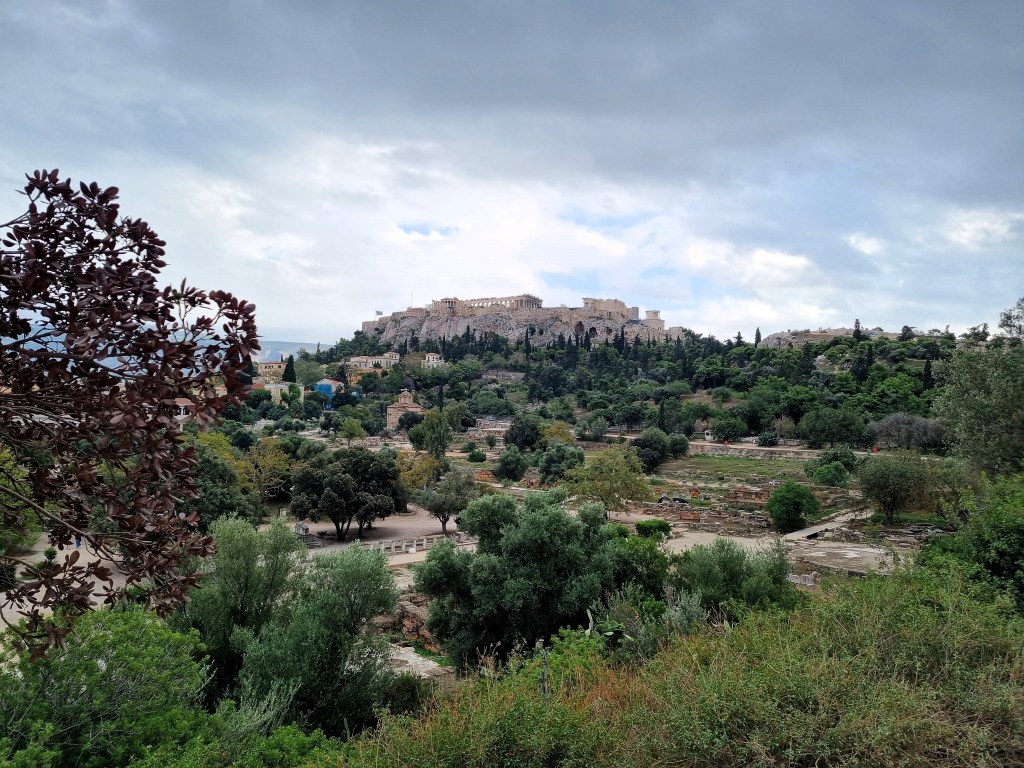
The temple [Parthenon] dominated the Acropolis and was the crowning glory of the city as a whole. It was elaborately designed, and no care or expense was spared in building and decoration to make it a worthy offering to Athena and a splendid symbol of the power and achievements of Athens.
R. E. Wycherly, The Stones of Athens. Princeton University Press. 1978. (105)
On the way up the Acropolis are spaces of honor for Greek godds, notably Dionysus and Asclepius. Across from a theatre for Dionysus is a wall with small holes, a place no longer accessible to visitors. Described as a sanctuary, this was a place where owls might live and be cared for as the special birds of Athena.
When you climb the steps up a side of the Acropolis, you will see to your right a smaller temple compared to other temples on the site. The tour guide pointed out this white marble structure, completed around 420 B.C.E., as a temple to Athena Nike, or Winged Victory. This Ionic temple was vulnerable to attack because of its location but was also well-situated to defend the rest of the site. Some researchers also believe the Myceneans used this temple for rituals.
Athena was honored here. She is still honored here, born into a world that needed her wisdom and her war in equal parts.
How Athena Was Born
Like other Greek deities, the birth of Athena is a complicated question. In some places, Athena is the daughter of Zeus, god of the sky and ruler of Olympus, and Metis, a Titan goddess of wisdom and skill, who was also the daughter of Oceanus and Thetis, Titan godds of freshwater. Other stories seem to show Athena as being born of Zeus alone.
Zeus, king of gods, took as his first wife Metis,
a mate wiser than all gods and mortal men.
But when she was about to bear gray-eyed Athena,
then through the schemes of Gaia and starry Ouranos,
he decided the mind of Metis with guile
and coaxing words, and lodged her in his belly.Such was their advice, so that of the immortals
none other than Zeus would hold kindly sway.
It was fated that Metis would bear keen-minded children,
first a gray-eyed daughter, Tritogeneia,
who in strength and wisdom would be her father’s match,
and then a male child, high-mettled
and destined to rule over gods and men.But Zeus lodged her in his belly before she did all this,
that she might advise him in matters good and bad.Hesiod. Theogony. Translated by Apostolos N. Athanassakis, Lines 888 – 900
Like other stories in Greek mythology, the godds in power want to remain in power, and Zeus is no exception. When he hears a prophecy that his children will overpower him, he swallows Metis so this will not happen. In some versions of the story, Zeus doesn’t realize Metis is pregnant with Athena.
Hesiod describes Zeus as having married others after swallowing Athena, and only when he marries Hera does Athena come into the world.
Last of all, Zeus made Hera his buxom bride,
and she lay in love with the king of gods and men
and bore Hebe and Ares and Eileithyia.Then from his head he himself bore gray-eyed Athena,
weariless leader of armies, dreaded and mighty goddess.Hesiod. Theogony. Translated by Apostolos N. Athanassakis, Lines 921-925
Apollodorus described the story in this way:
Zeus had intercourse with Metis, although she changed into many different forms in the hope of escaping it. While she was pregnant, Zeus forestalled further developments by swallowing her, for Ge [Gaia] declared that after having the girl who was due to be born to her, Metis would give birth to a son who would become the ruler of heaven. It was for fear of this that he swallowed her down. When the time arrived for the child to be born, Prometheus, or according to others, Hephaistos, struck the head of Zeus with an axe and from the top of his head, near the River Triton, leapt Athene, fully formed.
Apollodorus. The Library of Greek Mythology. Translated by Robin Hard. Page 31
The image of Athena being born fully formed and armed is one I found when preparing to invoke her in a magickal space for the first time. I see her arriving from parents who were at war with themselves and others.
But there was another story of Athena’s birth, which included a description of her being the daughter of Poseidon, as there were images of her with blue-green eyes, the color of the sea.
Above the Cerameicus and the portico called the King’s Portico is a temple of Hephaestus. I was not surprised that by it stands a statue of Athena, because I knew the story about Erichthonius. But when I saw that the statue of Athena had blue eyes I found out that the legend about them is Libyan. For the Libyans have a saying that the Goddess is the daughter of Poseidon and Lake Tritonis, and for this reason has blue eyes like Poseidon.
Pausanias, Description of Greece 1. 14. 6. Translated by W.H.S. Jones.
No matter what story of Athena’s birth is ‘right,’ a few things are consistent. That Athena is known for being of war and wisdom is predictable — and necessary for the times that followed.
Athena’s Siblings
Because Athena is described as the daughter of Zeus, she has many siblings and half-siblings, mortal and immortal, including:
- Aeacus
- Angelos
- Aphrodite
- Apollo
- Ares
- Artemis
- Dionysus
- Eileithyia
- Enyo
- Eris
- Ersa
- Hebe
- Helen of Troy
- Hephaestus
- Heracles
- Hermes
- The Litae
- Minos
- (The) Moirai
- (The) Muses
- Pandia
- Persephone
- Perseus
- Rhadamanthus
- (The) Graces
- (The) Horae
Some sources state that Zeus may have had up to or more than 92 children. Because of the many stories and writings about him, it’s hard to track.
Another Virgin Goddess
The work of richly crowned Cytheria affects everyone,
except the three goddesses she cannot persuade or fool.
The work of golden Aphrodite does not please Athena,
the owl-eyed daughter of Zeus who bears the aegis.
Athena rejoices in warfare and the work of Ares:
combat, struggles, and glorious deeds.
She first taught earthbound craftsmen
to make carriages and chariots inlaid with bronze.
She also taught glorious work in the house
to young women, instilling skill in each one.Homeric Hymn to Aphrodite V. Translated by Diane J. Rayor. Lines 6-15.
While some stories have linked children to Athena, the original stories of the Greek godds do not. As seen above, Athena is described as someone who disapproves of the ways of Aphrodite. Some of Athena’s epithets, or titles, reiterate this virginity, e.g., ‘Parthenos’ or Virgin.
However, another story connects Athena to motherhood without losing her virginity.
Some say that Erichthonios was a son of Hephaistos and Atthis, daughter of Cranaos, while according to others, he was born to Hephaistos and Athene in the following way. Athene visited Hephaistos, wanting to fashion some arms. But Hephaistos, who had been deserted by Aphrodite, yielded to his desire for Athene and began to chase after her, while the goddess for her part tried to escape. When he caught up with her at the expense of much effort (for he was lame), he tried to make love with her. But she, being chaste and a virgin, would not permit it, and he ejaculated over the goddess’s leg. In disgust, she wiped the semen away with a piece of wool and threw it to the ground. As she was fleeing, Erichthonios came to birth from the seed that had fallen to the earth. Athene reared the child in secret from the other gods, wishing to make him immortal.
Apollodogus. The Library of Greek Mythology. Translated by Robin Hard. Page 132.
Thus, Athena remained a virgin but may also have helped to conceive a child.
Practice: Crafting for Family
(stay tuned for this practice in next month’s installment!)
[1] Note: You can also lead yourself in this trance with your personal practices. Just read the trance a few times to get a sense of what is happening and how you will travel between worlds.
For more information: https://www.collectiveinkbooks.com/moon-books/authors/irisanya-moon

 The Pagan Collective
Leave a comment