
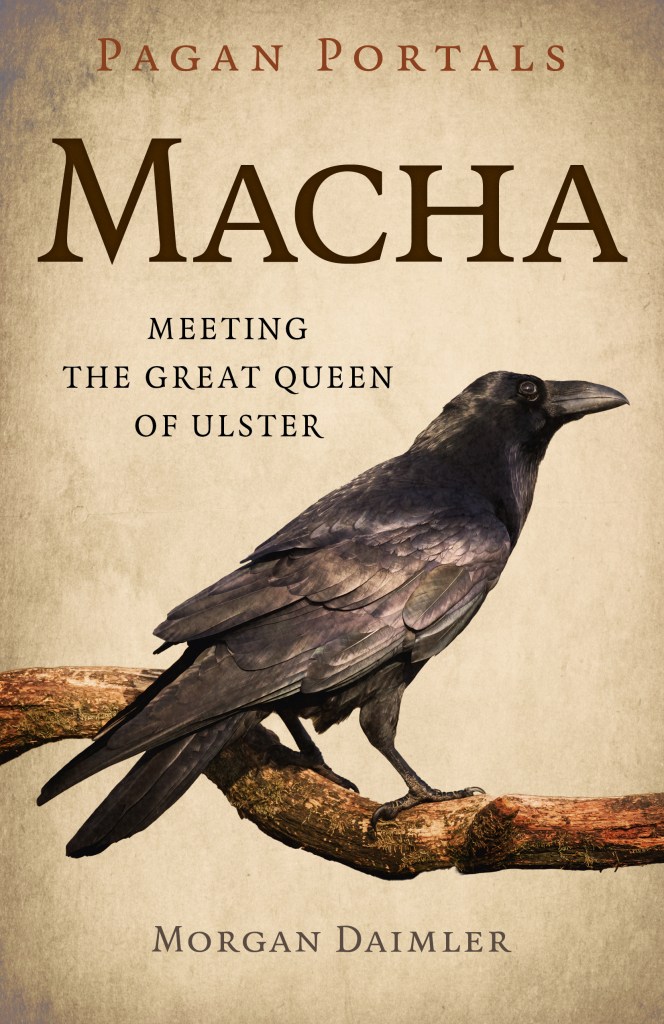
by Morgan Daimler
These Pagan Portals are all current works in progress, serialised here on the Pagan Collective blog with each chapter being open for comment. In due course the entire script will be published as a Pagan Portal book.
Chapter 2 – Macha of the Nemedians
“Eva, Cera, praiseworthy Medar, gentle Macha, a lovable company like to assured peaceful rest, were the women of Nemed the strong.” – Banshenchus
The Story
After the plague wiped out the Partholonians Ireland was empty for about 30 years until the Nemedians arrived. They were led by Nemed, whose name is a word in older Irish which means a sacred place, privilege, or sacred thing; it was also a term used for a high status person within society. Nemed’s four sons came with him as chieftains and they and all of his people settled the land, creating four lakes and 12[1] plains and building two forts (Macalister1941; Gwynn, 1924). Macha is named as the wife of Nemed, and it is said that she was the first to die of his people in Ireland, 12 years after they landed[2]. In the Lebor Gabala Erenn her husband cleared the land to create the plains but in an alternate version of the story she clears the land and then has a prophetic vision of the death and destruction of the future Táin Bó Cúailgne which causes her to die of a broken heart (Green, 1992). She was buried at Ard Macha [Macha’s height] which was named for her, and one of the plains that the Nemedians cleared was also named for her, Mag Macha. The Dindshenchas call her ‘lovely’ while the Banshenchus, quoted above, calls her gentle (Gwynn, 1924).
During his lifetime Nemed fought and won three battles against the Fomorians, who sought to oppress his people, but afterwards died of sickness, as the plague which had consumed the Partholonians seemed to have still haunted the new settlers of Ireland, although not quite as devastatingly. This unfortunately left his people open to Fomorian influence and they soon fell under heavy taxation by two Fomorian warriors, where they were required to give 2/3rds of their children, crops, and milk to the Fomorians every Samhain[3]. This tax weighed heavily on the Nemedians, or as the Lebor Gabale Erenn more poetically puts it: “Wrath and sadness seized on the men of Ireland for the burden of the tax” (Macalister, 1941).
In rebellion the Nemedians raised an army of 60,000, half fighting on land, the other half on the sea, to attack those who were oppressing them. They overthrew and killed one of the Fomorians but the other rallied his own forces and destroyed all but 30 of the Nemedians. One of Nemed’s sons, Ibath [Death] and his son went to the north (often a metaphor for the Otherworld) while another of Nemed’s son went to settle Britain and several grandsons to Scotland, and finally Nemed’s son Semeon went to Greece. In this way the few survivors dispersed and went on to establish their own nations, leaving Ireland uninhabited again.
Who were the Nemedians?
Of the various groups who settled Ireland the Nemedians are one of the most pivotal, if not the most pivotal. This may surprise some people who would immediately assume that the Tuatha De Danann would be more important but without the Nemedians the subsequent settlements wouldn’t have been possible, because they are the progenitors of both the next two groups who settled in Ireland. The Fir Bolg where the eventual descendants of Nemed’s son Semeon, while the Tuatha de Danann were the descendants of Nemed’s son Ibath. The Nemedians laid the groundwork for these later returns both literally by continuing the process of civilization of the land in Ireland and figuratively by establishing Ireland as a homeland for their descendants to return to.
It is important to understand these stories, but also to look at the metaphoric layers, to see Nemed as representing the sacred and sacred people who established a home – who made Ireland a sacred space – and were driven out by the Fomorians, representing chthonic and entropic forces, only to later reclaim Ireland with waves of returning descendants, one group of which are considered the Gods of Ireland. While Cessair and Partholon began the process of making Ireland habitable, or in some views creating it, Nemed blessed it, and was the hinge that turned the narratives from establishing to active tales.
Macha of the Nemedians
As with Macha of the Partholonians Macha of the Nemedians is a somewhat mysterious figure. She is barely referenced in the story, and then only as the wife of Nemed and the namesake of a height and plain. We may of course extrapolate that she was the mother of Nemed’s sons, which isn’t given explicitly but is a logical assumption, and therefore ultimately one of the ancestors of the people who would eventually be formed by those sons, including the inhabitants of England and Scotland, as well as the mythic groups of the Fir Bolg and Tuatha De Danann. It is interesting as well to note that Macha is referred to as one of the druids of Partholon and then appears next among the Nemedians who have intrinsic connections to sacredness. This then may show us an aspect of Macha that is part of these things, a Macha who embodies the sacred and brings that energy into new places.
It may seem confusing here to talk about Macha as a being who appears and dies only to reappear in another story, and as mentioned in the introduction not everyone believes that each of these Machas are the same being. But its also worth noting that Irish gods dying and popping back up apparently alive and well again isn’t that strange and occurs in a range of stories; the best example may be Miach who is killed early in the Cath Maige Tuired only to reappear shortly thereafter – clearly as the same being – working to help heal injured warriors. Death isn’t ever really permanent for the gods. It may also appear strange that Macha might be her own ancestor or descendant but again this seems to be an aspect of Irish pagan belief[4] and is something we see in other stories. For example, Cu Chulainn is the son of the god Lugh but is also, often simultaneously, thought to be a reincarnation or avatar of Lugh by many people. The Irish gods exist both within and beyond our understanding and manifest in a range of ways throughout the myths that are sometimes difficult for us to fully comprehend.
Pseudohistory and Mythic figures
Something we run across quite frequently in Irish myths is an attempt to tie the stories and characters into either Biblical narratives or human history, or both. This euhemerization is widespread in older pagan stories which were recorded by Christians and its very important to understand this framework for what it is and not to get too caught up in trying to prove the history of myths or to understand the gods as previously human beings. The Christian scribes were working from a cosmology that denied the existence of other deities and so sought to explain these beings as historic humans, often from foreign cultures. There was also an attempt to tie Irish stories to Biblical narratives to show their value and connect Ireland to the Christian world, hence Cessair was connected to Noah and the flood of Genesis and many genealogies of Irish gods are traced back to Biblical figures. In the same way the scribes tried to establish that the figures of Irish myth, particularly the various groups which settled the island, had ties to the classical world which established their importance, wider value, and connected them to human history as it had been recorded in Rome. Through this approach the Lebor Gabala Erenn claims the Nemedians are descendants of Noah, who Nemed’s lineage is traced back to, and came from Scythia; in contrast the Historia Brittonum says they came from Iberia (Macalister, 1941; Giles, 2000). Neither of these should be taken entirely at face value as historic truth but should be interpreted within the context of scribes trying to anchor these tales within their own cosmology.
In Irish mythology it is also common to see some real-world concepts or places used metaphorically rather than literally. The north, for example, is often referenced in places where the Otherworld is meant, with north being strongly connected to the Good Folk who are called ‘tuaith geinte’ [northward-moving folk] in some older sources. In the same way antagonistic or dangerous beings and groups are often associated with Norway or the Vikings, symbolizing threat. Again these aren’t literal descriptions or associations but are being used in ways people in the culture of the original texts would have understood on a metaphoric level.
When reading the myths and trying to connect to Macha its important to keep all of this in mind, and to see the layers that exist within the stories, and to try to avoid falling into either tunnel vision or an overly literal interpretation.
Macha in My Life – Macha in difficult times
Macha is a complex deity, as we are exploring in this book, and one who has a range of facets to her: she is a goddess of prophecy and abundance as much as she is of war and battle magic. She is a creator of sacredness and sacred space. To me she has also been a goddess who is ideal to turn to in difficult times, both practically and spiritually. Her stories as often as not are messy, and for every time we see her triumph we can find another time she failed; I find this very relatable and also very hopeful. If a goddess can suffer and fail and keep striving then so can I.
When I have faced challenges in my life it is usually Macha that I turn to. In 2006 when I started feeling pulled away from the Irish focused path I’d been following for 15 years (at that point) it was Macha I looked to, to help me find my way in uncharted territory. When I almost died in 2012 from anaphylaxis and then again in 2013 from post-birth complications it was Macha who gave me strength to keep pushing forward. I always felt as if she was there with me, in some sense, encouraging me not to give up. I found that every trial I went through in life helped me understand her stories better and gave me a deeper insight into who she was and is. I found her in my own struggles as much as in dusty histories, and I could see some small piece of myself in her tales.
- References
- Giles, J., (2000) Historia Brittonum
- Green, M., (1992). Dictionary of Celtic Myth and Legend
- Gwynn, E., (1924) Metrical Dindshenchas vol 4
- Keating, G., (1914) Foras Feasa ar Eirinn
- O’Donovan, J., (1848) Annals of the Kingdom of Ireland by the Four Masters
[1] Alternately according to the Dindshenchas 26 plains
[2] Alternately 12 days, according to the Annals of the Four Masters
[3] Samhain was a traditional time to pay rent, and remained so through the early modern period
[4] Alternately I will note this may be an artifact of different regional variations of stories being woven together, creating contradictions in the narrative
For more information: https://www.collectiveinkbooks.com/moon-books/authors/morgan-daimler
 The Pagan Collective
Leave a comment