

“Jack Frost had made ice flowers bloom on glass; I had to open the window to see outside (…) I was just about to close it (…), when I saw him standing right there (…): an unusually tall man with rather long, silvery hair coming out from under the hood covering his head. I froze in amazement.
My mind worked fervently in search of a satisfactory answer to the first and most urgent question that came to my mind: “Who is this?” Part of me wanted to jump back and shut the window, perhaps in a mix of fear and apprehension. The other part was completely mesmerized by the stranger shrouded in a long white cloak.”
(Daniela Simina, “A Fairy Path: The Memoir of a Young Fairy Seer in Training”)
Many people are probably accustomed to the bucolic image of fairies frolicking in lush green woods and meadows. Some may also be familiar with the tales of fairies stealing brides and young children, or maiming some farmer who cut a tree growing on a fairy mound. Summer or spring landscapes make up the backdrop upon which many folk tales – both merry and grim- unfold. But assuming that they don’t play Santa or go into hibernation, what do fairies do in winter?
Folklore relates the Wild Hunt to the dead but also to fairies. Hoofbeat, the sound of bridles and tack, the occasional horn blast, hounds barking, and the terrifying sight of horses’ eyes gleaming in the darkness like hot coals are not at all what you would wish to encounter if you are traveling alone on a cold winter night. From late October until early January, the fearsome procession flies around and late-night travelers are sometimes kidnapped, and other times asked to join. As one would think, answering the invitation involves great risk. The daring ones who go for the ride may never return or come back harmed in some way. But there is also a chance for those who agree to join the Hunt to return from the unusual escapade laden with gifts. The Wild Hunt is known in several western European countries and the United States. The best protection is staying indoors after nightfall throughout the season when the Hunt is active. If met with the Hunt, retreat quickly indoors, if possible. If taking shelter is not an option, interacting respectfully, yet without showing fear, is the best bet.
Newfoundland lore mentions fairies being very active in winter. In some areas, inhabitants scrupulously leave the fire lit overnight with chairs drawn nearby for fairy visitors who may wish to warm up a little on a cold night. Food is also left for them on the table and the doors unlocked for easy access. However, it is unwise to be outside after dark. In her book “Strange Terrain”, Barbara Rietti records the account of a woman abducted by fairies, possibly the Hunt, while taking clothes off the line, on a winter night. When the woman was brought back with the intervention of the village’s priest, she still had a pair of socks in her hands and acted confused.
Many Newfoundlanders testify that around Christmas fairy presence is strongly felt in the human world. Peeking into fairies’ whereabouts might be tempting, but misfortune befalls the human caught spying. Such is the case of a housemaid who insisted on spotting the fairies when they passed her house on a Christmas night. The fairy host caught up with the maid as she was outside spying, trampled her, and in the blink of an eye disappeared leaving behind the dead woman’s body.
In Icelandic belief, the period around Christmas and New Year is a time when the boundaries between the world of humans and the Otherworld almost completely dissolve. Encounters with the Huldufólk, fairy beings of Iceland, are most likely to occur on those days. As the story goes, a farmer spotted a group of Huldufólk traveling on New Year’s Eve. When the man followed them, a frightened fairy child put a pot on his path. The farmer stopped, and by the time he picked up the pot the Huldufólk group had disappeared. The man kept the pot which was passed down in the family as proof of that encounter. The pot is now in the National Museum together with many other objects of fairy provenance.
The relationship between fairies and members of a household could be harmonious or acrimonious, a lot depending on how the humans involved behave. Icelandic lore gives examples of such relationships forming on or around Christmas. When two fairy children came around on Christmas Eve, the housemaid – who was alone in the house- treated them nicely. When a fairy man came around and made advances, the housemaid turned him down politely but firmly. A fairy woman then showed up and gifted the housemaid a splendid piece of red cloth. The fairy woman explained that the cloth was a gratitude gift for the maid being kind to her children and not answering her husband’s advances. When the family came back from church, the housewife got jealous of the gift the maid received, and the following Christmas Eve she insisted on staying at home. The housewife slapped the fairy children when they appeared and slept with the fairy man when he asked. The fairy woman showed up and, understandably displeased, cursed the housewife to lose strength in her right hand. The woman’s right hand went limp and never recovered.
The house fairies expect to be rewarded for their contribution to the household’s good luck and for any other work they might be doing around the house. Porridge with large pats of butter or other offerings of food and drinks are left out for them at Christmas time and/or New Year’s Eve. Failure to provide for the household fairies attracts their anger and even makes them leave. This usually results in diminished luck and prosperity, or other kinds of trouble befalling the house and its inhabitants.
In Iceland of the late Middle Ages and well into modern times, fairies were known to take over homesteads to dance and party. There is also the explanation that people blamed fairies as means to exonerate themselves from accusations of breaching norms of conduct. The Protestant Church banned dancing and partying that were deemed improper as prompting immoral behavior. Whether people gathered on various occasions and then attributed the music and dancing to fairies, or the Huldufólk truly took over a barn for some winter celebration, no one can tell with absolute certainty. But since there is no smoke without a fire it is reasonable to consider both scenarios possible.
Although having fewer examples of fairy activity occurring in winter time compared to countries in the northern and northwestern Europe, Romanian lore does not lack in such episodes. Baba Dochia – an ancient goddess who also bears fairy associations – is mostly connoted to capricious weather rather than winter per se. Dochia is particularly active toward the end of winter and early spring. She dumps snow and sleet unexpectedly, thus posing a serious danger for herdsmen and their flocks, and for travelers. In the harsh Romanian winters, some fairies knock at the door asking for hospitality. They treat handsomely the generous hosts and retaliate on those who treat them poorly.
Not truly connected with fairy beings, yet not entirely separated from them, werewolves make an appearance in Romanian lore. Most of the folk tales involving werewolves are timed in winter. One such example is an older tale, also spun into a cautionary story, of the misadventure of a man whose behavior – “loose” by the standards of the nineteenth century conservative Romanian sociaty- leads him to father a son out of wedlock. According to much older beliefs, an illegitimate son who is also the seventh child becomes a werewolf. Turned werewolf, the son in the tale tracks his father throughout the winter and finally bites him. Unaware of who he was fighting against, the man kills the werewolf in self-defense, at which point the human traits replace the animal ones. The horrified man realized the he killed his own son. The man himself then metamorphosizes, turning into a werewolf.
Winter is making its debut. In the midst of celebrations and festivities do not forget about fairies: keep a safe distance, but if you must interact be polite, respectful, and firm. Don’t forget to feed the fairy-beings in your house and backyard, and if you have fairy familiars include them in your celebrations.
Happy winter everyone!

For more details: https://www.collectiveinkbooks.com/moon-books/authors/daniela-simina
- Bibliography
- Chronicle Books, “Nordic Tales” (2019)
- Daimler, Morgan “A Modern Dictionary of Fairies” (2020)
- Rietti, Barbara “Strange Terrain: The Fairy World in Newfoundland” (1991)
- Pilkington, Bryan, Terry Gunnell “The Hidden People of Iceland” (2016)
- Sigmindsdóttir, Alda “The Little Book of the Hidden People”
- Spariosu, Mihai, Dezsö Benedek, “Ghosts, Vampires, and Werewolves – Eerie tales from Transylvania” (1994)
- Simina, Daniela “A Fairy Path. The Memoir of a Young Fairy Seer in Training” (2023)
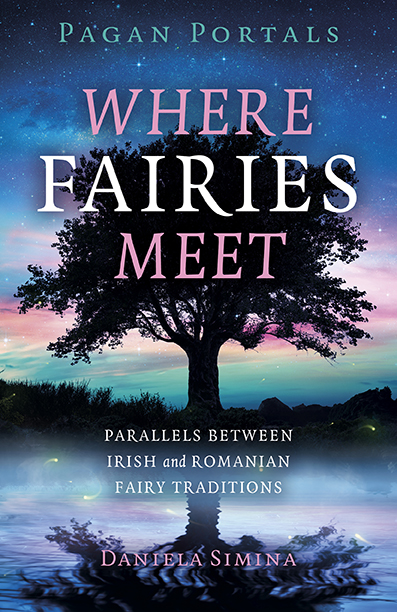
- Simina, Daniela “Where Fairies Meet: Parallels between Irish and Romanian Fairy Traditions” (2023)

 The Pagan Collective
Leave a comment