
Can you tell us a little bit about yourself?
Sure! I’m a mother of three and a dog-mum of two in my early forties, of Roma/Traveller heritage and living in Western Britain. I’m disabled due to Ehlers-Danlos Syndrome and dyspraxia, and until recently worked as a psychotherapist, when I went on long-term sick leave. I love poetry and fantasy novels and practice Qi-Gong.
How would you describe your spiritual pathway?
I’ve tried a few labels on for size over the years, and after over 25 years of what could be termed a ‘pagan practice’ still not sure that anything really ‘fits’! I suppose I’m a nature mystic at heart, and so often describe myself as a pantheist or green witch. I tend to refer to the Divine as ‘Goddess’ because that’s how I experience It, but ultimately I think It is beyond our own understanding. I’ve been deconstructing a lot over the past few years, and I’m finding that as I get older, things like ritual and spell work and divination interest me a lot less than simply being in nature, or meditating in front of a candle flame. I’ve been reading a lot into the more contemplative traditions; Daoism, Buddhism, Sufism and Christian mysticism. That doesn’t mean that I don’t find value in all of those other things, it just seems to be where I’m at right now. I’m also fascinated by mythology; by the stories we tell ourselves about the Divine and, ultimately, about the world and our place in it. I’ve recently been digging into Irish and Traveller folklore for what it has to tell us about how we relate to nature and the other-than-human, because with the looming climate crisis, I think this is crucial right now.
How and when did your spiritual journey begin?
I’m from a lapsed Catholic family, and so I wasn’t raised with a strong religious tradition as such but I was aware of the bare bones of Catholicism and familiar with candles of the saints being lit on certain days or for certain things. I have some family members who practice what would now be termed ‘the Fairy Faith.’ None of my family went to church except for christenings, funerals and weddings, but I went to an inner-city Anglican school. I was fascinated by the story of Jesus and very aware of a sense of Presence, although ‘God as Father’ never made much sense to me. I drove my teachers mad with my endless questions! So I was vaguely Christian until I discovered Wicca at around fifteen by reading the work of Silver Ravenwolf and Fiona Horne. Some female friends and I formed a small coven and experimented, but it fell apart after a while. I discovered Goddess Spirituality while at university as a single mother in my early twenties, and that had a profound impact on me. Ever since then I’ve described myself as a pantheist, and one who personally chooses to call the Divine ‘She’. I was and remain very inspired by the work of thealogians Carol P.Christ and Glenys Livingstone, as well as Starhawk. I’ve studied the Goddess movement and feminist theology more generally at postgraduate level. Because of my own heritage, I’ve always been interested in those specific faces of the Goddess that I find in my ancestral traditions, and I include the various Saints in that. I’ve been deeply studying the Brythonic Celtic traditions for the last decade and while I’m not a hard polytheist or Reconstructionist, I’ve learned a great deal from those communities.
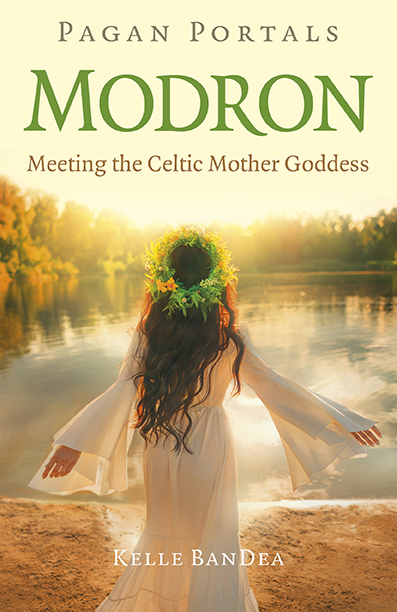
What inspired you to write your new book Pagan Portals Modron?
I visited Madron Well in Cornwall around 2016, and really knew very little about Modron at that point, but I had a profound spiritual experience there that deeply affected me. After that, I found out everything I could about her and this book was written in bits and pieces in the intervening years. It was just a personal project at first, and then I realised I had enough material for a book. I’ve always been a fan of the Pagan Portals series, so I took a chance and submitted my work.
Who is she?
Modron is a figure in the medieval Welsh and Brythonic myths. Her name means ‘Great Mother’ and denotes a divine/godly figure. She is the mother of Mabon, the ‘Divine Son.’ Her father is Afallach (from whose name we derive Avalon) a king of Annwn, the Otherworld. She is also the consort of the pseudo-historical king Urien of Rheged and mother of his son Owain. Urien and Owain repeatedly show up in the Brythonic tales and in Arthurian literature, and Modron herself was at least some of the inspiration for the character of Morgan le Fay. She also seems to have been Christianised into St.Madryn, also known as St. Materiana, who was popular in Wales and Cornwall and is still venerated there today.
Modron is perhaps a slightly obscure figure, why do you think that is?
It’s honestly something that baffles me, because even her very name indicates she was known as a – if not the – Mother Goddess to the Brythonic Celts, and her roots go back to the Iron Age Celts in Gaul. But the stories about her are scant and certainly not as rich in detail as those of say, later figures such as Rhiannon or Arianhod or Branwen. Scholars over the years have suggested these characters may contain threads of Modron’s earlier mythos which are now lost, particularly Rhiannon. There seems to have been an important story about Modron and Mabon where he was taken from her as a baby and imprisoned, and this motif of the Son being taken from the Mother plays itself out throughout the Four Branches of the Mabinogion. I’m convinced there are hints of something much older here. But because the details we now have about her are few, most neopagans seem to overlook her – or prefer to work with Rhiannon, who may be a later echo of Modron, or Morgan le Fay, who is actually a purely literary character but certainly one that has been heavily inspired by Modron.
What is her connection to the name Matrona?
The name ‘Modron’ is cognate with ‘Matrona,’ the Mother Goddess of the Iron Age Celts of Gaul, or at least some of them. Her worship may have originated in a cult around the River Marne in France and there are various sculptures and iconography dedicated to her, as well as healing springs and temples. Matrona was associated with abundance, the harvest and fertility. She may also have had a triple aspect as the Matronae, the Three Mothers, who were venerated across Celtic and Germanic Europe. Modron therefore seems to be a later version of Matrona. Essentially, they are the same goddess, albeit changed over time. Because the Iron Age Celts wrote nothing down, we don’t know what Matrona’s original myths were, and whether they would have been similar to the later stories of Modron. Like Matrona, Modron is associated with a river and fertility, and so it is my personal belief that the snippets of Modron’s mythos that we have at least have their roots in the original worship of Matrona.
Where are her legends and myths documented?
She is mentioned very briefly in the story of her son Mabon in the early Welsh Arthurian story Culhwch and Olwen, which seems to be a mash-up of different myths. As the mother of Owain her story is in the Triads and a Welsh manuscript fragment known as Peniarth 147. She is also mentioned in the poetry of Taliesin.
Are there specific landscapes or places associated with her?
The River Marne in France may be where a cult dedicated to Matrona first developed, and there is a ruined temple once built for her at Belesme-sur-Marne, which had twelve rooms and a spa. There have also been inscriptions to her found at the hot springs in Bourbonne-les-Bains. An altar dedicated to Matrona was found in Tongeren in Belgium, and the museum of Saint-Germain in France houses various artefacts dedicated to Matrona and the Matronae. As Modron she is obviously associated foremost with Wales, and also with the ‘Old North’ of England, particularly Cumbria, which used to be known as Rheged. It’s interesting that this ‘Old North’ as well as the border of Hadrians’ Wall and Southern Scotland was the site of an Iron Age cult to Maponus, the god who was the forerunner of her son Mabon. As St. Madryn she was and is venerated in North Wales and Cornwall and you can find churches in both places dedicated to her. Then of course there is Madron Well, which has been suggested as being associated with her – the whole parish in fact is called Madron!
Does Modron have a strong connection to the seasons and any in particular?
Nothing in Modron’s story connects her to any particular season, but as Matrona she was clearly connected to the harvest. In fact in her iconography she bears some resemblance to Demeter and was often referred to as ‘Dea Matrona’ (Divine Great Mother.) Many Neo-Druids associate Mabon with the rebirth of the Sun/Son at Midwinter and so Modron could be honoured as his mother at this time. This is a much newer association though as there is no clear link between Mabon and either Midwinter or the Sun. I find it interesting though that according to Bede, the Saxons celebrated ‘Mothers’ Night’ around Yule which may be linked to veneration of the Matronae.
What reasons or intent would you call upon Modron for?
Predominantly, fertility, abundance, harvest and motherhood. Due to her associations with water and the land I would also suggest healing and guardianship of the natural world. Also as Modron she is very much the grieving mother, and so I find her to be an excellent comfort in times of grief and loss, particularly pregnancy loss.
How would you recommend people start their journey with her?
I think there are various ways to approach this, but first and foremost I would suggest reading the story of her and Urien as mentioned above and the tale of Mabon in Culhwch and Olwen. If you are able to travel you could visit Madron Well or the temple at the Marne, or the churches dedicated to Madryn/Materiana. Of course, you can also simply approach her as you would any Mother Goddess. Put a figure on your altar, light a candle, and ask for her Presence.
Does she have any specific correspondences?
As above; fertility, abundance, harvest, motherhood, grief. Water and the Earth. Some of her iconography also features snakes, suggesting an association with rebirth as well as water.
What are the best items to give to Modron for offerings?
Go with your gut; but I would suggest grain, fruit and bowls of fresh spring water. Green plants, too.
Any other hints and tips?
I think it’s worth exploring what the concept of motherhood means to you. This can obviously be a fraught topic, but I think Modron is a good figure to approach with those complexities. Before my experience at Madron Well, I shied away from any image of Goddess as ‘Mother’ and was surprised by my sudden connection with her; but it had a purpose. I have a lot of trauma around my own relationship with my mother and working with Modron was a huge part of my healing around this, as well as around pregnancy loss resulting from violence. I would suggest Modron/Matrona as an ideal goddess for exploring female ancestry and the Motherline, especially issues of grief and trauma. Of course if you’re exploring incredibly difficult topics like this, keep yourself safe and seek support, maybe from a therapist or spiritual director.
Kelle BanDea is a neurodivergent mother of three with Traveller heritage. She currently lives in Warwickshire in the UK with her partner, children and a varied assortment of animals. She has postgraduate degrees in Feminist Theology and Creative Writing and you can find more of her work at kellebandea@substack.com
For more details: https://www.collectiveinkbooks.com/moon-books/our-books/pagan-portals-mdron-celtic-mother-goddes
 The Pagan Collective
Leave a comment