

These Pagan Portals are all current works in progress, serialised here on the Pagan Collective blog with each chapter being open for comment. In due course the entire script will be published as a Pagan Portal book.
Athena – Goddess of Wisdom & War – continued…
Last month, we left off at the end of Chapter 2, where there are two practices before we head into Chapter 3.
Practice: Crafting for Family
When I think about Athena, I begin to think of all the ways in which her family may have influenced and inspired her. Even the godds don’t come to their lives without the baggage of family, especially in Greek mythology. To connect more deeply to her, I want to call in my own family history, as what I notice in my life may help me relate to the stories I find.
What you will need:
- Pictures / photocopied pictures of your family members or Athena’s family members
- Glue or tape
- Scissors
- A large piece of paper, cardboard, poster board, etc.
Take a few moments to look over the family pictures. Who is in these pictures? Do you remember stories about them? Do you know their names and their birthdays? What do you know about them right now? If you don’t know these details, do your best to fill in the missing pieces.
Once you have gotten to know everyone, begin to place them on the large piece of paper. You can arrange them by how they are related, by alphabetical order, in a pattern, or some other design. I like to create a collage of how close people are to each other, based on what I know of their interactions. Again, if you don’t know about their level of intimacy or closeness, you can approximate and draw your best conclusions.
When you have the pictures arranged as you like them, attach the pictures with glue or tape. You can fill in any blank spaces with related images, paint, glitter, yarn, mirror, etc. Allow your own talent and creativity to bring forward the art into being. Notice what patterns emerge, what colors are showing up most, and whether you want to change things from your original idea.
As this feels complete, set aside the materials (knowing you can always come back to them) and close your eyes for a few moments. Notice what you feel, what stories have come up, and how this has impacted your interpretation of your family or Athena’s family. Does your body feel different? Do you have questions? Are there stories coming up that you haven’t heard before?
After a few moments, open your eyes and look at the results of your craft. Beside each image you might choose to write about their talents and skills. Or you might list these talents and skills on a separate paper or on the page of the larger paper. Consider the constellation of information and skill. Consider how this has impacted you. What do you notice as you look again? Is there something that surprises you? Is there something that shifts in your feelings about certain family members?
I invite you to keep this art piece in a place where you can view it regularly. You might begin to notice more information coming up and through. Journal about your feelings and impressions as an act of devotion to craft and family.
Practice: Tapping into Your Birth Story
I am fairly confident none of the readers of this book were born in the same way as Athena, but that doesn’t mean you don’t have an important birth story. In this practice, I encourage you to think about how you were born into the world. And if you don’t know that information or can’t get those details, I invite you to think about a time in your life where you were born into something new.
Think about all of the details of this birth: the date, time, location, weather, season, how quickly it happened, who was present, what happened beforehand, what happened afterward, etc. You can write this down or imagine it in your mind. It can also be helpful to share this story with a trusted friend or coven member so it can be witnessed.
Once you have the story in your mind, you can use these journal prompts:
- What qualities of my birth are seen in my life today?
- What qualities of my birth do I want to bring into my life?
- What do I wish was different about my birth?
- Are there ways that my birth impacted me positively? Negatively?
- Is there another birth story that I wish could be true?
Sometimes our birth story can deliver us into a world with a full set of armor, protected, but also potentially cut off or isolated. As you continue to build a relationship with Athena, she might be the one to help you rewrite any stories you want to rewrite. She can stand beside you in any battles you might need to face along the way.
Chapter 3: Who is Athena?
I sing to Pallas Athena, dread guardian of the city.
Warfare is the province of Athena and Ares:
sacked cities, battle cries, and wars;
she guards people setting out and returning home.
Hail Goddess! Grant us prosperity and luck.Homeric Hymn 11 to Athena. Translated by Diana J. Rayor.
Athena | Athēnē (Αθηνη)
Often described as grey-eyed or blue-eyed, Athena is as striking as she is fierce. Artists have shown her dressed in a long tunic, with a shield and a staff or her father’s aegis , a goatskin breastplate with the image of a Gorgon , a monster with terrifying eyes. Other images show her with a helmet, sometimes elaborately decorated with a crest of horse hair. She appears tall and strong, perhaps sculpted from battle and the responsibility of leadership.
These strong images are popular and easy to notice today, but she arrived earlier with a different name. In the Linear B, a text written in Mycenaean Greek that predates the Greek alphabet, she is :
a-ta-na (-po-tini-ja)
Αηάλα (-πόηληα)
Atana (-potnia = beloved)
These names are thought to be how the Mycenaeans brought a Minoan sun goddess into their time, and when Homer wrote about these events, the name was Hellenized to Potni = Athenaie. From there, she became Athene and later Athena, often with the epithet Pallas and later blended with the Roman goddess, Minerva.
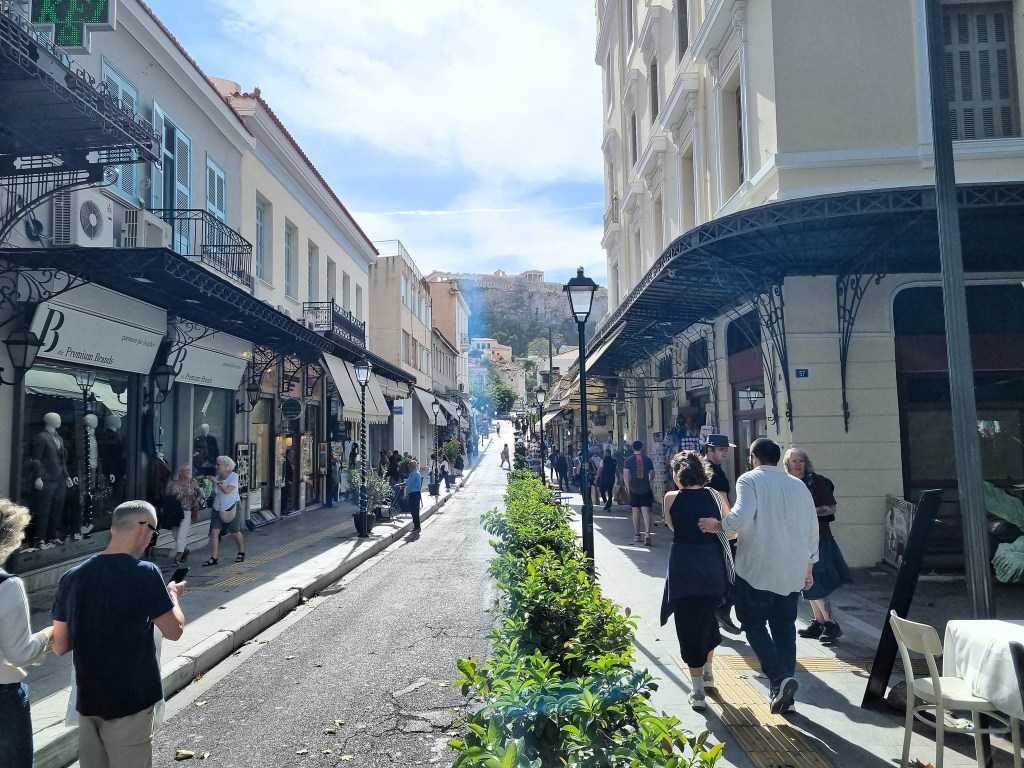
Athens and Athena
One of the most fascinating pieces of information and lore for Athena is her connection to the city of Athens. While I had always heard, and can still find resources that agree, that Athens was named for Athena as part of a battle with Poseidon, scholars do not seem to agree.
The myth begins with the land that is now Athens being ruled by a half-man, half sea serpent, Cecrops. Because of his snake-like features, it was thought he was closer to the land, possibly even born out of the land itself. From what is said, he ruled the land well, but was not dedicated to a deity, so the land’s name was subject to change.
Athena and Poseidon wanted to claim this land for themselves, and Zeus was concerned the two might battle each other if he did not intervene. Zeus told the two Olympians they would fight to claim the land as their own, with Cecrops as the judge. Poseidon began by striking his trident into the ground and releasing water onto the land as a gift to the people. But since the area already had access to water, this was not met with enthusiasm.
When Athena’s turn came, she planted and grew an olive tree, bearing a fruit that would offer nourishment and value as food and oil. The people of the land saw this as highly valuable, so the land was given to Athena and named Athens.
But, scholars noticed something in the spelling of Athena that gives another story.
The goddess Athena — more properly Athenaia, Ionian Athenaie, Attic Athena, shortened in epic to Athene — belongs most intimately by both name and sphere of influence to Athens, the city still dominated today by her Maidens’ Apartment, the Parthenon, which has come to epitomize all Greek art. Whether the goddess is named after the city or the city after the goddess is an ancient dispute. Since -ene is the typical place-name suffix — Mykene, Pallene, Troizen(e) Messene, Cyrene — the goddess probably takes her name from the city; she is the Pallas of Athens, Pallas Athenaie, just as Hera of Argos is Here
Argeie (Burkert 139).
The myth behind the naming of Athens continues to be told today, and was told to me when I visited Athens and took a tour of the Acropolis in 2024. What compels me about the myth is the idea that Athena could have offered protection in battle, but instead she is described as someone who wanted to nourish the people, realizing what they needed. Once again, this speaks to the complexity of Greek deities, as first impressions are rarely the last word in their significance.
And I would also point out that the myth with Poseidon continues with Poseidon getting upset that he lost:
Athena, therefore, called the city Athens after herself, and Poseidon in hot anger flooded the Thriasian plain and laid Attica under the sea.
And we’ll stop here this month. Next month, we’ll continue with Chapter 4: Athena Stories & Myths.
For more details: https://www.collectiveinkbooks.com/moon-books/authors/irisanya-moon
 The Pagan Collective
Leave a comment