
Interviewed by Thea Prothero.
This is the first in a series of interviews with people who either inspired or were featured in my book or were inspired by my book, A Guide to Pilgrimage, published at the end of last year in the Pagan Portals series by Moon Books. These interviews are a way of digging deeper into the various aspects of pilgrimage and a way of highlighting what it means to different people.
The idea is to inspire you, dear reader, to consider pilgrimage as an act of devotion, or a way of connecting to the world around you, now or in the future.
Today, let me introduce the amazing author, Andrew Anderson. He has written several books published by Moon Books including, Artio and Artaois, The magic of cats, and my absolute favourite tool of inspiration: The Ritual of Writing. He is also the editor of Touchstone, the monthly magazine of OBOD. Here we discuss how journalling and writing can be a wonderful tool to aid in your pilgrimage journey.

As you may recall, I used your wonderful book The Ritual of Writing as inspiration for part of one of my chapters in my book A Guide to Pilgrimage, It was chapter 3, Tools to Help You.
I do remember and thought it was a wonderful idea of yours to bring writing and journaling into the pilgrimage process. Thank you!
Lets start with a couple of questions about you. It says in The Ritual of Writing that you have kept a diary/Journal since 1985, firstly do you still have all the diaries and journals that you have written? If so, where do you keep them all?
I do still have them, yes! When I was younger, I used to keep them hidden away – I think I was afraid someone would read them – but now they are out and proud on the bookshelf. I’m quite proud of them and how long I’ve been writing a diary, so I like seeing them on the shelf. It also means I can take one down and browse through if I have a free 5 minutes. This happens quite often and tends to absorb a whole afternoon in reminiscence. I’m at a crucial point this year as my 2024 diary completed a whole shelf, so I have to find a new place for my 2025 diary and all of the ones which will come after it.
Has your journal writing changed since you wrote Ritual of Writing, ie since your more recent books?
It has. I’ve started to include a lot more visual element. I used to do this occasionally and augment the writing with the odd picture or banner (using the page toppers from Radio Times for Christmas Eve and Christmas Day, for example), but I’ve recently got into scrapbooking, so there is washi tape and stickers all over the place now! My 2024 diary would barely shut by the end! These visual elements give me an opportunity to shape the writing a bit more, and I’ve actually found that they make me more positive and mindful when I am thinking about what to write.
Is there any aspect of journalling that you find difficult or challenging and how have you overcome it? (if you have?)
I think the most challenging bit is always finding and devoting the time to journaling properly. Between 1997 and 1999 I just used a large exercise book to write in rather than a “day-a-page” diary. I would go weeks, months without ever writing anything and then have to write lengthy accounts to try and catch up with the important bits. It ended up just becoming a long list and lost all sense of character and detail. So, in 2000, I went back to the daily diary format. I also have a bit of a timetable, so I watch the headlines at 10pm to see if there is anything I want to catch up on, then turn the sound down and get on with writing! It’s part of my end of day, going to bed routine – and routine helps make space for things, I find.
At the end of a journal, do you spend time going through it and reflecting on what you have written? Do you change anything or leave it as it is?
That very much depends on what kind of year it has been! There is always a bit of a flurry of activity at the end of they year as I will stick in articles, photos, short pieces of writing a the back (I review all of the books I’ve read in the year, for example). Sometimes I will do a “Review of the Year”, where I go back through the journal and pull out fun or interesting phrases I’ve used or look again at how I responded to certain situations. I haven’t done that for 2024 as I suffered quite a bit of loss, including the death of both of my cats, last year and the grief is still a bit raw for me to dwell on the writing too much. But, despite not completing a review, I know I will take the diary back down and flick through the pages again. I looked at it just today, for example. I now consider 2024 ‘done’ so I’ve kind of moved on to my new silver 2025 diary now!
What is a typical writing day for you? Ie, do you journal at certain times, or when you feel the need?
This is a really interesting question. As I mentioned before I do generally journal at a specific time – around 10pm at night. But every so often I will break with that and write at different times. The last time I did that was in 2023, when I got covid for the first time. I live with someone clinically vulnerable so it felt like quite a momentous time for us, going through the illness for the first time, together. There felt like such an immediacy to the experience and a need to record the minutiae of the experience. So I wrote little and often, sometimes up to five times a day, just recording everything I could. I was very unwell and had to have 2 weeks of work, so I did that for a whole fortnight. I was quite sad when I went back to just writing once a day! If there is ever a similar situation, where I feel there is a need to record the immediacy of a potent situation, such as when I have been travelling, I do the same thing and write in small chunks.
Do you use your journals as an aid to write your books, for example, in Artio and Artaois you travelled to Bern to see the famous bear statue and discover the cities’ relationships with bears, did you journal this with the intention of using it within the book?
When I’m starting a new writing project, I treat myself to a new journal! It’s a great excuse! My daily journaling constitutes a daily diary, although it isn’t always simply a list of what I did that day. I may put some things in there which are useful for when I write a book but not often. With the trip to Bern I took my diary AND my bear journal, which was full of notes from books, passing thoughts and ideas, and I would take that with me around the sites in Bern. I remember sitting in the bear garden in the middle of the city and writing about what it was like there. I then did my usual sum up of the day in my diary later that night. So it’s the working project journal I tend to refer to, rather than the daily diary, as that’s the portable one where all of the valuable things are kept. It’s such a valuable thing to do, just writing in a different place because you might just capture something immediate which falls from your memory by the time you get home. And, yes, I keep all of those project journals too!

In your chapter Taking Your Story for a Walk, you suggest that readers go out into the landscape to observe it first hand, which also works very well with journalling and pilgrimage. How important do you think it is to experience nature/walking/being outside etc to aid in both spiritual growth and writing generally?
Oh, I think it’s vital. Writing can be a very insular thing to do. It tends to keep you inside, at a desk, on your own. And while that is a really valuable thing, you have to go out and see the world as it is, especially if you want to write about it. I found this while I was writing my festival tales, which form the spine for “The Ritual of Writing”. How could I write about Imbolc or Beltane unless I was out looking at the countryside and seeing what the landscape was doing? If you just try to imagine it, you often get it wrong. Just think of Christmas stories, for example. They’re always set in the snow and yet I can count on one hand the amount of times I’ve seen a white Christmas. I’ve seen far more white Imbolc’s, and yet the tendency is to embrace that as a spring festival! So, getting out and looking at what is living in the landscape helps your writing be more accurate and authentic. It also helps you learn the names of the plants, trees, birds and animals because you need to know what they are to write about them! And that aids spiritual connection and empathy with the natural world.
Have you ever been on a pilgrimage? Thinking of doing one? If so, how have/would you incorporate journalling into your overall experience?
I haven’t been on a pilgrimage as such, but I have been on a very long journey. I travelled from Tallin in Estonia to Shanghai in China by train, including the trans-Siberian railway. It was one of the most profound experiences of my life, seeing the world change around me and being totally out of my comfort zone. I wrote so much on the train, I filled a whole book. It was another one of those times when I wrote in short bursts, although the longer I spent on the trains the longer those passages became. I’d record everything. The really interesting bits are the vignettes of things that we whizzed past or things that happened on platforms. It is such a valuable testament to my journey and is a totally immersive read. I have shared it with friends and family too. It’s unedited so has a real immediacy about it. I’ve wanted to recreate the experience – I once described it to someone as “writing my way across a country” – but have never quite got there. I would like to do a pilgrimage along the Ridgeway or to Iona and would definitely do the same thing with my journal.
Can you offer any advice to readers who are thinking about going on a pilgrimage this summer (for example) should start creating a journal? Similarly, do you have any words of wisdom for newbie journal writers?
Use the journal you are going to take with you for all of your planning and preparation. For example, my trans-Siberian journal had so much in it by the time the journey began. It had all of the train timetables, dates, transfers – even phrases in Russian and Chinese which I could use or show to people if I needed help.
For newbie journal writers, the best piece of advice, which is the piece of advice I give in “The Ritual of Writing”, is just to start. So many people hold back because they can’t find the right journal or they are afraid of messing it up somehow. It doesn’t have to be perfect and it doesn’t have to be “fully formed” to begin with. It will be what it will be and your journaling style will grow and change and develop as you get used to it. But unless you start, it will never do any of those things – so just begin! Pick a day, any day and just start. Actually, today is the perfect day to begin!
Within Ritual of Writing, one of the key things you mention is that not only should readers write but that they should read widely. Do you have any good book recommendations to inspire readers to spend time in nature or pilgrimage? (Other than your book of course)
One of the most beautiful books I have ever read is called “A Black Fox Running” by Brian Carter. I had never heard of it but found it on a shelf in my local bookshop one day and thought I would give it a try. It’s set on Dartmoor, which I have never been to, but feel like I have because Carter’s writing is so evocative of place. While it’s an absolutely beautiful and deeply spiritual book, some readers may find some it a bit disturbing, in a “Watership Down” kind of way! And yet the visceral elements of the book somehow make it more spiritual. I cannot recommend it enough. It changed my life, and my writing.
Lastly can you tell us what you are doing now and if you are working on anything at the moment?
I am deep in the process of writing a Pagan Portals book on Herne the Hunter after a year or so of research. I love getting to this stage, where I have to weave all of these strands and stories together to create a compelling narrative for a reader and Herne is providing plenty of challenges! I don’t think it will be the book people will be expecting but I hope they like it. I also mulling ideas over for book number five, which I think will be my first book about Druidry. I have a possible title, which people seem to like, but we will see how it goes!
It was great to talk to Andrew about his writing and pilgrimage. To read my chapter featuring Andrew’s book, please check out my book, available from all good booksellers.
For more details about Andrew https://www.collectiveinkbooks.com/moon-books/authors/andrew-anderson
Next month I will be talking to Moon Books author Irisanya Moon about her pilgrimage to Greece.
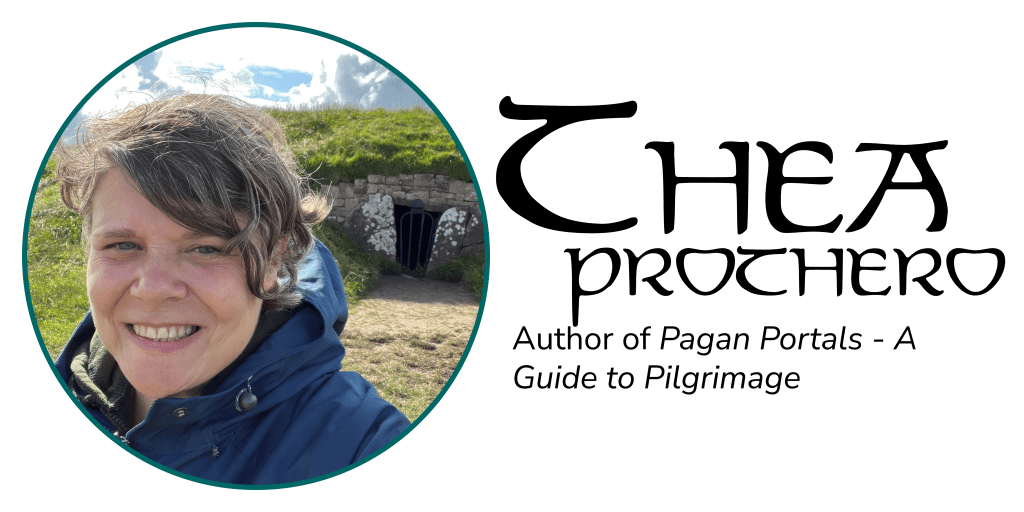
Thea is a Heathen and a pilgrim. She likes to think of herself as a Nemophilist, which means a ‘haunter of woods’. She spends most of her free time walking in the wildest remotest lands, places that still make the gods tremble, and she loves the challenge of finding connection through nature to the divine. She writes prolifically, read equally, has a passion for learning, taking photos, grow things, and spend time with her family. she works in education and lives in the south of the UK.
For more details: https://www.collectiveinkbooks.com/moon-books/authors/thea-prothero

 The Pagan Collective
Leave a comment