
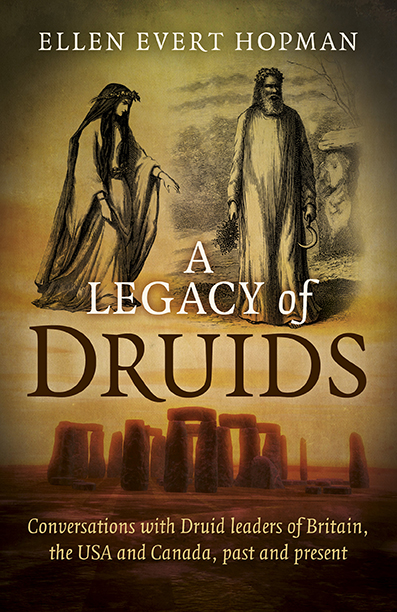
This interview is taken from Ellen Evert Hopman’s book ‘A Legacy of Druids’
Interview with Philip Carr Gomm
At the Craftwise Conference, Waterbury, CT
April 20, 1996
Philip is the Chosen Chief of the Order of Bards, Ovates and Druids (OBOD), an international Druid Order with two thousand members. Philip has a degree in Psychology and has studied Psychosynthesis, Adult Psychotherapy, and Play Therapy for children. Living in Sussex, England, he is the author of The Elements of The Druid Tradition and The Druid Way. He is also editor of The Book of Druidry and The Druid Renaissance and co-author of The Druid Animal Oracle.
OBOD traces its ancestry to the ancient Druids which it considers to have been one of the major inspirations for the Western Spiritual Tradition. It sees itself as a direct inheritor of an ancient lineage – from the Megalithic people who built the great stone circles and henges, to the Celts who added their wisdom and artistry, and to the Bardic schools of Ireland, Scotland, Wales, England and Brittany.
The 18th century Druid revival brought the present form of Druidry into being – flexible and relevant to the needs of the day and yet rooted in the heritage of the past. About ten years ago OBOD developed an experientially-based correspondence course, enabling individuals and Groves to study and participate in ceremonies of a like nature, all over the world.
Can you start by describing how you became a Druid and what it means to you to be a Druid now?
When I was a child my father knew the old Chief Druid, Ross Nichols, also known as Nuinn. I first met him when I was eleven and then again when I was fifteen. I was just drawn to it. I suppose it was just automatic, but that sounds like such a technical word. I was fascinated by it. I ended up asking to be initiated so when I was about sixteen or seventeen, I was.
I suppose being a Druid means a number of different things to me. There are times when the Druid inside me feels like an instinctive, sort of Shamanistic Druid. When I am out in the forest or someplace like that, I can feel him living in me and wanting to work in me. Then there’s the Druid who is the thinker, the philosopher. That’s when I am at home in my study with my books thinking about particular issues. That’s another kind of Druid who pops up.
That’s the “wet” path and the “dry” path. Those are old alchemical terms.
Oh really? I thought you meant in terms of the guy who doesn’t ‘
mind getting wet, being outdoors! In England that would be true!
The wet path is the relationship with nature and the dry path is meditation, study, and those kinds of pursuits. Both with the aim of enlightenment.
Great, the wet Druid and the dry Druid! Yeah, it fits. A friend was doing a spell check on her article and for Druid it came up with “drip dry”. So, we put a little cartoon in the magazine of these little Druids sort of hanging on a wash line. So that’s perfect. Thank you!
So how were you trained?
I was still going to school when I started to train. What I used to do was I would get off the train on the way back from school a couple of times a week and go round to my teacher’s house. He had a house in Baron’s Court. That’s where Ouspensky lived, I suppose it was the nineteen thirties or something, I don’t think they knew each other.
He would make me a cup of tea. It was strangely formal in a way. He would sometimes make a sandwich and then he would go to this big cupboard where he had all the teachings. He would take something out and he would read it to me and then he would explain things, on a paper napkin or a scrap of paper. He would draw a diagram of Stonehenge or do something to illustrate what he was saying.
Then he would ask me if I had any questions. Then we would talk about the ceremony that was coming up and that would be it. I’d go home.
Did your parents know this was going on?
Oh yes. Nuinn used to run a place called a Crammer’s which a kind of private, tutorial school was for kids who failed. Winston Churchill went to a Crammer’s. It’s a place where there is no sport, just solid cramming, and five kids in a class. And my father worked as a history teacher there.
So, my family knew about this, it was fine. I grew up in a family where both of my parents weren’t Christian. They questioned things, they were Agnostic. I went to church in school contexts. I went to Westminster so I was singing in Westminster Abbey every morning you know, which was beautiful.
So that was the training. It sort of drove me crazy in a way because it was apparently haphazard. In other words, I would turn up one day and he would talk to me about Stonehenge. I’d turn up three days later and he’d talk to me about the element of Fire, or something like that.
It was only years later that I saw the way it all fitted together, when I worked at putting the OBOD course together.
Is there any one that you are training right now in that way?
No. I don’t know if you have read the foreword to The Book Of Druidry but in there I talk about how he died in 1975 and he appeared to me in 1984, I was taking a degree in Psychology then. I was meditating one morning and suddenly I was intensely aware of him about ten feet in front of me. He told me that the Druid material was really relevant to the needs of the day and that it needed to be put into the form of a distance course so that lots of people could read it. OBOD was tiny in his day, less than a dozen people, so it was very limiting because you had to go and see him.
Now, at any one time we have about six hundred and fifty people actively doing the course. There are about four thousand people who have started it. As far as members it depends how you categorize a member. I would say that there are two thousand members.
Can you give an overview for Americans of the British Druid scene?
Well, there is the Ancient Order of Druids which is a bit like the Rotarians or the Freemasons. They do have some ceremony but they would not call themselves Pagan. They wear blazers and they raise allot of money for charity. It is said that they have about three thousand members. That is one type of Druidry which a Pagan-American Druid would feel quite uncomfortable with, I imagine. They do have some branches in America. It’s all male-only Lodges with one or two female-only lodges.
Then there is the Ancient Druid Order which is what OBOD grew out of. That is the group that you see photographed at Stonehenge. They don’t do that anymore though. They are quite heavily influenced by the Golden Dawn. It’s what you might call esoteric. I don’t know too much about them but they never joined the Council of British Druid Orders (COBDO) and they have kept themselves very much apart as a matter of policy.
Then there are a whole lot of much more recent Orders which are really quite small, who come together in the Council of British Druid Orders. One of those is the Glastonbury Order of Druids, the other is the Secular Order of Druids, who each have a dozen or so members.
Their main concern is having Stonehenge as a place for free worship. There is an ongoing debate about that that has been going on in COBDO for about six years and which has never been resolved. There are very persuasive arguments on both sides of the fence.
Put very simply the argument for free access is that this is a sacred place and you would never bar people from going, say, to a cathedral on Christmas day for example. So, to bar people from going to Stonehenge to celebrate the Summer Solstice is criminal. One of them has taken the British government to the European Court of Human Rights. That’s happening at the moment. It’s being done by a fellow who calls himself King Arthur.
The argument on the other side is that Stonehenge has become a sort of political focus. It’s become a focus of anti-establishment activity and even in the days of my teacher when they did the Summer Solstice there, people would come and throw beer bottles and it was an excuse for what are called in Britain the “lager louts” to come and jeer. Unfortunately, it has become a sort of magnet for that kind of energy.
So, the counter argument is that now that there are so many people interested in Stonehenge English Heritage have become the guardians of this site. And that it is appropriate for it to be guarded and to be used. They do allow private ceremonies, you can “book it” for that.
I have done ceremony there and I was very surprised about how I felt. I went there prepared to feel uncomfortable and feel that we were making a mistake. When we did the ceremony it took me by surprise, I was very pleasantly surprised. I immediately thought, I want to do this again. This is good.
I think we have to accept now that we live in a world that is so full of people…I’ve been to Glastonbury Tor and it’s been full of people camping out, drinking beer, cans all over and all the rest of it. If Stonehenge was completely open all the time there would be people camping there. You would be doing a ceremony and treading on beer bottles. That’s the sad reality of it.
If you go to Chalice Well, part of the reason there is that beautiful influence is that you have to pay a pound to come in and it adds to the protection. We know in magic about the power of the circle and the protection of the circle. Maybe places need it too.
What about the suggestion to have robed Pagan guardians at these sites?
Yes, but how long would it take the establishment to agree to that? The way we are looking at it now is that instead of confrontation in using the site, we are working it so that the feedback we are getting is; “The Druids came last week and there was no problem with them. There was a very nice feeling from them”.
They have these security guards and we were all thanking them. You start to build up a relationship. Then maybe a year or two down the line you say to them; “You see how we have been respecting the site. Could we now have a ceremony with two hundred people?”
The Druids aren’t the problem. The problem is the Traveler’s. (*ed. note – these are migrant people who live in their cars)
Right. And this is where I think the other Orders who are lobbying for free access are seeing it from a different point of view. They want everybody to be able to go.
So unfortunately, what has happened over the last few years is that these three Orders have pushed their agenda so strongly that it has taken up allot of time and energy in COBDO. The council has become a self-referring system, spending ages talking about its own structure and mechanisms.
Now the British Druid Order and OBOD have started something called The Druid Forum. We are trying to keep to the ideals of the original council which is to create a forum for people who are interested in Druidry to come and talk about Druidry. Not to get into voting rights and subscriptions or presenting “united fronts” which don’t exist anyway because everyone has such a wide range of opinions. So, the Ancient Order of Druids has left the council and the British Druid Order has left, and OBOD has left. Another thing that’s happening is that there is a phenomenon called The Gorsedd of The Bards of Caer Abiri. (*ed note – Caer Abiri is Avebury)
I am a member of that. I was initiated into it; I am the “real thing”. I think I’m the only American, there’s a fellow from Vermont but he is British.
Oh good! That is growing every year. OBOD had a meeting at Avebury in the conference center there. And there was a guy at the Stones Restaurant who asked if we would tell him all our festival dates because every time there was a festival they would sell out of food. And the people in the pub said they would lay on extra bar staff at the festival times. This last Spring Equinox was the biggest one – there were over two hundred people.
Another thing that is starting to happen is camps. We have run a summer camp for two years around Lughnasad. Philip Shallcrass and Emma Restall Orr are doing camps now at Calme, near Avebury. Ourcamps are ten-day camps. The ones they are doing are two or three days.
Cyber-Druids have come to England. We are setting up a web page which will be ready in the middle of May. The web page is great. The problem I find with lists, like The Order of The, White Oak, is that if you are in “overwhelm” as we tend to be you get all these messages coming in. I just can’t handle the mail. With a web page you can control it more.
Our web page has information about the course and the Order. We also have an art gallery with changing exhibits, a poetry archive- there is a Bard in charge of that, and we are going to try and develop a Poetry Cafe with links to other sites like the Poetry Society in the UK.
If people want to visit our site they will get there and see a Grove of nine trees and they click on the tree and that will take them to the poetry gallery or the art gallery. Then we have an archive, you have been asked to contribute, haven’t you?
Yes, and I have.
One development is the growing number of links between Wicca and Druidry. Allot of Wiccans are becoming Druids now. Around the same time that this has happened people like Ronald Hutton have started to look at the history of Wicca and Druidry around the nineteen fifties. The fact that Gerald Gardner and Ross Nichols were friends and the Wiccans were celebrating the Fire Festivals but not the Solar festivals and the Druids vice versa.
After Gardner and Ross got together in the fifties Wiccans started celebrating all eight festivals and so did the Druids. And so, there are allot of links. I talked about these links in my introduction to The Druid Renaissance which is coming out in July from Harper Collins.
What I suggest is that there is some danger that we will dilute our traditions if we mix them in a haphazard way. But if we recognize them as discreet in the sense of unique to themselves and complete in themselves it will be alright. Some of us will want to work with both and we can combine both. Other people may prefer to only work in one tradition.
This brings me to something that I keep bringing up on the internet and other places. I am an American. I live in America. I walk the land here. I listen to the trees; I look into the water and into the fire and I feel very close to the Native American ancestors. I feel them around me, I hear them, and I get messages from them. I give offerings to them.
In American Druid circles this is often taboo. You are not supposed to talk about Native American anything. They will give you all kinds of elaborate reasons about why, about not mixing traditions and how there is no way you could possibly understand who these spirits were so don’t even try. And yet when I was in England and also through the OBOD magazine I have noticed that people are very interested in Native American spirituality. They want to learn about it and there is no problem there.
Sure. Last year I went to California to do some workshops and the first night I spent in California I woke up at about three in the morning with this dream that became a waking dream, of a Native American man. He was suggesting what to do in the workshop. He was giving me Druidic things to do. I did it the next morning in the workshop and it was fabulous and it worked.
So, I think that in the spirit world they are not so interested in these kinds of divisions as we are down here. There are so many similarities with us in the Native American traditions. The circles, the bird’s feathers, the importance of the directions.
Another strange experience I had was when I first came to America. The day before I flew over to New York I had a dream in which a Native American teacher, a man, came to me and said: “It’s good that you are teaching Druidry in America because White people have to learn to connect with their own roots first. And once they have connected with their own roots then they can come to us if they wish.”
So, then I flew out and I went up to the Omega Center in Rhinebeck and I went into the staff room to have breakfast. There was a Native American woman sitting opposite me. She asked what I had come to do and I told her I was doing a workshop on Druidry. She then spoke the words of the dream to me. The only difference was she was female instead of male. It was exactly what had been said twenty-four hours earlier in England when I was asleep.
So, I think somehow there is a paradoxical dynamic which we experience as contradictory but it’s not. And that is on the one hand we feel as if we want to root ourselves in one tradition and yet we also want to reach out to all these others. We see stuff in Tibetan Buddhism which is inspiring and which draws us, we see something in Native American religion, in Shamanism, etc. etc.
Or if you are just relating to the land. It’s there.
Yes. And you feel it all around you. Sometimes you can get into a quandary when you feel a tension between these two dynamics. But for me it’s not a contradiction. It’s a bit like a tree that needs to be rooted in the Earth but can also reach out and touch the sky and other trees and people with its branches. Just as we can have within us dependent needs and needs for independence.
To begin with its kind of confusing when you connect with your dependent needs and you realize you just want to be parented and you feel very dependent. But you also feel that you want to be independent and go out in the world and do things. You think how can these two drives exist within me? Then of course you come to realize you can have both, it’s ok.
I think we can have a real interest in Druidry and we can practice Druidry and we can love Druidry and we can think of ourselves as Druids. But we can also be interested in and connect with Native American traditions and not be too concerned about the divisions.
You know how OBOD has created a ritual form and Keltria has created a ritual form and ADF has created a ritual form. I think what really raises people’s hackles is when you are doing a Druid ritual form and you then start to bring in Native American things.
Yes. I understand that. But I don’t have much experience of people doing that so I don’t know what it would be like for me.
The best student that I ever had was half Lakota Sioux. She was so connected. When she was talking about Fire she wasn’t just talking ABOUT it, she was really there with it. We would offer tobacco and we would offer sage and we would offer mead.
For me because of these experiences with the dreams and coming here I think there is a kind of bridge building work to be done. I talked a little bit with a chap called Ed McGaa who has written a book called Rainbow Tribe. He is very interested in the connections between Native American religion and Druid tradition.
That brings me to another point. I think that the way I see Druidry in Britain is different than in America. Here I see allot of Reconstructionism where people are trying to somehow reconstruct Druidry. In OBOD we have a different view to it which is this – that it’s very easy to see Druidry as something that existed in the past and we have a few strands that have come down to us in the present day and we are trying to reconstruct it and revive it.
The problem with that is there is so little material and also that it is kind of depressing because every day that passes the source of your tradition is getting further and further away from you.
We see Druidry as existing in the spiritual world. And that over thousands of years people have responded to the source in different ways. So, you have the pre-Celtic proto-Druids who built Stonehenge and the megalithic monuments. You have the classical Druids of the Celtic period. And then you have the Bardic schools that existed up until the eighteenth century. And then you have the revival in the eighteenth century.
Each time had different emphases. Some were influenced by Freemasonry or the Golden Dawn or whatever. But they all were somehow connecting to this spirit of Druidry. So, when we look at
Druidry in that sense it becomes something that is in the future rather than the past. Something that we are working towards, that exists in the spiritual world. That is a much more empowering idea. It means that our task is to connect with the spiritual source and to reflect it as faithfully as we can using historical material but also our present-day circumstances as well. Not somehow considering the present as inferior to the past. I think some of us have a subtle inferiority complex because we are living today as opposed to yesterday. In the end that isn’t productive.
If I could only write about one thing, I think that would be my message. Don’t see the source of Druidry as being in the past. See it as being in the spiritual world. Live with this idea for a few months and see.
I think we in America are doing that too or else we wouldn’t feel so inspired.
I think one of the nice things about Druidry is this huge diversity of opinion. You can get some guy who is a Christian and who wears a blazer and who is a Druid, and you can get a guy with rings in his nose and long hair who is a Pagan and a Druid and who does completely different things. He walks barefoot from Avebury to Stonehenge. And yet they are somehow inspired by the same source which is fabulous.

Ellen Evert Hopman is the author of a number of books and has been a teacher of Herbalism since 1983 and of Druidism since 1990. She has presented on Druidism, herbal lore, tree lore, Paganism and magic at conferences, festivals, and events in Northern Ireland, Ireland, Scotland, Canada, and in the United States.
She has participated in numerous radio and television programs including National Public Radio’s “Vox Pop” and the Gary Null show in New York.
She presented a weekly “herb report” for WRSI radio out of Greenfield, MA for over a year and was a featured subject in a documentary about Druids on A&E Television’s; “The Unexplained” (Secret Societies, February 1999).
She is a Master Herbalist and professional member of the American Herbalists Guild (AHG) and lay Homeopath who holds an M.Ed. in Mental Health Counseling.
She is a founding member of The Order of the White Oak (Ord Na Darach Gile, http://www.whiteoakdruids.org) and its former Co-Chief, a Bard of the Gorsedd of Caer Abiri, and a Druidess of the Druid Clan of Dana.
She is currently ArchDruid of Tribe of the Oak, an international Druid teaching Order based in New England, USA (http://tribeoftheoak.org/)
She was Vice President of The Henge of Keltria, an international Druid Fellowship, for nine years and has been at times a member of
The Order of Bards, Ovates and Druids and Ár nDraíocht Féin: A Druid Fellowship (ADF).
For more details: https://www.collectiveinkbooks.com/moon-books/authors/ellen-evert-hopman
 The Pagan Collective
Leave a comment