
Can you tell us a little bit about yourself?
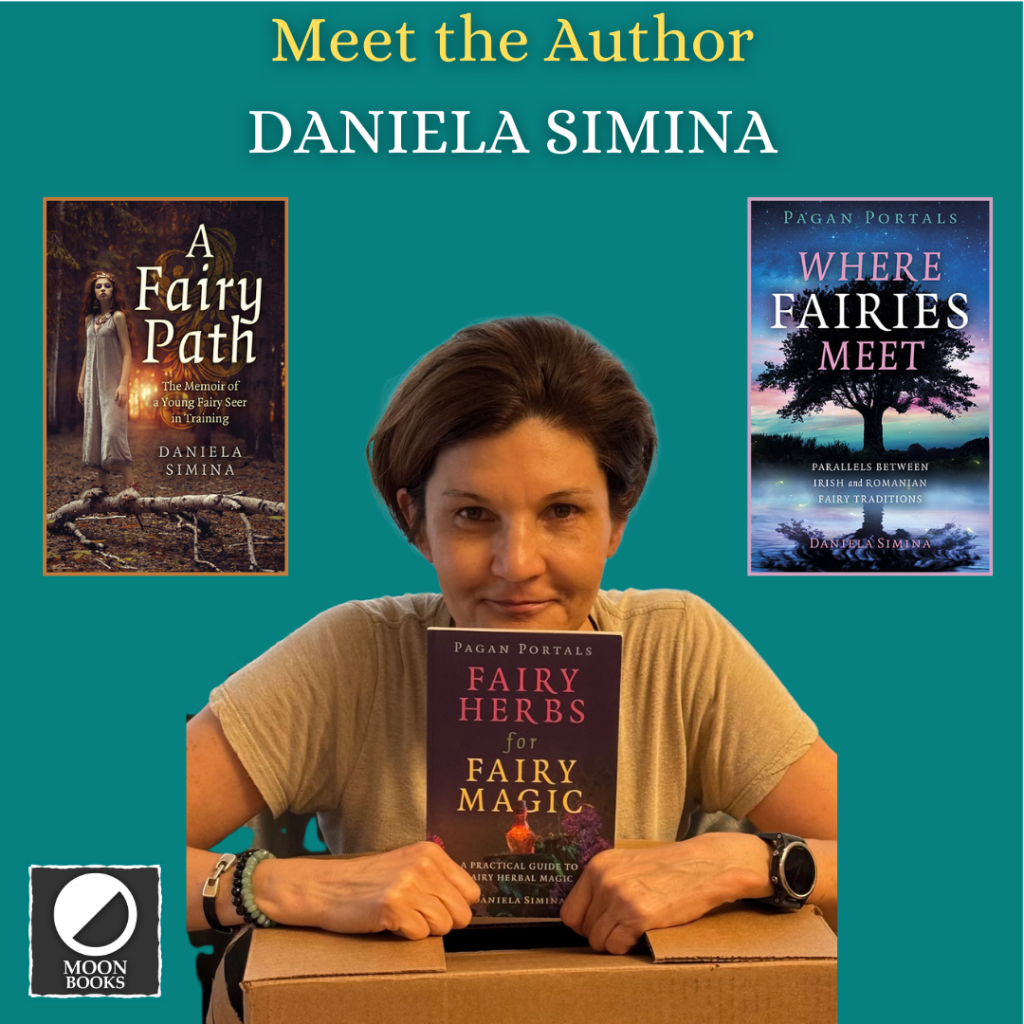
D: I am an author writing for Moon Books and a teacher of various esoteric subjects. I am also a folklore enthusiast, an avid reader and researcher of folk magical practices particularly those related to fairies, which is the crux of my spiritual and professional paths. I grew up in Romania, and since my grandmother was a folk medicine woman and a fairy seer, I also grew up steeped into folk magic and fairy lore which shaped my beliefs and approach to spirituality.
How would you describe your spiritual pathway?
D: I would describe my path as a confluence of rivers, with Norse-Germanic paganism as the main stream and the Irish and Romanian fairy traditions as tributaries. Also, there’s no real separation between what I do as a profession, which is writing and teaching, and my spiritual life. Both revolve around relationships with fairy-beings, nature spirits and also deities. Most of the things I write, whether books or articles, are materials I wish I had available at different stages in my personal journey with the numinous. I might say that most of my work models the saying “Write the book you wish to read”, and by (my) extension “teach the class you wish to take”. I see my work as a devotional act toward the spirit-beings who guide my spiritual path. I also see my work as a small act of service toward people seeking inspiration or plain and solid information to guide them on a nature-based, magical, fairy-led path. My spiritual pathway informs my work and then, the research and experimentation that go into my writing and teaching further shape my beliefs and practice. Things are never static on my spiritual pathway, and while this may be occasionally tiresome, I accept it as a normal part of the process: my path grows and changes because I grow and change, and my writing is both product and catalyst in this process.
How and when did your spiritual journey begin?
D: I don’t think there is a straight answer to this question. I am tempted to say that my journey began when I was very young, maybe five years old. But, back then, this fairy-business and messing up with folk magic were part of my everyday reality and it never occurred to me that I was actually engaging in something spiritual. As a teenager, I distanced myself from anything spiritual because I wanted to fit among peers. Being the weirdo didn’t make me popular nor helped making friends, so I talked myself out of all spiritual endeavours and opted to be “cool” instead. But that didn’t work either, because I didn’t feel whole, I didn’t feel ‘myself’ and consequently, I went on exploring different approaches to spirituality and religion. So, there were a number of new beginnings on short-lived paths. The “big” beginning, the one that actually lead me to where I am today, occurred sometime between 2011 and 2012. In that timeframe I got acquainted with North American shamanic practices and Neopaganism which I credit for helping me understand where I belonged, on a nature-based spiritual path. I found myself pursuing an Irish-focused style of paganism and then dove into Norse-Germanic paganism – which is yet another beginning.
What you class as a fairy?
D: I personally prefer to use fairy as an umbrella term which encompasses a large variety of beings. The beings that I see fitting under this umbrella are humanoid-looking, of different sizes, various skin-tones, with and without wings. They all have magical powers, enjoy extremely long lifespan yet are not immortal, and live in societies of various levels of complexity. Fairies have their own agendas and do not exist solely to serve humans although some among them may act in the capacity of guardians for different places and/or lead humans toward a more respectful relationship with the environment. Fairies live in worlds which are parallel or intertwined with the world of humans. Fairies can change their appearance and shift between corporeal and incorporeal, can cross into the world of humans and sometimes can get humans to cross into their worlds. I am using ‘worlds’ instead of ‘world’ because as we gather from the numerous bodies of lore, there are several descriptions for various fairy places and the beings inhabiting them. I like to think of this by analogy with our planet and its human inhabitants. At the present, all of the Earth’s human inhabitants belong to the same species, Homo sapiens. But there is a huge diversity within the human population and this diversity is largely related to geography. Landforms, climate, types of ecosystems and resources available shape lifestyles and influence physical appearance. I believe the same to be true about fairies. While they can all be classed as fairies, there is great diversity among them in the same way as there is diversity among humans from different places on Earth. It is my understanding that fairies inhabit various worlds in the same way as humans inhabit continents and geographical regions.
What made you realise there were similarities between the Irish and Romanian fairy traditions?
D: When I began my journey as Irish-focused pagan, I came across an archive, “The School Collection” which preserves authentic Irish lore collected from around 1931. I found there an overwhelming number of tales about fairy beliefs and encounters people had with fairy denizens. While reading those tales, I was awestruck by how beautiful Irish lore and fairy traditions are and how much they resemble to those stories and practices that I grew up with. The deeper I went into exploring Irish fairy-related folklore, the more the similarities stood out for me. I just couldn’t contain my excitement! Eager to share these with the world, I put everything in a book, “Where Fairies Meet: Parallels between Irish and Romanian Fairy Traditions” which published through Moon Books and has received very positive reviews.
Whenever there are stories of fairy and people are looking to work with them, they come with a warning, are their cautions?
D: Every fairy-related tradition that I am aware of has taboos and guidelines. For example, Irish lore mentions mounds and trees recognized as fairy abodes and it is prohibited for humans to disturb those. Digging into a fairy mound, cutting any bush or grass off of fairy mounds, and damaging fairy trees can lead to accidents, illness, ill-luck or even death befalling the human guilty of such disrespect. Romanian lore warns against walking through certain places especially at specific times of the year when fairy activity heightens. Trespassers may become paralyzed, lose their mental faculties, or suffer other kinds of long-term consequences which last until ritual specialists intervene and fairies agree to restore the person’s health. Sometimes, however, no intervention helps and trespassers die. In Icelandic lore Huldufólk, the Hidden People, live in certain rocks. Disturbing these rocks will anger their inhabitants who will then punish the offenders. Usually but not always, fairies give warnings to the humans damaging fairy habitations or otherwise encroaching their spaces. When people heed these warnings, things resolve positively. When warnings are ignored, the humans in questions do not fare well at all. As a basic rule, do not intrude into fairy spaces whether to spy or collect anything from there.
What does the term Fairy Doctor mean?
D: The term Fairy Doctor describes people who received their knowledge form fairies, work in partnership with fairies, and are also able to cure illnesses induced by the fairy themselves. The term Fairy Doctor describes a rather complicated relationship. Occasionally, fairies inflict harm on humans and animals. Fairy Doctors heal such ailments employing, paradoxically, knowledge and/or remedies given to them by fairy allies. The description of Fairy Doctors’ competency and role as mediators between humans and fairies casts some light on the complexity of these relationships: some fairies cause distress, and some others equip humans with the means necessary to deal with such distress. The job description of a Fairy Doctor informs that not all fairies are fond of humans and not all fairy clans get along with each other. Consequently, there is always a good chance for a human to get caught in the middle because gaining favour with some fairies could attract the animosity of another fairy or fairies.
And fairy magic, what does that actually involve?
D: On the one hand, fairy magic can be taken to mean magic that is performed by fairies themselves. When exercised by fairies and it is directed toward humans, fairy magic can impact humans in positive or not-so-positive ways. For example, fairies can magically render a farmer’s land to become particularly prosperous, bestow good luck upon a child or young person, or gift money which must be used within a certain timeframe before it turns to dirt or dry leaves. There are also examples of fairies gifting leaves and pebbles, which the disgruntled humans usually throw away only to discover the next day that the little debris left in their pocked has turned to gold. Glamour is another kind of magic that fairies use to change not only their own appearance, but also the appearance of places and objects in order to deceive humans.
On the other hand, fairy magic might refer to magic that humans learned from fairies and use to various ends. Across the breadth of European folklore, there are numerous examples of people who work in partnerships with fairies and learned from them different skills including magic.
Why would someone want to work with the fair folk, what are the benefits?
D: I will venture guessing that oftentimes, seeking to work with fairies is informed by a very idyllic vision of fairies. Infantilizing fairies, declawing, defanging and placing them in service to the humankind are all modern ideas. These ideas are in stark contrast with the much older fairy lore which, for hundreds of years, has consistently presented fairies as powerful beings endowed with magical abilities and power, with agency and agendas of their own, and living in worlds adjacent to the world of humans. Folklore abounds in descriptions of fairies who not only reward lavishly but also act mercilessly toward humans, oftentimes for no obvious reasons.
From the sources I read, from my own experience with fairies and the experience of people whom I know and trust, relationships with fairies are complex and oftentimes intense. Some think of approaching relationships with fairies from an anthropocentric point of view which places humans at the centre of everything. Engaging with fairies on such premises typically results in disappointing experiences. Anthropocentrism places fairies below humans. But fairies are people too. They are magical, powerful and should be approached with respect. The human seeking to work with them has to ponder carefully what exactly motivates them to seek such partnership.
With all these being said, I personally believe that working in partnership with fairy allies is a spiritual path that has a strong appeal and, from my perspective, worth pursuing. There is knowledge to be found and magic to be learned from fairy allies but one has to be aware that a lot of work must go into building the relationship.
How would you advise someone to begin their journey with the world of fairy?
D: A short answer would be, cautiously and patiently. In its vast majority, the lore I studied and traditions I engaged with, advise that fairies are best left alone. At the polar opposite, the same lore gives examples, albeit fewer, of humans who established good relationships with fairies. Fairies appreciate humans who are generous, smart, brave and respectful. So, I would suggest to begin the journey with reading as much genuinely old fairy folklore and lore as possible to gain an understanding of the beings one seeks to engage with. Additionally, I recommend reading modern fairy lore because it shows how peoples’ perceptions have changed over time. I use the term modern fairy lore in reference to experiences that people had with fairies in recent times. This is not the same as creative writing. One must learn to distinguish creative writing form authentic lore and folklore because they are different things.
As a next step, l would recommend getting into the habit of leaving offerings for fairies. It is important to be specific about what kind of beings are invited; lacking specificity is the equivalent of leaving the house door wide open and a sign that reads “Come in, everyone, no matter who you are and what is your intent!” which doesn’t strike me as a good idea.
Reading the lore is important for personalizing offerings and finding guidelines for interaction. When offerings have become an established practice, one shall begin to look for signs of fairy presence, such as things disappearing and reappearing in unexpected places, or the feeling of not being alone even when knowing for a fact that there is no other human around. Also, encountering plants, birds or animals that are rare or completely strange to one’s area, brief but outstanding and very isolated weather anomalies might signal fairy presence. For example, a few months ago I was in my backyard carrying out a ritual for my elven allies. The weather was exceptionally cold. When I got to the part where I was presenting the food and drink offerings to them, I felt a stream of warm air wrapping itself around my ankles. It stayed with me until the end of the ritual when it vanished as suddenly as it appeared.
Be consistent in your work and practice (study, offerings, monitoring your surroundings) but don’t have expectations for things to happen immediately: fairies may or may not take an interest in a person right away. Journey work and guided meditation are great ways to tackle contact and find out who among fairies might be willing to become an ally. Some connections made this way could become long-term relationships. Other fairy-guides will stick around only for a short while. It is also possible to have more than one fairy-guide. Monitoring one’s dreams, taking omens, using divination tools are means to communicate with fairy allies.
How would you use fairy herbs in your practice?
D: At a basic level, herbs can act apotropaically by clearing the space from unwanted entities, or propitiatory by making the space more appealing to one’s allies. Because fairies are vastly diverse, an herb that appeals to some may feel repulsive to others. In deciding what herbs to employ, one must take into account the kind of fairies they are connected to, or intend to connect with. There is another thing to keep in mind: with very few exceptions, fairies are not tied to one geographical area. For example, we have fairies from Celtic languages-speaking-cultures right here on the North American continent. Moon Books author Morgan Daimler has an excellent book on this topic which I believe is a must read for everyone who lives in North America and has an interest in fairies. And it is not just “Celtic” fairies who migrate: all the beings covered by the umbrella-term fairy can and do travel, sometimes to accompany migrating humans but also for reasons known only to themselves. As a concrete example, I am native of Romania and my first contact with fairies occurred there. However, among the beings I encountered there, not all were from among the local, Romanian fairy beings.
So, in deciding what herbs to use one must take into account the preferences of both, local fairy-beings and of fairies who are coming in from other places oftentimes at the invitation of the human seeking to connect with them. Here, in the area where I live, my primary fairy connections from among Scandinavian Hidden People show up side by side with local land spirits. I must know who likes and dislikes what, because I would not want by mistake to banish my own allies and open up the space to other beings who may not be so well disposed toward me and mine. Choosing the right herbs is based in research, practice, and learning from others – sometimes from fairies themselves. Errors are unavoidable, and it is important to know how to mitigate when they occur. I wrote “Fairy Herbs for Fairy Magic: A Practical Guide to Fairy Herbal Magic” because it is the book I sorely needed for years. Employing herbs in fairy magic is not limited to clearing a space or rendering it appealing, but it extends into crafting charms and remedies that could be potentized through the participation of fairies themselves. Aside from priming the space and leaving out offerings, fairy assistance in the creation of charms can be propitiated through employing herbs that they themselves favour and/or are connected with in other ways.
Do you work with deity?
D: Yes. I am a polytheist, so there’s more than one deity that I worship. I am asked quite often how do I balance my devotional work and if my spiritual landscape isn’t too crowded. Honestly, when I had just started on my path as a pagan, I briefly entertained the thought of focusing on either fairies or gods. Despite the fact that both were calling, I found myself craving for a practice that was simpler and easier to structure. But giving up one, gods or fairies, did not feel right either. Then, I thought of my own grandmother who was a devout Christian and never saw any conflict between worshiping her god and various saints while also carrying out devotional work for fairies. From Scandinavian lore, saga material, and the work of scholars writing on this subject, I learned that in the pre-Christian past people worshipped gods while simultaneously holding in great honour the Hidden People, the fairy-beings in their surroundings. I realized the futility of my concern, and I identified it as baggage that still needed unpacking. Unpacking isn’t something that happens overnight but the more time passes the more comfortable I feel being both in service to my Heathen gods and in clique with elves and other fairy-beings.
What or who inspires you on your spiritual pathway?
D: I find inspiration and oftentimes motivation in the lore or other materials that I am studying, in old myths and modern scholarship. I find inspiration in the work of several Moon Book authors, such as Mhara Starling, Geraldine Byrne, Mael Brigde, Halo Quin, Rachel Patterson, Morgan Daimler and several others. I have a couple of close friends, authors, and our discussions are always inspiring and motivating. Last but not least, spending time outdoors, whether in my backyard or at a location with special meaning, oftentimes leads to experiences which become themselves sources of inspiration.
What new projects are you working on?
D: I just added the finishing touches on a four-part course, “Fairy Magic: Foundations to Advance Practices” which I will teach both in person and online. The course aims to provide not just answers to theoretical questions but equip participants with the knowledge necessary to safely enter relationships with fairy beings from across the spectrum.
I am preparing my presentations for two upcoming conferences, Mystic South, in mid-July, and Ancestral Pathways, in early November. At Mystic South I will present “Fairy Herbs for Fairy Magic: Working in Partnership with the Scandinavian Hidden People”. The presentation I’ll give at Ancestral Pathways, is titled “When it Gets Dark in Fairy: Incorporating Apotropaic Elements in Home Design”
I am currently gathering material for a book comparing Romanian and Scandinavian fairy traditions, but I also entertain the idea of two other books, “Ancient Gods and Faires of Romania” and “Hidden People: Fairy Beings of Scandinavia”.
I aim to create more free educational content to offer through my social media channels. The content would be centred around various fairy traditions and Norse-Germanic paganism.
I guess this is enough to keep me busy for a while.
For more details: https://www.collectiveinkbooks.com/moon-books/authors/daniela-simina

 The Pagan Collective
Leave a comment