

Tell us a little about yourself.
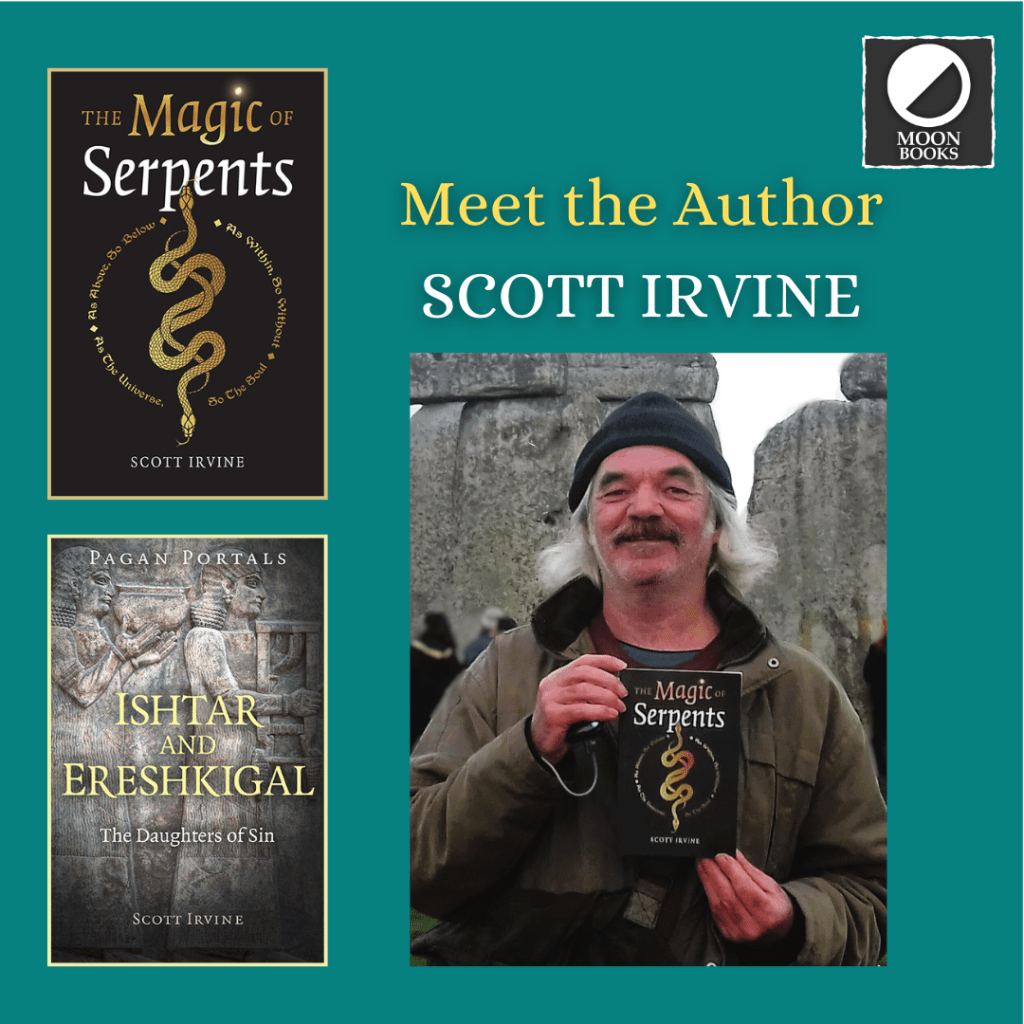
I am a druid in a witch’s hat, initiated into the Cotswold Order of Druids inside Stonehenge at their Winter Solstice ceremony 2021. I have two books published by Moon Books/Collective Ink, Ishtar and Ereshkigal (2020) and The Magic of Serpents (2022). I have three books published by Veneficia Publications, two for the Dark Devine Feminine series, Ereshkigal – the Dark Side of Venus (2021) and Kali the Destroyer (2023) and a fantasy adventure novel based in Dorset during the Iron Age, the King’s Odyssey (2021)
I live on the south coast of Dorset (UK) in the sleepy village of Wyke Regis close to many ancient standing stones, dolmen and Iron Age hillforts. When I am not writing I explore the locality with my camera or gardening, stone carving, catching up on my philosophy or learning ancient history, especially the Anunnaki period of Mesopotamia. I am currently the vice-chair of the local Friends of Rodwell Trail and Sandsfoot Castle group.
How do you describe your spiritual pathway?
I work in and with nature, aware of earth based spirits that pervade all of life, everything is connected through nature including us. These earth spirits, which some describe as fairies etc. are my connection to Mother Earth and the universe beyond. Working in all the elements as a gardener, learning through observation how nature works using the eight-fold seasons of the year of the druid and the witch.
How and when did your spiritual journey begin?
It really began when I finally chose to deal with the death of my girlfriend in a motorbike accident in 1983 that I had kept bottled up for the best part of twenty years. After manifesting itself from out of the darkness in the final year of my degree, causing me to almost quit and run away but I used that ‘energy’, if that is the right word, for my final project in her memory and gained a 2-1. It was my inability to talk about my work that cost me a first, but I am what I am. I enrolled into a philosophy course after graduating. There were many questions that mainstream sources could not answer. I discovered a world of spirit energies through philosophers like Socrates and Plato, Descartes and Spinoza, Locke and Hume, Hegel and Nietzsche, Freud and Jung. They questioned the reality of the world through ‘pure’ thought and reasoning. I examined the teachings of Buddha and Jesus, Brahma, Vishnu and Shiva, the works of Shakespeare and the mysteries of William Blake. They all believed that the spiritual realm was as real and as important as the physical ‘Real’ world.
Who were the Daughters of Sin and how did you discover them?
The Daughters of Sin are the Babylonian sisters Ishtar and Ereshkigal, the eldest daughters of the Moon God Sin. Ishtar is the Goddess of Love who ruled over the living and Ereshkigal, the Goddess of Death who ruled over the dead. One was the Queen of Heaven and the other, the Queen of the Underworld.
I discovered them when I was tracing back the origin of Briget, the Celtic Queen of Heaven, back 3,000 years to Ishtar (and further back to Inanna), with Cailleach the ‘dark’ sister/aspect of Briget leading to Ereshkigal.
How are the planets involved in their story?
The seers, soothsayers, shaman of many ancient cultures saw the celestial spheres that cross the heavens as having powerful influences on our psyche. Over time, the planets, which include the Sun and Moon, became our seven days of the week. Ishtar and Ereshkigal ruled the planet Venus with Ishtar representing the morning star heralding in the light of day and Ereshkigal, the evening star heralding in the dark of night.
‘And on the First Day, God created Sunday’, after the Sun. The Babylonian Sun God was Shamash, the younger brother of Ishtar and Ereshkigal. His Greek equivalent is Helios/Apollo, in Hindu myths, he was Lord Surya, the ‘eye of the universe’, and for the Norse she is the Goddess Sunna, or Sol, ‘all bright’.
‘And on the Second Day’, was Monday after the Moon. The Babylonian Moon God was Sin, the father of Ishtar and Ereshkigal, who transformed into the Greek Goddess Artemis, the Hindu Lord Chandra, the ‘Lord of Night’, and the Norse Goddess Mani, which literally means ‘moon’.
Tuesday was the third day named after the planet Mars. Nergal was the Babylonian God of the Dead and husband of Ereshkigal. The Greek equivalent is Ares; the Hindu is Lord Mangala and the Norse God Tyr, all Gods of War.
Wednesday represents the planet Mercury and the Babylonian Messenger God, Nabu and the Greek Hermes. To the Hindus, he was Lord Budha, not to be confused with the 6th Century BC Gautama Buddha, but the earliest ‘Enlightened One’, from which all the following Buddha’s incarnated. The Norse God was Odin.
Thursday is named after the King of the Gods, Jupiter, the Babylonian Marduk, the Greek Zeus, the Hindu Lord Brihaspati, the ‘spirit of the vastness of the universe’. The Norse God was Thor.
Friday is the day of the Goddesses (and God) of Love from the planet Venus, Ishtar, Aphrodite, Lord Shukra, ‘clear and bright’, and Freya.
The final and completion of the week, the 7th day of Saturn, giving his name to Saturday, governed by the Babylonian Storm God Ninurta, half-brother to Nergal, the Greek God of Time, Cronus, the Hindu Lord Shani, the ‘evil eyed one’, and the Norse Njord, God of the Wind and Sea. It was created to be a sacred day, a day of rest to worship the Gods and Goddesses.
Have archaeological finds been important and has there been any important finds?
The most important discoveries is the hundreds of thousands clay cuneiform tablets and cylinder seals revealing the stories of the Anunnaki. They have been unearthed less than 200 years ago across Mesopotamia, mostly around what is now Iraq and Iran. Without the archaeology of ancient Sumerian and Babylonian sites, the world would not have heard of ‘those from heaven to earth came’, the Anunnaki Gods.
The most iconic discovery is the Burney Relief depicting Ishtar/Ereshkigal, standing on the backs of two young lions, representing courage and strength, flanked by two owls of wisdom, prosperity and good fortune. It is dated to around 1800 BC, discovered in the early 1920’s in Southern Iraq, and now housed in the British Museum.
What makes you say Ishtar and Ereshkigal are opposing forces?
I came to that conclusion after discovering their existence from the Vedic creation Goddesses, Aditi and Diti who gave birth to the gods and devils respectively, opposing forces of light and dark, good and evil, growth and constriction, very similar to the Chinese Yin and Yang.
There is no evidence in Mesopotamian myth that they were opposites only in the sense that Ishtar was the Morning Star of Venus and Ereshkigal the Evening Star. Ishtar was the Queen of the Great Above and Ereshkigal the Queen of the Great Below with humanity in between.
Can you tell us about the Mesopotamian underworld beliefs?
The Mesopotamian underworld, which includes the Sumerians, Babylonians, Assyrians, Hittites and Persians, was ruled by Ereshkigal and her husband Nergal. It has been described as the ‘House of Darkness’, an abode which none leave who enter. It is bereft of light, where dust is the inhabitants fare and clay their food. They are clothed like birds with wings for garments.
Enkidu, the hairy beast man, a supernatural gift from Ishtar to Gilgamesh ventured into Ereshkigal’s realm to retrieve a drum and drumstick, a gift from Ishtar to Gilgamesh where he saw his body devoured by vermin and filled with dust. Enkidu also noticed that those who had received proper funeral rites by priests lived in eternal paradise and those that did not had to make do with a miserable existence. Shamash would journey back from the western horizon through the underworld eastwards to rise again the following day. During his journey, Shamash would give food parcels and clothes to the dead sent from their loved ones on the surface.
You mention chakras and kundalini in your book Ishtar and Ereshkigal. What is the connection?
There is no direct connection. The chakras and the kundalini are spiritual enlightenments from Hinduism, which began soon after the Sumerian civilisation. I have related the 7 chakras and the kundalini of the Shakti serpent that powers them, to Ishtar’s descent into the underworld, removing a piece of earthly attire at each of the 7 guarded gates that separate the worlds of the living and dead.
I like to explore the connection of numbers in different cultures to see where they take me, see the myth from a different perspective.
What is the importance of the number 7?
As well as the 7 gates to the underworld and the 7 planets and 7 days of the week already discussed, there are 7 tablets of creation, the enuma elish from which the 7 days of the Biblical creation was based. There are 7 Anunnaki Lords who dwell in the subterranean Halls of the Living that sits between our world and that of the dead, existing in the Sacred Flower of Eternal Light. Each Lord has a specific duty to assist humanity in requiring wisdom. They are the serpent kings.
What is the connection between Ishtar and Aphrodite?
The Greek Goddess of Love is the reinvention of Ishtar for the European market. She was much less warlike and aggressive than Ishtar and more beautiful and vain, but just as devious and jealous of her rivals. Both are Queens of the planet the Romans called Venus.
How important is nature to you and your pathway?
Nature is very important to me, without nature there would be no life on our planet. A large part of being a druid or a witch is the respect and care of our forests, our countryside, parks and gardens. They are all born from the spirit of the earth goddess and maintained by the fertility goddess and god, who for the Babylonians were Ki, Ishtar and Tammuz.
My favourite places are all in nature and I have fulfilled a career in gardening. I enjoy pottering around in my garden at home, taking long walks along the coast and exploring the many ancient sites across Dorset regularly. Much of my magic is concerned with healing the earth where it is needed. People tend to forget that we too are a part of nature, as much of nature as a tree and hedge, a flower and herb.
You talk about balance in the book. Is that important to you?
Yes, because we live in a world of duality (1+1=2), opposing forces like light and dark, hot and cold, summer and winter etc. Balance is an aspect of much of our reality and is required to harmonise the unbalance that causes dis-ease and suffering. It is the balance of summer and winter with spring and autumn that ensures the fertility in nature. It is the balance of masculine and feminine that ensures the continuation of all biological life. It is the balance of life and death that drives human growth, creativity and evolution.
Balance is also important between work and rest, socialising and self-time.
What inspired you to write The Magic of Serpents and do they play a part in your practice?
I find the concept that the serpent is evil unjust and so ingrained in modern thought because the Holy Roman Church perceived that feeding wisdom to humanity was evil and the symbol of the serpent forever cursed as the antitheist of domestication and hard labour. The Magic of Serpents was written to readdress the injustice of YHWH who wished to control humanity to his world order and condemn his brother Lord Enki, the Babylonian Serpent King to eternal shame.
Druids were known as Serpent Kings for their knowledge of elemental magic and influence over the spirit world, the wisdom of the ancient serpent.
I use the creative serpent Shakti in my practice when I can. Shakti, who contains the influences of Kali, Pavarti, Lakshmi and Sarasvati, opens the 7 chakras connecting the physical with the spirit. Awakening the kundalini is not always about deep meditation, it is freeing the consciousness to completely focus on being creative like writing, art, music, dance etc. The power of the Serpent is divine creativity.
What does the serpent symbolise?
The serpent symbolises many things on many levels. On a basic level, the shedding of a snake’s skin reflects our ability to discard outdated thoughts and habits allowing us to grow. On a religious level, the cursed serpent is an abomination, a deceiver, a trickster never to be trusted. On a philosophical level, he is Lucifer, our EGO who rules the mind. The realm of Lucifer separates the higher and lower selves controlling the information between Shekinah above and Lilith below. On a spiritual level, the serpent is the feminine earthy power of Shakti, raising the kundalini to connect with her beloved Heavenly Shiva.
At an esoteric level, serpents entwined around a caduceus represent the undulating waves of opposing forces. The coiled serpent represents the cycles of fertility in nature like the ouroboros eating its own tail symbolising the continued cycles of time and the changing seasons.
What is the relevance of the serpent, bird and tree?
This 5000-year-old story reveals friendship, broken oaths, revenge, suffering and finally clemency. A serpent lived among the roots of an ancient tree with his family and an eagle nested with his family high in its branches. The serpent and the eagle grew up together and had become very good friends and neighbours. They made a brother’s pact, an unbreakable oath to protect each other’s family when the other was away hunting. After many, many seasons of harmony, the serpent returned home one evening to discover his family had been killed by the eagle and wished revenge. With the help of the Sun God Shamash, the serpent captured the eagle, crushed him half to death, breaking his wings and left him to rot in a pit on a mountain.
The moral of this myth is the severe consequences of breaking an oath and destroying a friendship. An oath to the Mesopotamian was as sacred between men as it was with God. On a simple level, the roots of the tree represent the underworld of the earth spirits, the trunk is the realm of the living and the canopy is the upperworld of the Gods.
On my level of thinking, the serpent is the Water God, Serpent God Enki, Lord of the Earth who resided in the city-state of Eridu, south of the River Euphrates. The eagle is Enki’s nephew Nergal, the God of War and Lord of the underworld whose city was Cuthah, north of the Euphrates and the tree that separates the two is the Euphrates.
After many generations, the eagle was seen to have served his punishment by Shamash and allowed to return to his kingdom at the top of the tree. The eagle became the symbol of a snake hating religion. God needed an adversary to fight, an antagonist, terrorist, a scapegoat to blame for humanities woes.
Serpents feature in many myths and legends, why do you think that is?
I believe that is because serpents are as old as the hills, literally, they are a remnant of the dinosaur age. Serpent energy is the vibration and drive of Mother Earth, creating mountains and valleys as she slithered across the landscape preparing the world for nature to take hold. She is the many frequencies that create worlds and ensures fertility in nature, before the gods from heaven arrived and claimed creation for themselves and demonising the serpent as a negative evil force ever since.

 The Pagan Collective
Leave a comment