
These Pagan Portals are all current works in progress, serialised here on the Pagan Collective blog with each chapter being open for comment. In due course the entire script will be published as a Pagan Portal book.
Chapter 6 – Putting It All Together
“Rough the dwelling places there
Where men shear off Macha’s crop
Where warriors drive a multitude into pens
Where the raven women stir up strife.”Sanas Cormaic (translation by me)
Thus far we have looked at the different appearances of Macha across the mythology, exploring each individual story, the themes connected to them, and the ways each might – or might not – intertwine with the others. Now we will move into looking at Macha as a cohesive being by discussing the particular things that she is most associated with or connected to. This will include both historic ideas as well as some modern ones that people embrace today.
This chapter is going to be wide ranging and will be broken down into smaller subsections for each category. The goal is to cover all the major points in ways that will help people both better understand Macha and the various things that she is connected to or associated with.
Colours – from a strictly historic perspective we have no knowledge of colours associated with Macha by Irish pagans, however modern pagans have developed some based on hints in stories. The Banshenchus refer to Macha as ‘the sun of womanhood’ and some people associate her with red because of that, while others connect red to her because of Macha Mongruadh’s red hair. Black is associated with all three of the Morrigan sisters because of their strong association with black birds, particularly crows and ravens. She may also be associated with the colour grey because in the Ulster cycle Cu Chulainn has a horse from the Otherworld named the grey of Macha.
Symbols – as with colours there is no clear idea of what pre-Christian Irish people would have considered a symbol of Macha, if they even had any. In modern paganism some people associate the triskele or triquetra with the Morrigan more generally. People may also wear pendants with horses or crows for Macha specifically.
Associations – Macha has a range of associations that apply to either all or most of her aspects. These include sovereignty, magic, witchcraft and Druidry, war, battle, death, and prophecy. Her connection to sovereignty has been discussed in several previous chapters. Her connection to magic can be seen in Macha of the Tuatha De as well as Macha of the sidhe, both of whom use magic to achieve their ends, one through battle magic that defends her community and the other through a curse to punish those who have wronged her. Related to this Macha of the Tuatha De is explicitly called both a witch and druid in the source material (as are all three Morrigan collectively). Macha of the Tuatha De and Macha of the Redhair are both strongly connected to war and battle, and by extension death, so that she may represent the side of the fertile land Goddess that is sovereignty personified as war (Waddell, 2014). And we see prophecy coming in with Macha of the Nemedians who predicted the Táin Bó Cúailgne before dying of a broken heart.
Ulster – Macha is strongly tied to Ulster in Northern Ireland. Her name is used in some myths as a synonym for Ulster itself or for Armagh specifically, as we see in the Silva Gadelica where saint Patrick says “he shall go to serve Macha in the north…” referencing the location not the pagan goddess (O’Grady, 1892). In a range of sources from that time Macha was used to refer to either Ard Macha or Emain Macha and the surrounding areas. This connection between Macha and Ulster would particularly hold true for three aspects of Macha; Macha wife of Nemed, Macha of the Sidhe, and Macha Mongruadh who gave their names to geography in Ulster further associating them with the land there.
Ard Macha – ‘Macha’s height’, Anglicized as Armagh the name belongs to both a city and county in Northern Ireland. The Dindshenchas connect both Macha of the Nemedians and Macha of the Sidhe to Ard Macha, which is named for them in different stories.
Emhain Macha – The main location associated with Macha’s is Emhain Macha (Navan Fort) located in Navan, county Armagh, Northern Ireland. This site was once the seat of power in the area, one of the three biggest ritual sites in Ireland, and was in use from the neolithic period forward. Evidence suggests that during the Bronze age, approximately 800 BCE, a timber structure existed at the site of the main mound which was replaced by another similar structure in the Iron age, around 400 BCE (Halpin & Newman, 2006). This was then rebuilt again in the 1st century BCE, then filled with stones – possibly from a previous neolithic cairn – before being burnt and covered over with dirt creating the mound as it is today (Halpin & Newman, 2006; Lynn, 2003). The reason this was done is uncertain with some scholars suggesting it was meant to be a ritual offering of the space to the Otherworld, while others suggest that it was done to contain or focus the Otherworld’s influence within that space or create a sidhe, or Otherworldly hall, there (Lynn, 2003; Warner, 2000; Waddell, 2014). Today Navan Fort and Centre maintains the site, including the mound, and has a visitor centre and reconstructed iron age village featuring reenactors portraying life at that time.
Emain Macha was a flourishing ritual site for centuries and archaeology can offer valuable insight into Macha and this location by telling us what animals were sacrificed there. Macha is strongly associated with horses, discussed in depth below, and although horse sacrifice was not a main focus in Ireland archaeology has shown that unlike other Celtic-era ritual sites like Dún Ailinne and Teamhair, both located in central Ireland, horses were only extremely rarely sacrificed at Emhain Macha – making up less than only 0.8% of all faunal deposits compared to 5.5% at Teamhair and 2.4% at Dun Ailinne (McCormick, 2009). It’s also interesting to note that although cattle were the main deposits at both of the other sites by significant amounts, it was pigs that were the main animal offered at Emain Macha (McCormick, 2009).
Oenach Macha – Macha’s role as a Goddess of sovereignty is seen in several key ways, one of the clearest being her association with the oenacha, or Lughnasá fairs, which occurred in August, usually across several weeks. The word oenach is explained in Cormac’s glossary as meaning horse races, and the fairs themselves were well known for horse racing (Patterson, 1994). Emhain Macha has a long tradition of these fairs and it is said in the Prose Dindshenchas that the Oenach Macha was established in remembrance of Macha of the Red Hair (Waddell, 2014). This yearly harvest fair celebration was not only named for the eponymous Goddess of Emhain Macha but also prominently featured horses being raced. Waddell theorizes that the strong connection to horses at Oenach Macha may reflect both Macha’s role as a horse Goddess and also possible earlier ceremonies at the site which would have connected the king to the Goddess ritually (Waddell, 2014). Interestingly another, possibly older, name for Lughnasá is Brón Trogain – “sorrow of earth” – which may be as MacNeill suggests in her book The Festival of Lughnasa: “a metaphor for birth” (MacNeill, 1962, page 10). This could suggest a connection, at least tenuously, between Macha of the Sidhe and the horse race she ran at an oenach with the horse races and celebration of Lughnasa. Each of the Irish Goddesses associated with Lughnasa celebrations including Macha, Tailtiu, and Carman is also a deity who was known for her motherhood, for dying in childbirth, or for dying after clearing plains (Sjoestedt, 2000).
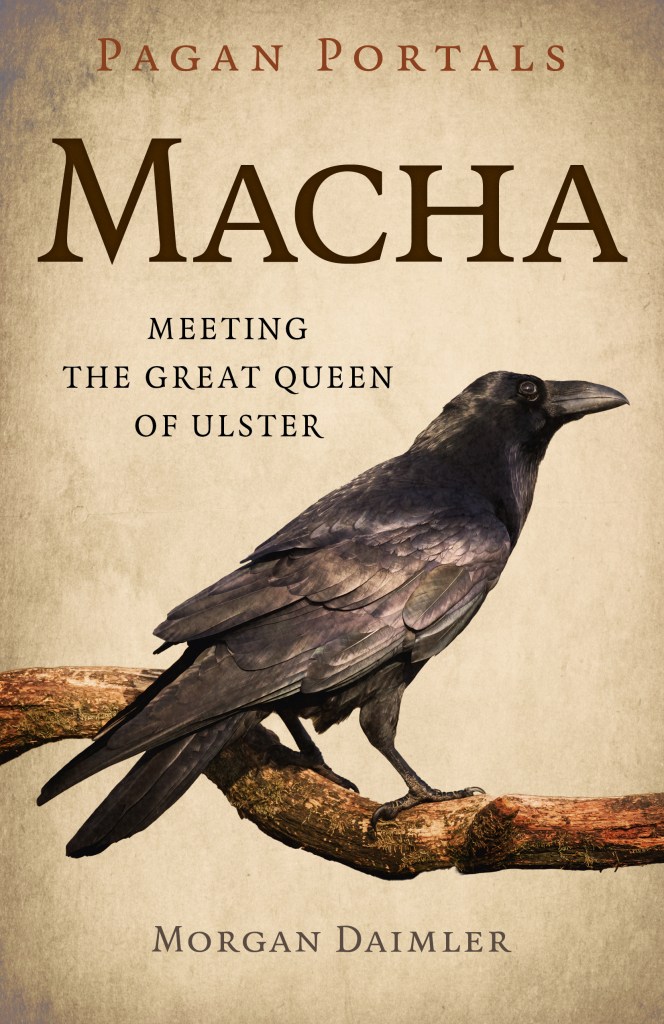
Crows – Although both Badb and the Morrigan are more strongly connected to crows than Macha, she does still have some connection to them. In some versions of the Aided Conchulann all three sisters appear as crows and circle over the place where Cu Chulainn is dying, showing that she could and did take on this form. Additionally in older Irish the word Macha could refer to either a milking yard/field or a hooded crow. The hooded crow or Royston crow (corvus cornix) is a bird found across Ireland; the name hooded crow is an allusion to the bird’s colouring, grey with a black head, wings, and tail, which gives the impression the crow is wearing a hood. The connection of her name to this bird reinforces Macha’s wider connection to them, as illustrated in this excerpt from O’Clery’s Glossary: “Macha .i. badhb no feannóg” Macha that is a hooded crow or Royston crow, where all three terms represent synonyms for the same crow.
Crows are seen as a mix of good and bad omens. It was believed that witches, fairies, mná sidhe [banshees], and Badb appeared as hooded crows in Ireland, a belief that was especially strong in county Clare, and were thus seen as unlucky (Anderson, 2008). As with ravens a crow landing on the roof of a house or flying over a home was an omen of death or disaster, but others believe that bad luck comes when crows leave an area (O hOgain, 1995; Anderson, 2008).
Ravens – a less substantial connection than crows, Macha is nonetheless associated with ravens. The Sanas Cormaic calls her and her sisters, Badb and the Morrigan, ‘raven women’, and as discussed above the holiday of Lughnasá was once known by the name Brón Trogain, with the term trogain having meanings that included female ravens specifically.
One of the most well known birds of omen is the raven. Anytime ravens are in the area their activity, calls and direction of flight might be noted and interpreted, as they are generally seen as an ill omen. If a raven arrives just as a new task is being begun it is seen as an omen that the work will not end well, and a raven near a home signifies a death (O hOgain, 1995). A raven hovering over a herd of livestock was thought to indicate disease among the stock, and to steal a raven’s egg would result in the death of a human child (Anderson, 2008).
Horses – That Macha is a horse Goddess is often simply assumed and many sources state it as a fact including Waddell and Clark. Macha is often compared to other horse goddesses, including Rhiannon and Epona; even though the meaning of their names varies greatly and their stories are not cohesive they are treated as equivalents across cultures (Waddell, 2014). It is likely that her association with horses is drawn from both her connection to Cu Chulainn’s horse Liath Macha and the myth where she races against the king’s horses, and Waddell further suggests that the horse races held at her main ritual site on Lughnasá may also contribute to this connection. It may further be assumed from the way horses were only rarely sacrificed at Emhain Macha, as it was a common early Irish belief that one shouldn’t kill or eat an animal strongly connected to the person; this is shown in the prohibition against charioteers eating horses because “a horse rules the chariot.” perhaps mirrored here in the idea of not sacrificing horses to a goddess connected to them.
Horses have long been seen as sacred animals in Ireland (O hOgain, 2006). Horses were a status symbol, a very practical means of transportation, work animals, and also served in warfare, the Irish fighting both mounted and with chariots. Horses often figure in mythological tales; for example Cu Chulainn’s horses played a role in the Táin Bó Cúailgne, including the Liath Macha [grey of Macha; he acquired this magical steed after the horse emerged from the sidhe and the horse wept prophetic tears of blood before the hero’s death. Holidays like Lughnasa, both in the distant and recent past, prominently featured horse racing, which might be a race over a flat course or involve the riders swimming the horses across a river. So significant was the social role of horses that from at least the medieval period even into modern times a horse might be kept as little more than a pet because of the prestige having such an animal gives to its owner (Patterson, 1994).
The horse was intrinsically linked to kingship and horse Goddesses seem almost invariably to be Goddesses of sovereignty as well. The symbolism of the horse as swift, brave, fertile, and intelligent are qualities reflected in the deities horses were connected to (Green, 1991). A horse Goddess, ultimately, is a Goddess of sovereignty and the fertility of the land, who represents the land’s ability to prosper and to be ruled well by the nobility.
Swords – A more obscure item connected to Macha is the sword. This comes from a reference in the Táin Bó Cúailgne where the sword is referred to as a sacred object of Macha: “Fergus said: ‘good men smile upon this and great deeds are made, by the point of my sword, halidom of Macha, swift vengeance [when] swords of the Leinstermen cry out.’”. A halidom is a sacred object, so this shows us that swords were viewed as sacred to Macha, and in the context of what Fergus is saying even possibly used to swear oaths.
Macha and Heads
One of the most significant associations Macha has -and often very underappreciated today – is to heads, specifically the severed heads or skulls of warriors. We see three separate references to this in the old glossaries:
“Macha, that is Badb or one of the three Morrigans, whence Macha’s crop that is people’s heads after the slaughter.”
– O’Mulconry’s Glossary
“Macha, that is Badb, one of the three Morrigans, that is Macha and Badb and Morrigan. Whence the crop of Macha, that is people’s heads after the slaughter, having said that, dark red. Rough dwellings are over there. Where men sheer off Macha’s crop, where warriors drive a multitude into pens, where the raven women cause battles.”
– Irsan, Dublin, Trinity College, MS 1337 (H.3.18), pp. 79c–83b
“Macha, that is a crow or hooded crow, the heap of Macha that is collecting of a crow or a hooded crow.”
– O’Clery’s Glossary
The entry from O’Mulconry’s is fairly straightforward and we see it repeated in the Irsan manuscript entry. Both use the word “mesrad” to describe the severed heads gathered as war trophies; mesrad is a general term for nuts often translated into English as masts. Mast is itself an archaic word for fallen nuts of any variety which were used to feed animals. This should create a pretty evocative image, of the severed heads of warriors being like the fallen nuts that cover the ground beneath trees, left to feed animals.
When we look at the, admittedly much later, entry in O’Clery’s glossary the nut reference has been lost entirely and instead Macha is compared to “a crow or hooded crow ” and we are told that a “mol Macha”, or heap, lump, or a rounded mass of Macha, is what is gathered or collected by crows, ie probably carrion although also possible heads. It is worth noting that the word mol used here is a form of mul and is used in compounds like mulcend which means round-headed and is closely related to mullach which is a term for the head, indicating at least a tenuous connection between this entry and the earlier ones. If we were to assume that O’Clery’s is in fact a confusion of the earlier expressions we might see it more properly as “the heads of Macha, that is what crows gather” which is entirely logical and in line with the idiom. However I can only speculate and as it stands the term used does literally mean heap or lump.
All three entries are clearly discussing Macha, although the first two give her the title of Badb and describe her as one of the three Morrigans. The second entry makes it clear that calling her Badb is meant as a title as it is followed by listing her with Badb (as a separate being) as the three named Morrigans. The final entry does not mention the Morrigan or three Morrigans at all. The first two entries also clearly use what seemed to have been a well known phrase “mesrad Mache” literally “masts of Macha” or “nut crop of Macha” and then explain that it is this which the severed head’s of warriors are called. Based on this I think it is, at best, inaccurate to attribute the severed heads to the Morrigan either generally or specifically. They were clearly something associated with Macha in particular.
In the end what we have is three references to Macha and terms related to death. The first two refer to severed heads as her nut-crop; the second to what a crow gathers as her “heap” although I believe it’s possible this is a later confusion of the earlier saying, given the similarity of the word used for heap with a related word for head. We know that severed heads were highly symbolic and meaningful in Irish culture and can safely assume that the connection between Macha and these heads is layered and significant. In all three cases we are given some beautiful, evocative imagery relating Macha to the trophies of war and to carrion.
Celtic culture in general, and the Irish in particular, were known to practice head hunting, the belief being that a person’s power resided in their head. The heads of enemies would be taken with the belief that the owner of such a trophy would also possess the power of the person whose head was taken; in some cases, the head would be preserved, usually with oil, or else hung up for all to see as a trophy (Ross, 1998). The head was seen as the seat of the soul and repository of personal power. As Ross says, “…a symbol which, in its way, sums up the whole of pagan Celtic religion….This is the symbol of the severed human head; in all its various modes of iconographic representation and verbal presentation, one may find the hard core of Celtic religion.” (Ross, 1998, p.154). We see many references to heads being taken as trophies in the Táin Bó Cúailgne and find severed heads that talk and prophecy in other stories, reflecting the idea that the head retained its power after the person’s death. Symbolic heads were also used and archaeologists have found examples of carved stone heads, which are believed to reflect the ideas associated with actual heads and skulls.
Macha in My Life – A Dream
I had a strange dream in 2014 about a ritual at Lughnasa. In the dream the people had gathered to honor Macha and Nuada at the harvest, which they were calling Brón Trogain. Everyone had met at a recently harvested field, the earth exposed with only a stubble of stems left jutting up in ragged rows. Two horses had been harnessed together with someone walking behind them, driving them. Two older girls walked in front and to each side of the horses tossing handfuls of straw in their path. The horses were driven over the straw as someone prayed to Macha to bless the earth and Nuada to ward it. I do not remember all the words of the dream prayer, only this part – “…walking, may your steps be sacred steps, walking, may Macha, raven of fierceness, bless this earth, walking, may Nuada, hound of battle, ward what we hold dear…”.
When I woke up I remembered the imagery and feeling of the dream quite vividly. I thought it was very odd because, although I know Brón Trogain is an alternate name for Lughnasa, it’s not one I had ever used. Macha is tied to Lughnasa by the Aontaí (harvest fairs) at Emain Macha, but we don’t have, as far as I know, any existing rituals or even hints of rituals for her at that time. Also although there were traditions in the spring of leading horses over fresh planted fields to make the crops grow better (O hOgain, Lore of Ireland mentions that) I don’t know of any such rituals in the autumn.
I decided to do some research into the different parts of the dream and as expected didn’t find anything relating to the ritual itself. Weirdly I did find a study showing the agricultural benefits of covering fields in cut straw over the winter, but I don’t believe this was an Irish practice in antiquity. Macha is connected to horses, so the idea of the horses as a blessing agent had a certain logic to it. What I found most interesting though was looking up Brón Trogain in Old Irish. Usually the name of the holiday is translated as “sorrow of the earth” because of the phrase given in the Wooing of Emer passage and it is firmly connected to the beginning of autumn and Lughnasa. I decided to look at what the words themselves actually meant to see if that could offer any insight. Brón means sorrow, grief, burden, or lamentation. Trogain not only means earth and autumn but also female raven, so it could be translated as “Sorrow of the (female) raven”. Macha, of course, as one of the Morrigans is associated with both the hooded crow and the raven, forms that she was believed to take. Additionally Trogan is associated with childbirth through this expression “used as an imprecation [curse] troigh mhna troghuin foruibh `pangs of a woman in childbirth” (eDIL, n.d.). I have long held the personal belief that it was at a Lughnasa aonach that Macha was forced to race the king’s horses and gave birth to her twins, and cursed the men of Ulster, so the odd linguistic connections between the name Brón Trogain for the holiday and the translation of “sorrow of the raven”, along with the connection of the word trogain, possibly, with a phrase relating to women in childbirth seems far from coincidental to me.
I still don’t fully understand what this dream meant or why I had it. But I have personally been calling the holiday I celebrate on August 1st Brón Trogain since.
For more details: https://www.collectiveinkbooks.com/moon-books/authors/morgan-daimler
References
Anderson, G., (2008) Birds in Ireland: Facts, Folklore, and History
Clark, R., (1991). The Great Queens: Irish Goddesses from the Morrigan to Cathleen ni Houlihan
Freeman, P., (2002). War, Women, and Druids
Green, M., (1992). Animals in Celtic Life and Myth
Green, M., (1995). Celtic Goddesses
Halpin, A., and Newman, C., (2006). Ireland: An Oxford Archaeological Guide to Sites from Earliest Times to AD 1600
Lynn, C., (1993). “Navan Fort: Home of Gods and Goddesses?”. Archaeology Ireland, Volume 7, Issue 1.
— (2003) Navan Fort: Archaeology and Myth
Maiche (n.d.) Sanas Cormac. Retrieved from http://www.asnc.cam.ac.uk/irishglossaries/search.php?sText=Maiche
McCormick, F. (2009). ‘Ritual feasting in Iron Age Ireland’. In Relics of Old Decency : Archaeological Studies in Later Prehistory. Retrieved from https://pure.qub.ac.uk/en/publications/ritual-feasting-in-iron-age-ireland
McNeill, M., (1962) The Festival of Lughnasa
Meyer, K., (1890). The Wooing of Emer
O’Grady, S. (1892) Silva Gadelica
Ó hÓgáin, D., (1995) Irish Superstitions
Patterson, N., (1994). Cattle Lords and Clansmen; The social structure of early Ireland
Ross, A., (1998). Pagan Celts
Sjoestedt, M., (2000). Celtic Gods and Heroes
Smyth, D., (1988). A Guide to Irish Mythology
Waddell, J., (2014). Archaeology and Celtic Myth
Warner, R., (2000). “Keeping out the Otherworld: The internal ditch at Navan and other Iron Age hengiform enclosures”. Emania – Bulletin of the Navan Research Group, Issue 18

 The Pagan Collective
Leave a comment