

Across dozens of cultures and religious traditions, birds were believed to deliver human souls to the afterlife, and in some cases assist them through the process of reincarnation.
At funerals for a shaman, the Yakut and Dogan of Siberia placed wooden swan effigies atop a series of poles in ascending height to represent the flight of the shaman’s soul. In Denmark, a 6,000-year-old grave held an infant covered with the wings of a swan. The Finnish epic Kalevela described swans carrying souls along the Milky Way to the northern celestial pole, while in Norse legend, Valkyries were swan-maidens who carried dead warriors to Valhalla.
Between 5,000 and 3,100 years ago on the island of Crete, the Minoan civilization decorated sarcophagi with birds and chariots. Early 20th century archaeologist Bernhard Schweitzer believed the Minoan birds represented an “image of the soul released from the body.”
Between 3,600 and 3,100 years ago, birds were the dominant image on pottery buried with the dead among the Mycenaeans of Greece. Painted on a wooden Mycenaean ash-chest was a huge, over sized bird accompanying two warriors to an unknown destination.
In the Roman classic Metamorphoses, Ovid described ashes rising from King Memnon’s funeral pyre taking the form of birds, “which flew on whirring wings, joined in noisy flight by countless sisters born from the same source.” The Greek writer Pausanias described swans singing the soul of a king to the heavens. When Poseidon’s son Cycnus was killed in the Trojan War, the gods turned him into a swan.
In ancient Egypt, the goddess Isis and her sister Nephthys took the form of raptors to fly to their murdered brother Osiris, finding him dismembered. Isis miraculously “originated coolness with her wings and wind with her feathers” and brought Osiris back to life. The wings of Isis and Nephthys were carved and painted in tombs in the Valley of the Kings.
About 2,700 years ago it became popular in Egypt to place small wooden statuettes of a human-headed bird on the chest of the mummified dead. The three-inch figures represented the ba aspect of the human soul, which had the power to fly in the company of the sun god. Infused with the sun’s rejuvenating during the day, the ba soul flew back to the tomb at night and transferred the solar energy to the mummified corpse.
The Egyptian Book of the Dead contains transformation spells encouraging the soul of the deceased to become a divine falcon or a heron. The transformation of the soul into a falcon allowed for the power of flight to the heavens where the soul communed in the spiritual fire of the sun god Re. The transformation of the soul into a heron gave it the qualities of a nurturing mother laying eggs and hatching new life.
The towers of the temple at Angkor Wat in Cambodia represent the mythical Mount Meru, where Hindu souls are reincarnated. On the walls of the temple are painted the mythical Garuda bird, who discusses the metaphysics of reincarnation in the Sanskrit text, Garuda Purana.
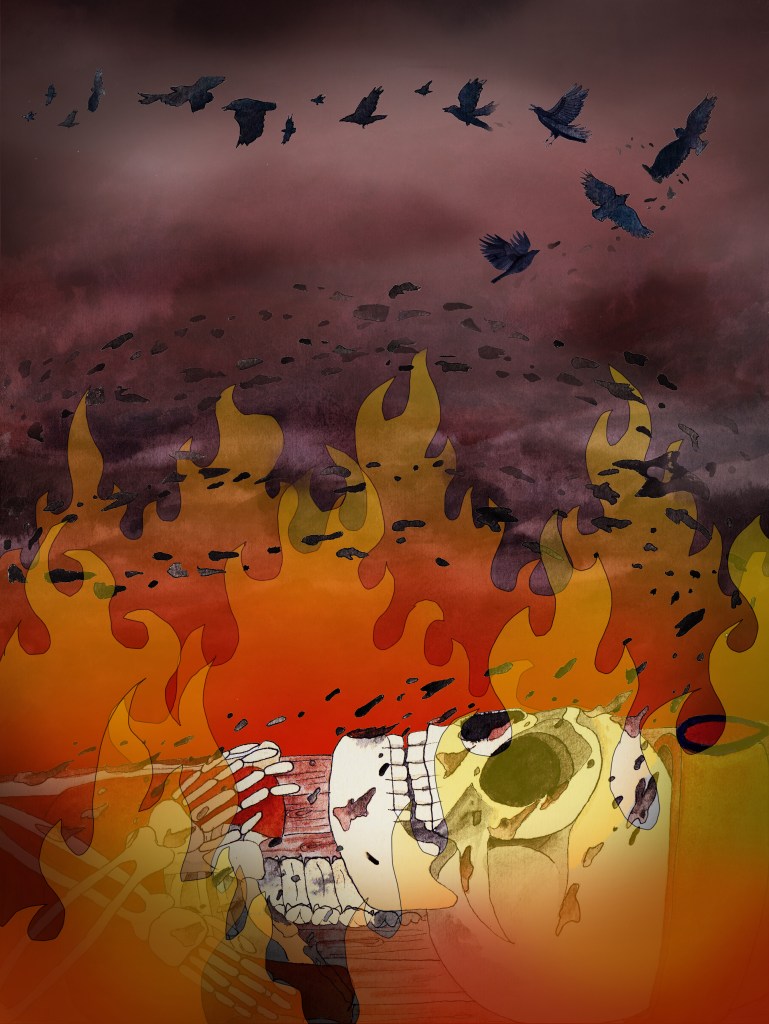
An illustration of the pyre of King Memnon with ashes transforming into birds. By Catherine Masters/wondrousmoon studio.com.
In Shanghai, archaeologists excavated more than 200 “spirit jars” dominated by bird imagery and dated to between 1,700 and 1,900 years ago, each with a unique design. While there are no texts to explain the jar’s function, most scholars believe they were made to contain the souls of the dead. Chinese scholar Kominami Ichirō believes the people depicted on the vessels are conducting a funeral service with help from the painted birds, representing the Hun soul.
In North America, Native American tribes built burial mounds and held sacred ceremonies in which birds played a role in conveying souls to heaven. Cremated human remains were found inside the Rock Eagle Effigy Mound in Putnam County, Georgia, where thousands of quartz stones were arranged in the shape of a raptor, measuring 120 feet from head to tail. Another bird effigy mound known as Rock Hawk is 13 miles to the southeast.
At the Native American city of Cahokia in southern Illinois, some of the 270 people buried in Mound 72 were wrapped in beaded blankets patterned in the shape of a bird, including a bird-head placed near the heads of the deceased. The burial of birds and bird artifacts with human remains may have been intended to infuse the soul of the deceased with the power of flight through the afterlife.
In South Carolina, Native Americans buried a soapstone human-like figurine with wings and a human head in the Chauga Mound, which contained the remains of 30 people. The site showed signs of human habitation dating back 8,000 years.
At Spiro Mound in eastern Oklahoma, one of the most common artifacts found with human burials was a small but detailed “Bird-man” made from copper. In Georgia, the Etowah Indian Mounds contained copper plates showing bird-man “falcon dancers.”
The flight of souls was a concept shared across continents and cultures, but the oldest practice was known as the sky burial, in which vultures consumed humans and flew the soul to heaven. At Çatalhöyük in eastern Turkey, a 9,000-year-old mural shows two vultures pecking at a human head, which was once widely believed to be the seat of the soul. At nearby Göbekli Tepe, a megalith dating back 11,500 years, a carving shows a headless man holding onto a bird that appears to be a vulture. Above that carving is another showing a vulture holding the man’s head in its wings.
In 2014, an archaeological team concluded that villagers in the area had taken the heads of relatives from their graves only to return them sometime later. It’s possible that people brought the heads of the dead to Göbekli Tepe so vultures would peck out the brain/soul and carry it away to the heavens.
Ben H. Gagnon has won awards as a newspaper reporter, editorial writer, documentary filmmaker, long-range city planner, and most recently as a novelist for his work of historical fiction, People of the Flow: A Journey into Ireland’s Ancient Past, published in October 2019. Gagnon has been a speechwriter, a campaign manager for open space, co-producer of the State of the World Conference at the Aspen Institute, and a DJ on public radio in Colorado and Massachusetts. His website, churchofbirds.com, features the colorful work of illustrator Catherine Masters. He lives in Charlemont, MS.
For more details: https://www.collectiveinkbooks.com/moon-books/authors/ben-gagnon
 The Pagan Collective
Leave a comment