

Ask most people what they know about Ireland, and I guarantee two things pop up – our literary heritage and our music. Rarely has a country enshrined the power of the word and sound so completely at the heart of the national identity, from earliest times onwards. Despite cultural upheavals, invasion, oppression and tragedy, the legacy of the poets, the “Filí,” endured, creating both a body of literature and music unique to these shores and a folk tradition that expressed the needs and aspirations of its people.
The name given to this folk magic tradition is Draíocht Ceoil, literally translated as the “Magic of Music,” but incorporating a belief in the transformative and protective power of all kinds of sound. The study of this ancient practice is the history of early Ireland, of the power and status of the Filí (poets) and the Master Harpists, of the Dagda’s Harp and the many gifts of Lugh, or the Caointe (keen) of Brigid at the death of her son. But it is also the study of the history of Ireland, of how the legacy of the Filí and musicians was preserved and encoded, handed down through generations albeit in new forms.
It is the story of how an oppressed, dispossessed people kept large portions of ancient learning intact, preserved music and stories, and handed them down in a largely oral tradition, and how – cut off from legal and medical redress, they used the magic inherited from the past to create a vibrant folk magic tradition. Through it they navigated the liminal spaces of the landscape and negotiated with otherworldly entities, including the Sidhe, using sound. As our land was taken from us, and our rights to ownership of it dissolved, sound energy was used to retain our connection to a scared, and storied landscape.
We can clearly see the survival of ancient poetic and musical forms in the folk magic of the 18th and 19th centuries, and indeed well into the present day. From the ancient art of Satire, both full and “speckled,” the robust traditions of Hexing emerged. From the old poems of praise, healing and warding evolved, and the three strains of music – Goltraí, Geantraí and Suantraí – gave us the power to keen, to alleviate pain and suffering and to promote calm and peace. Non lexical sounds such as humming and whistling could both invite and prevent otherworldly interactions, and the many-layered nuanced language of the ancient Filí can be traced through the folklore of more modern Ireland, in all its magical power.
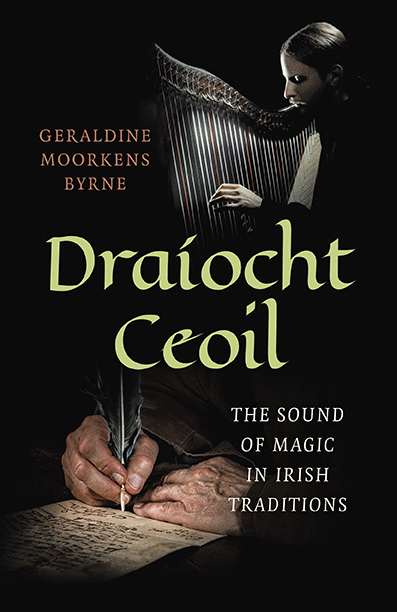
Perhaps most importantly of all, our ancestors made a useful, practical, accessible form of folk magic that can be used as easily today as in the past and that can enrich any personal practice. Our folklore record is filled with interesting stories that illustrate the power of Draíocht Ceoil in the everyday life of people. Draíocht Ceoil is wide-ranging and versatile, used for the most domestic and personal of magic as well as for matters of public and social importance. Mundane tasks, especially repetitive ones like spinning and churning, lent themselves to extemporaneous chanting and singing, allowing the worker to “sing into being” their dreams -perhaps a suitor, or a pregnancy or a good crop. Chanting, humming, and singing are still used today for the same purposes but taking into account the needs of modern life.
On a larger scale the great poetic form of early Ireland, the Rosc, used for public issues including battle magic and legal judgements, remained in used and its importance politically cannot be overstated. It was used to express injustice, and rage against the powerful – just as the Filí had done thousands of years before. Now, in our troubled world, practitioners of Draíocht Ceoil use the same Rosc poetry and related poetic forms to create magical works of activism, to raise awareness and to change the energy of the political landscape.
The power of sound, of music and words used against the tyrannical establishment, played a crucial role in creating a sense of nationality, and pride in our heritage, that was the root of successful political and revolutionary movements in the 19th and 20th centuries. Poets and songwriters intentionally used old magical poetry such as Aisling (dream poetry) to create an image of the future. Against all the odds, this public aspect of Draíocht Ceoil helped shape public opinion, unite disparate factions and build a sense of national identity. Small wonder then, that the Irish belief in the magic of sound has never faltered.
But it remains above all a joyous and creative tradition, fostering an intimate connection to landscape and to the unseen world around us. Draíocht Ceoil encourages us to sing out loud, to make noise, to be heard and at the same time, to listen deeply and hear truths. It doesn’t demand perfection or ritual, but asks us to connect with sound energy, which in our culture is magical energy, and to bring it out into the world.
Writing the story of Draíocht Ceoil has been a journey, linking the modern folk practice to its roots in early Ireland, and while it is tempting to see the glory days of the Filí, with their unrivalled power and exalted status as the highest expression of the practice, I personally lean towards the folk magic of my more immediate ancestors. There is to me something deeply affecting in that heritage, to use tried and trusted methods that saw a poor, but proud, people through their darkest days. I feel it celebrates the tenacity and inventiveness that replaced access to Law with natural magical justice, and that turned to words and music to heal, to protect, and ultimately, to conjure up a vision of a better future.
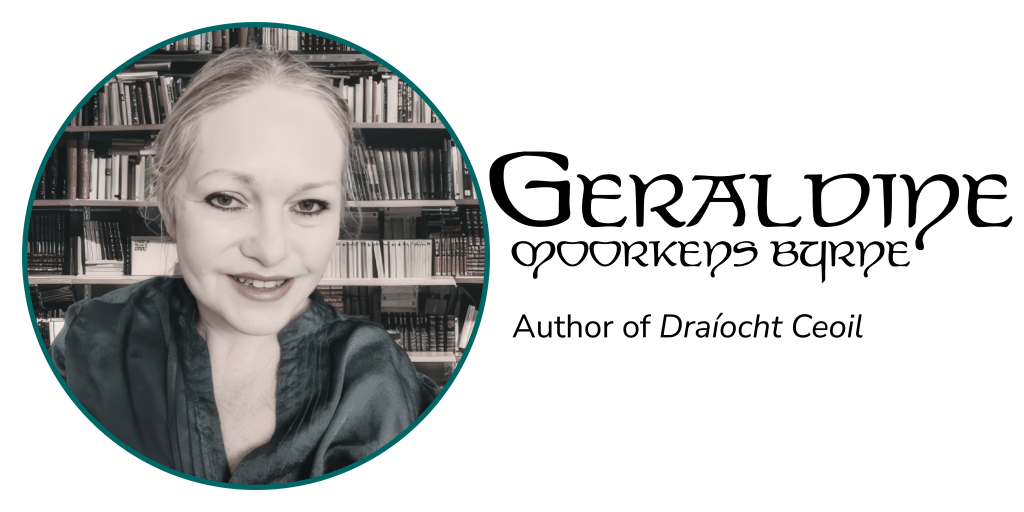
Geraldine Moorkens Byrne is a well-known poet and writer, as well as an educator in Irish Folk Magic Traditions and Ceremony writer; she was a founding editor of the Pagan Poetry Pages. She has facilitated workshops and creative writing groups. Her work has been published in a variety of media from print anthologies to Ezines, including Poems from a Lockdown, and her poem “Where Once Were Warriors “was the title-piece of Asia Geographic Tribes edition. Several poems have been performed as theatre in Ireland, the UK and USA. She was a prizewinner in the Inaugural John Creedon Listowel Writers Festival Competition. Her short story “A Stranger Among Friends,” was a winner in the Cunningham Short Story Competition. She is also the author of a popular series of mystery novels. Her collection of poetry “Dreams of Reality” is available now.
She was the fourth generation of Byrnes to run the famous Charles Byrne Music Shop, in Stephen Street Dublin Ireland. This was a landmark business in the city of Dublin and an integral part of Irish classical and traditional music for 150 years.
For more details: https://www.collectiveinkbooks.com/moon-books/authors/geraldine-moorkens-byrne

 The Pagan Collective
Leave a comment