

While the idea of worship seems complicated and even dull, Hestia was worshiped in the mundane, but essential, moments of life. She would witness the preparation of meals by families at the hearth, which was the religious focus of a home and also the place of offerings and sacrifices.
But the hearth was not just for cooking. It was also a place for rituals around birth and death. In celebration of a birth, a baby would be carried around the hearth and new household members would be bathed in nuts and figs while sitting in front of the hearth as Hestia’s blessings. When someone died, the fire would be put out and then lit again to honor the death.
Women were the ones who typically watched over the fire, ensuring it never went out. If the fire did go out for some reason, it was thought this was a sign that Hestia removed Her favor from the family. To light the fire again, the family could go to the public hearth to get an ember.
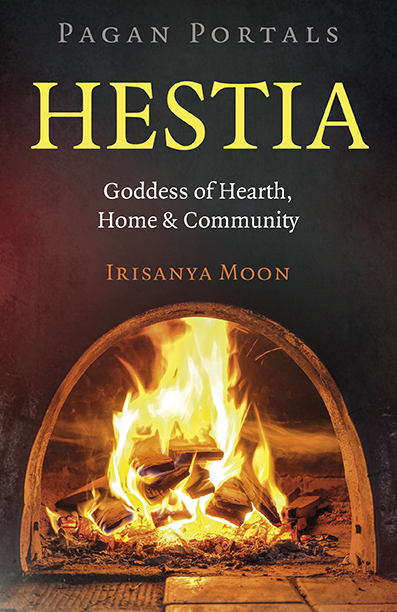
Hamilton writes that every meal began and ended with an offering to Hestia (37):
“Hestia, in all dwellings of men and immortals
Yours is the highest honor, the sweet wine offered
First and last at the feast, poured out to you duly.
Never without you can gods or mortals hold banquet.”
The everyday life of the Greeks centered on family and togetherness, not only for nostalgia, but also for survival. The fire was necessary for food and life. Hestia was at the center of that, and some have even noted that the very idea of having a hearth in a home comes from Her worship.
Traditions with Hestia
Birth and Marriage
“One of the most characteristic manifestations of Greek sacred space was the hestia, the circular hearth which formed the center of the house and around which various rites such as marriage and the deposition of the infant took place. The hestia was also the seat of the goddess Hestia who accordingly symbolized the solidity and immobility of the cosmos as well as the centeredness of enclosed, domestic space. Not only did the hestia anchor the house to the earth but through the roof opening over it the god’s portion of the meals cooked on the hearth rose to the world above.”[1]
People gave birth and were married around the hearth, and as Hestia is the hearth, she witnessed these rites and blessed them with her presence.
“….Hestia came to represent the sacred bond of family (as understood by its members). To that end, ‘children, brides, and slaves were formally accepted into the family by being led to or around the hearth, often in a shower of dried fruits and nuts, a ceremony no doubt performed by the father with all the other family members present.’” [2]
Again, we see that those who entered into a family (willingly or not) were taken to the hearth to be blessed in this transition.
There is also the celebration of Amphidromia[3], when a child would be presented to Hestia five to seven days after their birth, as many children died before they were seven days old. The child would be carried around Hestia’s hearth to be presented to the gods of the house and the family. Members of the family often brought gifts, and the house would be decorated with olive branches if the child was a boy and with wool garlands if the child was a girl.
Mourning
“The Hestia of the home was always extinguished on an occasion of mourning, if the latter signified at the same time the end of a household, the death of a family, the abandonment of a location, and the dispersion of those who had formerly constituted the household”
(Paris 168).
Since the hearth is the embodiment of the health of a family, when someone died, it makes sense that the flame was put out then too. The flame would be lit again after a period of mourning, but if the person was the end of the family or the home was no longer going to be lived in by that family, the flame was put out for good.
Hestia could go to a new place, but Her part in that particular family would be complete.

Irisanya Moon (she/they) is a Witch, author, priestess, international teacher, and initiate in the Reclaiming tradition, who is devoted to Aphrodite, Iris, Hecate, and the Norns. She has written 10+ books for Moon Books, including the recently published “Hestia: Goddess of Hearth, Home & Community.” You can find out more at their website: www.irisanyamoon.com
For more details: https://www.collectiveinkbooks.com/moon-books/authors/irisanya-moon
An excerpt from Hestia: Goddess of Hearth, Home & Community
[1] https://www.newworldencyclopedia.org/entry/Hestia#cite_ref-18
[2] https://www.newworldencyclopedia.org/entry/Hestia#cite_ref-19
[3] https://en.wikipedia.org/wiki/Amphidromia

 The Pagan Collective
Leave a comment