

These Pagan Portals are all current works in progress, serialised here on the Pagan Collective blog with each chapter being open for comment. In due course the entire script will be published as a Pagan Portal book.
Chapter 1 – An Eye for an Eye – First Sightings
In this wide and wonderful world are an infinity of things. And, of those things, some may be classed as ‘magical’.
Although from a mystical perspective, everything is such – what’s a cooking pot but a tool of transmutation? What’s a daisy but a white-petalled wheel reminding us of beauty? – Some of the objects around us may be used as instruments not just for cooking, but also as an adornment, etc., but instead (or additionally) as aids in those practices which draw us towards a realisation of the inherent magic in everything, including ourselves.
Through the use of these items, we conduct rituals, practice meditation, go on spiritual journeys, and expand our self-awareness, coming to the conclusion that we are not a ‘thing’, either, but an immortal soul, set for a time in a physical body. These tools help us grow towards a remembrance of who and what we really are.
In this attempt at a definition, one man’s wand might be another gal’s walking stick; but there isn’t space in this slim volume to elaborate or explore definitions in depth. Whatever your definition of magic, it is probably similar to mine, although your path might be very different. The magical instruments we use, also, are many, whether that’s the warlock’s staff, the witch’s cauldron, the seer’s stones, the scryer’s mirror, the occultist’s grimoire, the shaman’s rattle, the priestess’s chalice, etc., blurring along the boundaries of shared meaning and symbolism to encompass the poet’s pen, the cook’s spoon, the walker’s compass, and so on. If we were going to fit a shop with magic(k)al items, we all know what would be in there, I think.
The elemental essence of such items is interesting, whether they are vessels for holding water, working fire, embodying the attributes of earth or using air for a purpose, such as making sound with a flute, gong, or drum. Many of these instruments are manmade: fashioned from the materials of earth into artefacts. The raw form of wood becomes an altar; stone is fashioned into a font; glass makes for the windows, and so on, until a temple rises from the ground.
Some items are manipulated to a lesser degree, however: crystals, bones, herbs, shells, wands and staffs that are ‘found’ rather than carved. And, beyond these categories – the manmade and the ‘natural’ – there are some other objects which are also obviously ‘fashioned’, this time by nature’s more unusual machinations as well as by non-humans hands: the more unique wands and staffs, perhaps; and then on to creations such as mermaid’s purses; insect galls; birds’ nests; amber; and other items formed by animals, their processes and as part of their lives.
Shifting into a space that blends between these two latter categories – the raw, nature-created form, and the animal-made – sits the hagstone, our object of focus in this introductory guide.
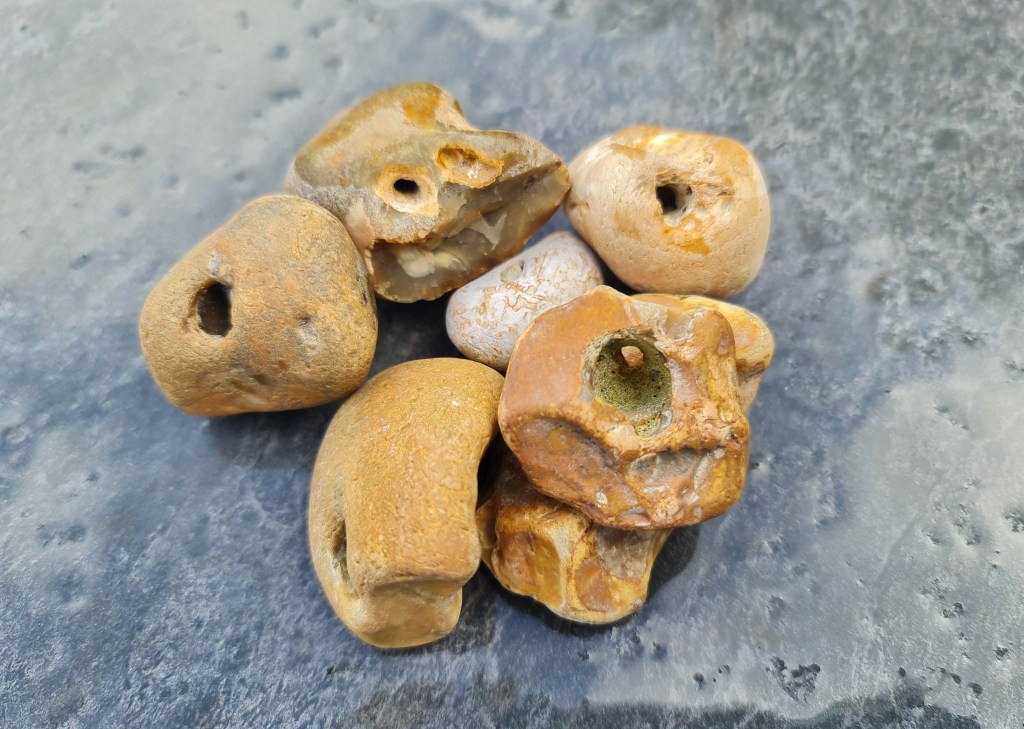
“The stone that saw me first” – my first encounters with hagstones
I first consciously encountered hagstones over a decade ago; perhaps more towards two decades. They were, for this seaside dweller, just something that was always there at the edge of the estuary where I live in South Wales. I remember, some years ago, telling my mother that hagstones were magical objects, and that you could find them by going to a beach and expecting to find them; a kind of manifestation practice that I like to indulge in, sometimes (the other thing I like to experiment with is four leaf clovers, of which I have a small collection, these days).
My mother tried the technique – of expecting the hagstones to be there; of feeling happy in advance for the finding – and was pleased to pick up many on her beach visit. I mean, perhaps where she went there were plenty of hagstones already… Perhaps this is more about focusing the mind and eye, rather than wishing things into existence… But, this was what happened, and it was as a result of my own first (conscious) contact with hagstones, which took place on Llantwit Major beach in the Vale of Glamorgan.
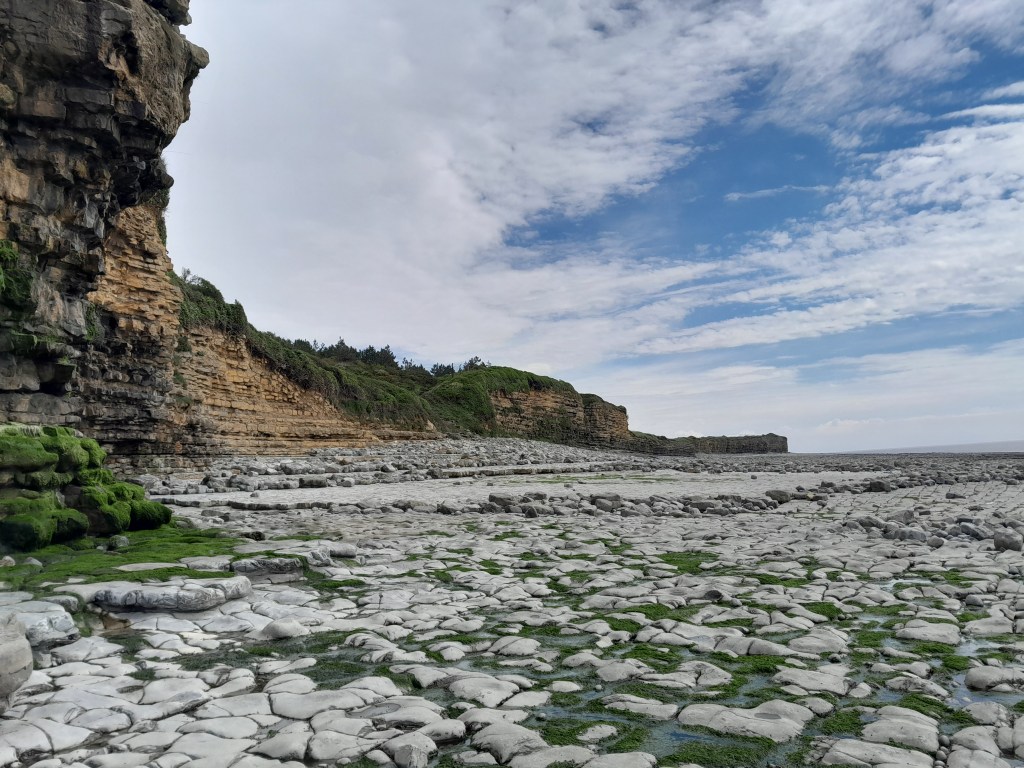
The day that sealed my connection (now, passion!) was not one of tickling sun and cooing breeze. It was an afternoon of bruise-purple cloud and a restless, churning sea that spat its foam towards us on the shore. The wind had bite – that proper Welsh coastal wind that seeps, soup-like, into your bones, reminding you that you are a very small, soft, easily blown-out thing in a world rippling with powerful, muscular forces. I wasn’t walking with any great purpose on this particular day; I was just wanting to let the weather scour my thoughts, and to feel the clear, cleansing energy of this spot by the sea that is windy, stony, shell-studded, and – to me – beautifully bleak.
The Vale here possesses what’s known as a ‘fossil coastline’: its cliffs and shorelines expose extensive layers of sedimentary rock – mainly limestones, shales, and sandstones – that were laid down in the Jurassic and Triassic periods 200 million years ago. These rocks contain abundant fossils formed by marine life, such as ammonites, corals, and brachiopods; they even sport dinosaur footprints in some spots. It’s not unusual to find them. I am the owner of a fantastic fossil assortment (don’t we all, who live by such interesting shores…?) – on my shelves sits a private museum of spirals, swirls, and ridges that speaks of deep time.
But the hagstone isn’t a glamorous fossil thing; it wasn’t made by ancient monsters. Next to the toe print of a long-dead something-o-saurus, pebbles and pieces of rock with bits missing are far less glamorous. On that windswept day, however, I wasn’t looking for the grand philosophical statements of geological aeons: I was hunched, strolling headfirst against the wind, my eyes scanning the shingle at my feet, immersed in a kind of walking meditation. I had already been collecting fossils and – at the manmade end of the spectrum of things – seaglass. And that’s when I saw it. Or, more accurately, that’s when it saw me…!
It wasn’t huge – no bigger than the palm of my hand. It was a smooth, grey, unassuming stone, reasonably flat: the kind you’d skip across water without a second thought, except for the hole. The hole, well, that was just perfect. Not a chip or a crack, but a clean, smooth, and straight tunnel right through its centre, as if a cosmic drill had passed right through it. As I bent to pick it up, the wind seemed to quieten for a moment. The stone was cold and heavy, solid and real. I lifted it to my eye, instinctively, and peered through.
The world on the other side was the same… yet different. The grey sea, the scudding clouds, the dark shoulders of the cliffs – they were all framed, contained, and somehow clarified by the stone’s small aperture. It was like looking through a keyhole into the secret heart of the land. In that moment, this object ceased to be a mere stone for me. It was a lens; a portal; a point of focus. It felt less like I had found a thing and more like I had been given a tool – a key to a different way of seeing. This stone had been waiting, not just for someone to pick it up, but for someone to look through it. It was an invitation, I now believe, and through my responsive actions, I had made an acceptance.
I warmly invite you to do the same!
Natural formation and mythic backstories
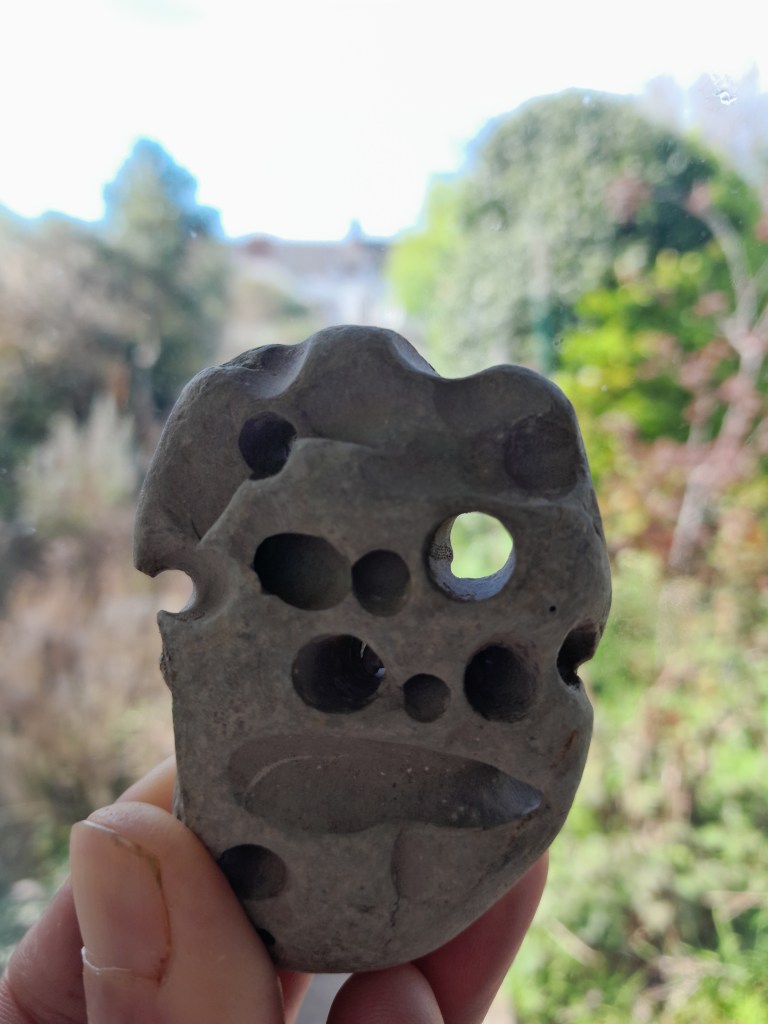
That single, profound experience sent me down a rabbit hole – or piddock hole, might be a better analogy! What was this object? How was it made? And why did it feel so deeply, undeniably magical? The answers, I discovered, are a beautiful blend of the mundane and the mythical. A hagstone is, quite simply, a stone with a naturally occurring hole through it. But the story of how that hole gets there in the first place is a kind of legerdemain in itself!
Although hagstones may be formed by purely geological processes – the ceaseless movement of water, or “coarse sand and/or smaller stones repeatedly grinding into a stone’s surface” (Drbeachcomb, 2017) – they are often creature-created. And, whilst in the UK, local “rock borers include bristle worms and a yellow sponge” (Barrett & Yonge, 1985), the architect of my Llantwit Major stone, and many others found on our South Walian shores, is a humble sea critter called a piddock. The piddock, classified as a bivalve mollusc, is a master of patient craftsmanship. These unassuming, clam-like creatures possess shells with rough, file-like ridges. When they are young, they find a suitable piece of soft rock, like clay or sandstone, and begin to burrow.
Using a combination of rocking motions with their shell and a weak acid secretion, they slowly, painstakingly, grind their way into the stone, creating a permanent home from which they will never leave. They are nature’s tiny anchorites, in a sense: holy hermits sealed inside cells of their own making, for a piddock “will never be able to back out of the tiny entrance it made when it first colonised the rock” (Cleave, 1984). Piddocks live out their existence filter-feeding through siphons that reach out into the seawater, protected from predators by the very stone they have hollowed out. When the piddock dies, its soft body decays and, eventually, the sea may break the stone, revealing the perfectly bored tunnel it left behind. The hagstone is its legacy – the ghostly remnant of a life lived in slow, determined industry.
The animal origin of a hagstone lends it a different energetic feel. It is not just an object of elemental force, shaped by the grand, impersonal power of the sea – it is also an animal artefact, imbued with life force from a living being. It speaks of the creature’s persistence; of its work to create a home, hollowing out safety; of slow and steady work. A hagstone thereby connects us to hidden lives in the world, those of smaller creatures going about their purpose. It’s no wonder that worm-holed pieces of wood are also considered magically potent in many traditions – despite their seeming inanity, they are records, sometimes of an entire life’s journey.
This natural wonder is where myth and folklore rush in to provide a deeper layer of meaning. Such stones have been collected and treasured by coastal peoples for millennia. They are known by many names, each carrying a fragment of a story. In English, they are hagstones, witch stones, wish stones, fairy stones, hex stones, holy/holey stones, ring stones, serpents’ / snakes’ eggs, eye stones, or adder stones. In Welsh, we know them as glain neidr (snake glass / gem / jewel), again linking them to serpents (neidr) and druidic lore, a name that’s echoed in Scots Gaelic, where they are known as gloine nan druidh (druid’s glass). In Cornish, they are milpreve; further afield, in Egyptian culture, they are aggry / aggri. In parts of Scandinavia, they are Odin stones. In Russia, they are associated with spirits (kurinyi bog / Куриный Бог – chicken god), and in Germany they are similarly called ‘chicken gods’ (Hühnergötter) and believed to protect livestock. Other names exist in other places, no doubt.
For us, the name ‘hagstone’ is significant. The ‘hag’ is not the ugly caricature of fairy tales, but also the crone – the wise woman – who holds in her the wisdom of the earth. To possess a hagstone was to hold a piece of this witch’s potency. A central belief, common across nearly all cultures, is that these stones are protective amulets. The hole is the key to their power. It was believed that malevolent magic, curses, or evil spirits could not pass through running water, and the hole in the stone, created by water, carried that same protective quality. A hagstone hung by a door would prevent a malevolent witch from entering (!). Tied to the head of a bed, it would prevent the ‘night-hag’ from visiting and causing nightmares. Farmers hung them up in barns to protect livestock, especially horses, from being ‘hag-ridden’ and found sweating and exhausted in the morning. Sailors would nail them to the masts of ships to ward off evil spirits and the subsequent storms they thought would follow.
The other primary mythic function of the hagstone is as a tool of sight. Just as I did instinctively on that beach, folklore tells us to look through the hole. Why? Because it is said that looking through a hagstone allows you to see things as they truly are. It peels back the glamour and illusion of the world, allowing one to see into the faerie realm, spot disguised spirits, or perceive the truth of a person’s intentions. It is a spyglass into the Otherworld. This belief may stem from the simple optical effect of focusing the eye, but its metaphorical power is immense. It teaches us to narrow our focus, look past distractions, and focus in on the hidden reality shimmering just beneath the surface of the mundane, which is always, always there.
The slow ritual of stone creation
Contemplating the birth of a hagstone is a meditation in and of itself. Consider the two potential paths of its creation: in the first, there is the endless, percussive rhythm of the sea. A wave lifts a piece of sand, or a small, speck-like sliver of pebble, and smashes it against a larger stone. It does this again, and again, and again. For a day, a month, a year. For a century… A millennium! The water and the grit worry away at a single point of weakness – some softer inclusion in the rock – until a microscopic pit becomes a dent, the dent becomes a hollow, and the hollow, after an unimaginable span of time, finally becomes a hole.
This is the magic of persistence. It is the wisdom of water, which knows that, given enough time, it can wear down anything. It is a testament to the power of slow, repeated action. In our own lives, how often do we seek the lightning-flash of inspiration, the instant result? In this on-demand, everything-instant age, very often. The hagstone reminds us that the most profound transformations are often also the slowest. The steady drip of daily practice, the patient application of will, the refusal to give up – this is how we carve a tunnel through the rock of our own limitations; our own circumstantial life situation. This is the ancestral craft of becoming.
Then there is the piddock. A tiny, vulnerable creature, finding its place in the world and painstakingly carving out a space of safety, its entire life is a single, focused act of creation. It doesn’t rush. It doesn’t doubt! It simply does the work it was born to do, day after day, grinding its shell against the cold, hard stone. The resulting hole is not a void, but, in many ways, a presence – the physical memory of a life dedicated to a single, astounding task.
This parallels the path of the artisan, the witch, the mystic, etc. We choose our stone – our craft, our path, our tradition (and it chooses us!) – and we begin to work. We pour our life, our breath, the whole of our being and focus into it. We create our own sacred space within the world, whether that is a physical place or just the frame of our own (energy) bodies; either way, it is a hallowed home that we fill with safety and serenity, power and peacefulness, eked into existence by our own determined efforts. Like the piddock, we may be hidden from view, but the work always continues! The magic is not in the finished product alone, but in the ten million small, repetitive actions that brought it into being: the chant repeated, the herb tended, the symbol drawn, the circle cast time and again. The meditation, in my case, and the listening to the symbolism of the world each day, noting its wind, leaf, insect, animal, totem, token, song, or whatever it is. For all of us, this work is slow magic. It echoes the deep, ancestral rhythm of creation, and I would say that the hagstone is its humble yet perfect honed emblem.
A brief overview of magical properties
To hold a hagstone is to hold in one’s hand a story of time, water, land, patience, slow creation, and magic. Bringing this item into your practice is to invite these energies into your life. Whilst the best way to understand such a stone’s power is to sit with it, listen to it, and build your own relationship, tradition offers us a map of potential uses that may assist us. Think of these not as rigid rules, but as starting points for your own exploration.
- Protection: This is the hagstone’s most famous virtue. Hung over a doorway or window, it acts as a spiritual filter, preventing negative or unwanted energies from entering your home. Kept in a car, it is a talisman for safe travel. Worn around the neck, it protects your personal energy field from harm, like a small, portable shield. It has been used as a protection against nosebleeds, lightning, and for livestock (King, 2021). Although historically it was “employed as an amulet against witches and evil spirits” (Pymm, 2017), this speaks of past misunderstanding as to what a witch is, and hagstones may of course be used by witches, and anyone else, as a protective aid.
- Truth-Seeing and Scrying: As a portal to the ‘true’ nature of things, the hagstone is an invaluable tool for divination. Peer through its hole at a candle flame, a bowl of water, or the moon to aid in scrying. Use it during a tarot or oracle card reading, placing it on a card you wish to understand more deeply. If you feel a situation or person is deceptive, quietly look towards them through the stone (either physically or in your mind’s eye) and ask for clarity.
- Healing and Renewal: Formed by water, the hagstone has a deep connection to this element’s powers of healing, cleansing, and emotional clearing. Place it in bathwater to create a purifying soak. Hold it over aching parts of the body and visualise the clear, cleansing energy of water flowing through the stone and into you, washing away any pain.
- Connecting with Ancestors and Spirits: As a key to the Otherworld, the hagstone can be a powerful aid in ancestral work or spirit communication. Place it on your altar or hold it during meditation to act as a focused gateway, a safe, psychic telephone line to those you wish to contact.
- Weather Magic: For those who work with the elements, the hagstone is a tool of connection. It is said that by tying a string through the stone and whirling it around your head, you can summon wind or disperse fog. At the very least, it is a powerful way to feel the movement of air and connect with the spirit of the wind.
- Oaths and Promises: The act of passing something through the hole of a hagstone can be used to seal a pact or promise. If you make an oath to yourself, speak it aloud whilst passing a piece of thread or a blade of grass through the hole, symbolically binding your word. The stone may be worn as a bracelet or necklace, reminding you of your oath, if useful.
This is just the beginning, and some ideas for you to consider. Your stone may have other stories to tell you; other gifts to offer. It has travelled through so much slow time to find you. The least we can all do is listen to what these astonishing artefacts have to say to us.

Mab Jones is a “unique talent” (The Times) who has read her work all over the UK, in the US, France, Ireland and Japan. She is the winner of many awards and accolades, including the John Tripp Spoken Poetry Audience Award, the Word Factory Neil Gaiman Short Story competition, the Wolverhampton Literature Festival Poetry Prize, the Aurora Poetry Prize, the Rabbit Heart Poetry Film Festival Grand Jury Prize, and the Geoff Stevens Memorial Poetry Prize, amongst others.
Mab has made and presented several BBC radio programmes with a poetic theme, and has also appeared on BBC television. She has written for the New York Times, was coordinator of International Dylan Thomas Day, and was, for a time, the social media manager for world famous writer Wilbur Smith. As a poet, she is the author of three published collections and three pamphlets. She additionally runs two small presses, and has been publishing since she was a teenager.
Bog Witch is Mab’s first book of prose, inspired by her ongoing residency in Cardiff Wetlands and her associated podcast which encompasses all the wetlands of Wales. This work was also supported by a Royal Society of Literature ‘Literature Matters’ Award. As well as following an individual and often eclectic spiritual path, she also enjoys comedy, crochet, crafts, costume jewellery, colour, and cooking. Mab hails from Wales.
- Barrett, J.H. and Yonge, C.M. (1985) Collins Pocket Guide to the sea-shore. London: Collins.
- Cleave, A. (1984) Watching Seashore Life. London: Collins.
- Drbeachcomb (2017) Hag stones, Dr. Beachcomb. Available at: https://drbeachcomb.wordpress.com/2017/12/05/hag-stones/.
- King, V. (2021). Hag Stones and Lucky Charms. [online] Horniman Museum and Gardens. Available at: https://www.horniman.ac.uk/story/hag-stones-and-lucky-charms/.
- Pymm, R. (2017) ‘“A charm to impose on the vulgar”: the medicinal and magical applications of the snakestone bead within the British Isles’, Geological Society, London, Special Publications, 452(1). doi:10.1144/sp452.
For more information: https://www.collectiveinkbooks.com/moon-books/authors/mab-jones
 The Pagan Collective
Leave a comment