
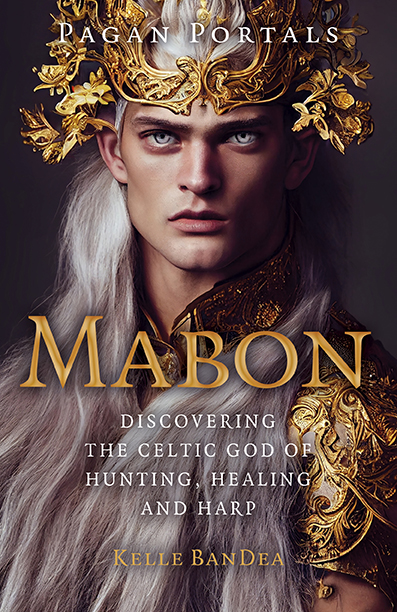
Looking for the potential, naturalistic underpinnings of myth is something I find fascinating, and while I was researching for my book for Moon Books, Mabon; Discovering the Celtic God of Hunting, Healing and Harp, I came across the myth of the Oldest Animals.
In the Welsh text Y Mabinogi, Arthur (yes, that Arthur) and his men ask five animals for Mabon’s whereabouts. These are three birds: a blackbird, an owl and an eagle, then a stag and finally a salmon.
There is something strange about these animals (other than the fact that they can talk!) They are all ancient; unbelievably so, and each one that they encounter is older still. Yet none of them are older than Mabon’s imprisonment, a fact which tells us, regardless of the actual given location of Gloucester, that Mabon’s incarceration takes place in the mythical Otherworld, out of ordinary time. Mabon’s imprisonment is ancient, and yet he is forever a youth.
Legends of the oldest animals are found in many cultures, and one of the oldest versions is found in the Jataka, the mythical birth stories of the Buddha. In it, a partridge, a monkey and an elephant are the oldest animals, and it is revealed that the partridge – the most ancient of the three – is the Buddha himself.
In Ireland, a group of stories describes animals surviving the Biblical flood in order to be able to relate the history of Ireland’s mythical invasions from the Fomorians to the Milesians. In a 1981 paper by Michael Bath, he discusses a Hesiodic fragment which uses the Oldest Animals motif and the theory that it originated as a proverb, one which had hardened into a literary form by the time Hesiod was writing. Hesiod’s oldest animals are crows, ravens, stags and phoenixes.
Birds, stags and salmon are common across the Classical and Celtic versions, as are dogs, horses, and to add variety, oak trees. Which animal is the oldest varies across the tales, but as Bath points out, enough medieval and Renaissance authors, including Milton and Donne, alluded to the Oldest Animals to show that by this time, knowledge of the motif was commonplace.
In the Triads of the Island of Britain, Triad 92 lists the ‘Three Elders of the World’ as ‘the Owl of Cwm Cowlwyd, the Eagle of Gwernabwy and the Blackbird of Celli Gadarn. The Irish Book of Linsmore has;
Three lifetimes of theStag for the Blackbird
Three lifetimes of the Blackbird for the Eagle
Three lifetimes of the Eagle for the Salmon
Three lifetimes of the Salmon for the Yew
There are also other tales where these animals appear in a similar fashion; one is ‘The Ancients of the World’ in The Welsh Fairy Book, a 1908 collection of folklore. Again, they are consulted to find a specific person or piece of knowledge, and again, they are poetic in their descriptions of just how ancient they are. In this tale, the order of age is slightly different, with the Owl of Cwm Cowlyd being the oldest. There is also another ancient animal listed, the Toad of Cors.
The ‘oldest animals’ may change with each telling, but clearly the core features of the tale itself are as ancient as the creatures claim to be.
So, what’s the significance? The fact that this motif appears across cultures tells us that there’s something important going on here. It’s been suggested as anything from a ‘Just So’ style folktale to a metaphor for shamanic initiation to alluding to reincarnation across species. While all of these are possible, I’ve come to read it as being about something else.
Evolution and planetary age.
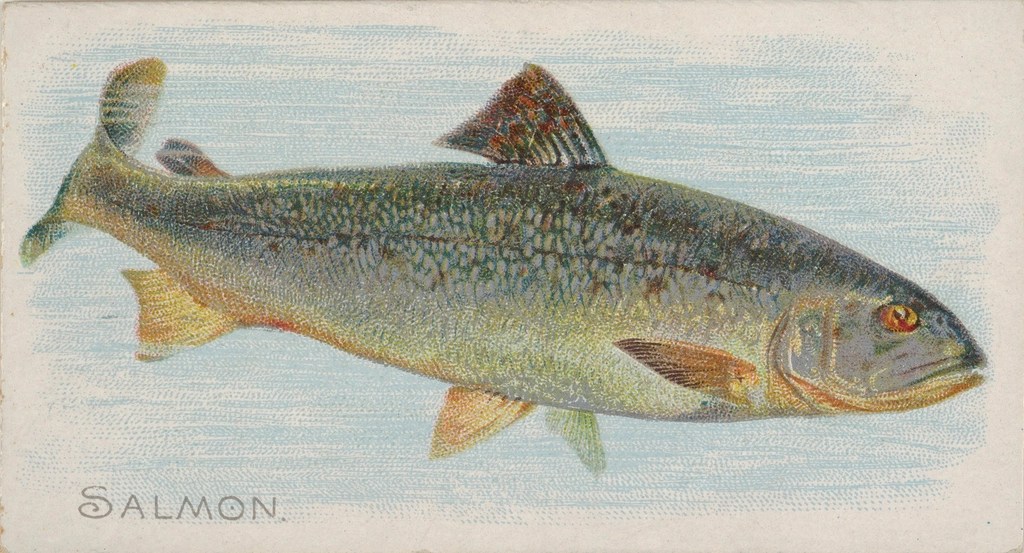
While not all of the tales have the evolutionary order correct (and we can hardly expect them to, given the limited knowledge of our ancestors), there’s a recognition that these animal species have been around for an incredibly long time, longer than humans, and some species have been around longer than others. There’s no omnipotent creator god here, fashioning them out of whole clay for the use of the superior human, but rather a recognition that these creatures have been around a lot longer than us. With that comes the realisation that the world is far, far older than we can imagine. In the Mabon story, the Salmon is the oldest animal (the others are three types of bird and a stag), and he describes himself as
I came here a long time ago, and when I first came here, I had a rock, and from its top I would peck at the stars every evening. Now it’s not a hands-breadth in sight.
This hints at a better understanding of the age of stone that we might expect medieval scribes to have had.
But if the Oldest Animals, in my telling, is about evolution and the age of the Earth, where does that leave Mabon himself? In the story, he’s a Divine Youth who has been imprisoned and needs to be set free. It’s often read by modern Druids as a metaphor for the Winter Solstice, of the light in the darkness and the sun being reborn.
Well, if the Oldest Animals (and plants, in the case of the yew) are taking us right back to the birth of our planet, or to the beginning of life, then surely Mabon is the spark of life, that mysterious event that began the entire evolutionary tree? Or even before that, the Big Bang, which brings time itself into existence? The light in the darkness which birthed us all?
Myths are not static; they grow and change with each telling. Whatever the ancestors who originally came up with this story were trying to tell us, we can never be sure of. But there is timeless wisdom in some of the old tales, if we look for it.
Perhaps the biggest lesson we can take from the Oldest Animals in the age of the Anthropocene is to remember that humans are not the pinnacle of creation, but simply a stage in one long chain of life.
Kelle BanDea is a neurodivergent mother of three with Traveller heritage. She currently lives in Warwickshire in the UK with her partner, children and a varied assortment of animals. She has postgraduate degrees in Feminist Theology and Creative Writing and you can find more of her work at kellebandea@substack.com
For more details: https://www.collectiveinkbooks.com/moon-books/authors/kelle-ban-dea
Sources:
Bath, Michael Donne’s Anatomy of the World and the Legend of the Oldest Animals (1981) The Review of English Studies Vol 32 Number 127 pp302-308 https://www.jstor.org/stable/515167 accessed 12/11/23
Bromwich, Rachel (ed) Trioedd Ynys Prydein: The Triads of the Island of Britain (2006) University of Wales Press
Davies, Sioned (ed) The Mabinogion (2007) Oxford World Classics
 The Pagan Collective
Leave a comment