

From my research, I discovered that Brigantia was a sacred deity to both the warring Celts as well as the Romans, specifically during the rule of Emperor Severus. She was the goddess of the land in both Celtic and Roman cultures. For these reasons, I strongly associate her with the element of earth. For the British Celts, she was the goddess of the Brigantes, a tribe of the north and was the name used by the Romans to rename the lands of Britannia. In her most primal earthly association, I sense a wild woman energy with Brigantia. As a deity of the land, I regard her as a tribal, territorial goddess. I also deem her energy as the land. She is of the trees, crystals, mountain tops, hill tops, groves, bushes and plants. If I were to give her an image, I imagine her wearing the fur of the hunt around her shoulders and her head adorned with antlers. I envision Brigantia to have the unmistakable flaming red hair associated with Brigid, and it is as wild and messy as can be. On her face, I imagine blue paint, smeared and revealing of her wild, vivacious personality. This is, however, but one aspect of her persona. It is the part that is Gaulish and British Celtic. But she is more than that. She is also imperial.
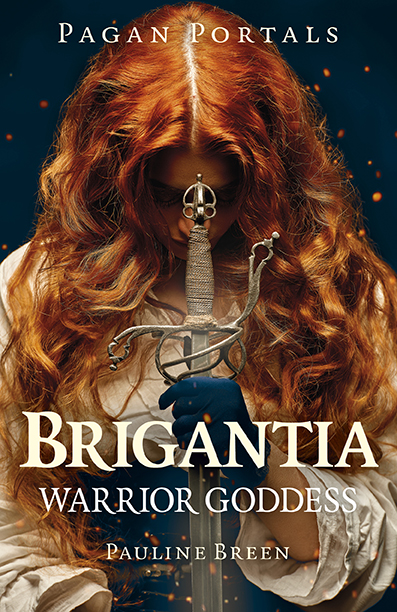
In her Roman capacity, we meet a classical deity. One who is wise, confident and noble but can easily declare war. For the Romans, Brigantia was equated with victory over new lands conquered. Immediately, as her name covers firstly a tribe, the Brigantes, and then the entire nation, Britannia, we can instantly see a surge in her power and status, made possible, perhaps, because of the Roman spotlight on her. Her greatness from regional to national goddess is possibly indicative of her expansive and ever-growing power at the hands of the Romans or demonstrative to the people that, under Roman rule, they too could evolve, grow, and prosper.
Brigantia as goddess of the land to both Celtic and Roman cults may indeed stem from the manifestation of the great mother goddess brought into Britain through the Belgae, Goidels and the Gauls. Her mother goddess energy may also have come with the Romans through Isis, who had been assimilated into Roman culture. Regardless of the mother goddess origins, Brigantia, as a mother goddess figure, was common to both cults, and her identity as such was closely connected to the land.
Even though we have similarities between Britain and Rome, we can see the differences between Celtic and classical. The first difference contained within Brigantia is the existence of a mother and war goddess. The two may at first seem contradictory or at odds with each other, but in fact, it is the same maternal energy that supports as well as defends. As we will later see, the energy of Brigantia contains the maternal and the military. They are fused together from two separate cults that inflate her and project her forward to give us the powerful archetype of warrior queen, defender and slayer of all that she loves to the nth degree. Brigantia, belonging to two worlds, is the balance of both worlds of female and male energy. She is a giver and taker, nurturer and defender, creator and destroyer. As mother goddess, she is the birther of humanity, and as war goddess she is the force of continued life for the tribe, nation and Earth, which was important for both the Celts and the Romans. She shows us with confidence, that she is, in addition to the bountiful, abundant mother goddess, that she is also the reactive, defensive, territorial goddess that will not stay quiet or stay seated when her boundaries are pushed.
For more details: https://www.collectiveinkbooks.com/moon-books/authors/pauline-breen
For Pauline, Brigid is an expression of the Great Mother Goddess. Pauline is passionate about showing the various faces of Brigid that are often overlooked. Pauline is the author of three books on Brigid. In her first book ‘This is Brigid – Goddess & Saint of Ireland’ Pauline introduces Brigid in her original, pagan form as mother goddess and then as Christian saint. She considers both versions and shows the interplay between both cults. She suggests many ways to connect to Brigid through her symbols, numbers, animals and practices on her feast day of February the 1st associated with the goddess and the Saint. In her second book ‘Maman Brigitte – Dark Goddess of Africa and Ireland’ Pauline shows another lesser known face of Brigid, a vodou deity that came forth into being during the hardship of slavery. Maman Brigitte is also a blended deity from indigenous African deities and Brigid of Ireland. In her third book ‘Brigantia – Warrior Goddess’, Pauline questions whether the migrating Brigantes tribes of northern England brought Brigid into Ireland, as we know her today. Pauline hopes that showcasing all sides of Brigid that includes her side as dark goddess and warrior goddess, from historical. archaelogical and linguistic sources will enable even more people to connect to Brigid.
 The Pagan Collective
Leave a comment