

While many gods and goddesses are known to oversee specific areas of focus, it is important to remember that few, if any, are known simply for a single role. This is just as true for Frigg as it is for any other deity. What she is no doubt most famous for is her role as both a wife and mother. However, her influence far exceeds these functions that are defined by her relationship with someone else. Certainly, she can be sought for her wisdom on these important matters and will offer superior guidance, to be sure. Personally, these are not really aspects that I can attest to, but she can be honoured for a diverse array of other strengths as well. She is a healer, a goddess of love, and in modern times she is seen as a goddess of hearth and home. These various aspects, or roles, are known through the lore as well as the personal experiences of those who honour her in their practice today.
The guise of Frigg as a goddess of children and mothers is probably best illustrated in the tale involving the actions leading up to and after the death of her beloved son Balder. This story is told in section 49 of Gylfaginning of the Prose Edda. In this tale, Frigg, having learned of Balder’s dreams of impending death, sets out on the journey to ask oaths of everyone and everything not to injure her son and thus rendering Balder invulnerable. Unfortunately, Frigg failed to ask the oath of mistletoe because it was too young and seemed harmless.

Through an act of deception, Loki learns of this and uses this knowledge to cause the death of Balder. Frigg asks if anyone would ride to Hel to request the return of Balder. Hermod, a son of Odin, agrees to partake in the task and returns with the news that if everyone weeps for Balder then Hel agrees to his return. After learning this, the Aesir sent out messengers to ask that everyone weep for Balder and all agree, that is, except for the giantess Thokk-who many believe to be Loki in disguise. Because of this Balder is not allowed to return to Asgard. This story relates the extreme dedication of Frigg to her son and illustrates the great sorrow that she endures at his eventual death.
In an earlier source, the Second Merseburg Charm, we see an entirely different aspect. Here she is part of a team of several goddesses that display magic to heal the horse of Balder. It should be noted that her name is rendered Frija in this tale, and many believe this to be the cognate with Frigg despite its similarity to Freya. In this charm, she is said to be the sister of Volla, who is quite likely the same goddess known in the Norse sources as Fulla. In the Norse lore, Fulla is said to be the handmaiden of Frigg who keeps all of Frigg’s secrets. In the charm, it is with the addition of Odin, here Wodan, that the finishing touches on the magical spell are placed to heal the horse. Some believe that it is Odin alone who heals the horse, but others, myself included, feel that it is the combined efforts of all those involved in the spell casting. In any case, we see Frigg in the role of wielding powerful healing magic. Send up prayers to Frigg and make an offering to her should you feel yourself in need of healing for either yourself or a loved one.
Another key to understanding the areas of Frigg’s influence comes from the days of the week and her name itself. In the West Germanic languages, notably English and German, the name for Friday comes from ‘day of Frigg’. This is equivalent to the Latin name for Friday dies Veneris, meaning the ‘day of Venus’. Venus is of course, known most prominently as being a goddess of love. This can easily lead one to relate Frigg to a role as a goddess of love.
To bolster this identification, one only has to look at her name. The name Frigg itself is derived from the reconstructed Proto-Germanic *frijjō meaning ‘beloved, wife’. This in turn originates from Proto-Indo-European *priya, meaning ‘beloved one’ with the root *pri- translating as ‘to love’. So if we are to couple the connection with Venus, and the meaning of her name, it is safe to assume a role linking Frigg with love. This should be seen as going far beyond simply romantic love, but love for a child, friend, and yes, a spouse. So, pray to Frigg in matters pertaining to all aspects of love that come into your life.
As we have seen, Frigg has many avenues of influence. Each one is well worthy of our devotion. However, she is quite often seen as a goddess of hearth and home. This does not necessarily play out specifically in the lore. However, again and again, you will see those who equate this role with her, including in my own devotion. The hearth itself was seen as not only the physical centre of the home, but the spiritual as well. Its fire warms the home and cooks the food, and its light illuminating the home. Spiritually speaking, it could be said to nourish spiritual development with its smoke, sending our prayers out to Asgard. Of course, its connection with the home is quite obvious, so the two are frequently spoken of together in matters concerning the spiritual sphere.
So, how is Frigg linked to the hearth and home? As the beloved mother of Balder, and the devoted spouse of Odin, it is quite easy to see in Frigg a strong, grounding individual. One could say she is the very heart of the family. As Frigg can represent this symbolic centre, it only stands to reason that you can connect her with the centre of family life, the hearth. Likewise, the connection to motherhood and spousal duties connects her with the home overall, where many of the associated functions take place. Due to these associations, it makes a great deal of sense to link Frigg to the hearth and home.
Frigg is known to possess other traits as well. Her ability to see all fates is one that is often cited. She is said to know a great deal, but does not reveal what it is that she sees. Her wisdom appears to be unmatched as the wise Odin is known to seek her counsel on occasion. Through these diverse roles, it is easy to see why Frigg was so important in the past and how relevant she can be today. There really is not much that she cannot be regarded to influence in our lives.
You do not need to partake in some elaborate ritual to honour Frigg; though you certainly can if you choose to do so. It is because of this that I dedicate my work around the house to Frigg. Each time that I sweep the floor or wash the dishes, and yes, even when I empty the garbage, these are sacred acts to honour Frigg as I honour my home. I feel that she sees each of these tasks as acts of reverence. We are showing love for ourselves and our families by taking care of the places that we spend our lives. These simple steps show her that we recognise her various qualities and seek to replicate them in our own lives. So take action and pride in the place that you call home by tending to it. As pagans, our homes often serve as makeshift temples to the deities as it is. Why not see tending to these temples as acts of reverence, and accordingly, why not dedicate such work to the divine?
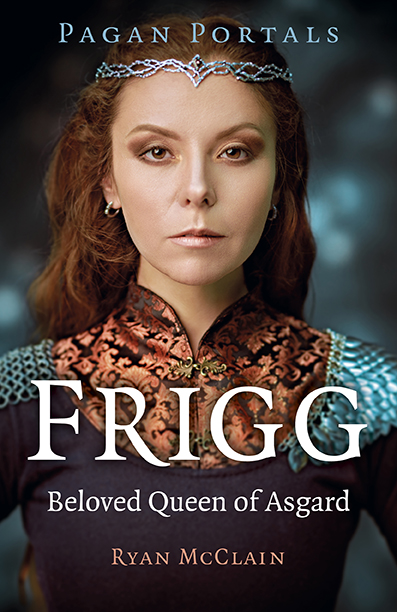
While other deities play an important part in my life, there is no other that is such an integral part of my daily activities. Offerings of fresh-baked treats make a very suitable offering that she has always welcomed with open arms. However, a daily offering of incense, or a candle lit in her honour, with a simple prayer of thanks for her guidance and aid, is typically given before my day begins. So if you are new to Frigg begin with a simple prayer and act of devotion. I feel that she appreciates hard work and dedication more than anything else. Just remember to do what comes from the heart, and your work will be well-received.

For more details https://www.collectiveinkbooks.com/moon-books/authors/michael-mcclain
Ryan McClain has spent well over two decades as a student of several polytheistic traditions. He considers himself an animist who is primarily influenced by Gaulish and Germanic Polytheism. His practice involves several deities, but he has become increasingly connected to Frigg, Abnoba and a few select others over the last several years. He earned his degree in General Studies in 2010. Since that time he has taken part in a great deal of independent study, meditation and prayer. Ryan lives with his husband, their two dogs, a rabbit, and a bearded dragon in a small town in Indiana. When he is not out wandering in the woods, you can catch him doing housework as a dedicated homemaker.
 The Pagan Collective
Leave a comment