

Interviewed by Thea Prothero
This is the seventh in a series of interviews with people who are inspired by my book, A Guide to Pilgrimage, published at the end of last year in the Pagan Portals series by Moon Books. These interviews are a way of digging deeper into the various aspects of pilgrimage and a way of highlighting what it means to different people.
The idea is to inspire you, dear reader, to consider pilgrimage as an act of devotion, or a way of connecting to the world around you, now or in the future.
Pilgrimage is an ancient form of devotion, one which is as relevant to the modern seeker as it was to ancient Greeks over 2000 years ago. One of my missions as a modern advocate is to bring pilgrimage out of the medieval church and firmly into the twenty-first century.
This October, I had the opportunity to interview the wonderful Frances Billinghurt, an initiated witch, and known to Moon Books readers for her three books: ‘Encountering the Dark Goddess’, ‘On Her Silver Rays’ and ‘Contemporary Witchcraft’. She is the presenter of ‘The Magic In You’, which interviews magical practitioners on her own YouTube channel.
Frances was kind enough to talk to me about her many pilgrimages.
Firstly, as an introduction, could you tell me how you define a pilgrimage and what it means to you?
The standard meaning of pilgrimage is to take a journey to the holy [sacred] place that can lead to a personal transformation, after which the pilgrim [the traveller] returns to their daily life. Typically, this is a physical journey (often on foot) to some place of special significance to the adherent of a particular religious belief system.
I would add to this definition that, at least for me, sometimes there may not be any pre-planning involved. Sometimes opportunities present themselves where the pilgrim may end up undertaking a journey to or visiting a place that often has a deeper spiritual significance, which changes their life in a profound way.
Could you please tell us where you went on pilgrimage and why this place is significant to you?
Some of the pilgrimages, both intentionally as well as unintentionally, that I have been on include:
1994 – This started out as a tour that focused on various Celtic sacred sites throughout Britain however it evolved into something much deeper (at least for me) through opportunities of meeting local guides who opened up “portals”(for want of a better world) between the realms (both the seen and unseen, a somewhat alchemical experience) for those of us on this tour who were “open” to such experiences when they happened. Examples included a “guardian” appearing at one of the sacred wells, a spirit guide in the form of a dog who led me to various ancient sites in Wales, seeing other worldly beings, and experiencing a deeper connection with the land or sites that were visited.
1995 – Callanish (Isle of Lewis) for the summer solstice. My first sabbat (sacred seasonal festival) in a stone circle that my distant ancestors erected as part of their spiritual beliefs. Being able to connect with the underlying energetics of the land, which my ancestors would have been aware of, seeing firsthand the sacred dance and connection between the land (the position of the stones) to the rising sun.
1996 –Ireland: Maybe this is not a pilgrimage as such but during the nine months in Ireland, I visited various sites, many of which continued with the Celtic connection, or from the Irish “ancestral memory” of the various “takings”, and underwent various experiences while at sidhe (faery) mounds, within sacred stone circles, even on some of the smaller outer islands.
2017 – Bali: I was emerging from my journey with cancer (and subsequent fallouts, including the finalisation of my long-term relationship and the death of my best friend). The first pilgrimage was due to the facilitator being of Balinese/Hindu training, which they mixed with Western esoteric teachings. As such, it involved engaging in authentic Balinese Hindu practices (sometimes with a Western slant) at many of the traditional sacred sites, including Gunung Kawi Temple complex, Goa Giri Putri Temple (cave temples) on the island of Penida, and a rite on a sacred beach, where I experienced some extremely intense, almost out-of-body, experiences. My return visit later that year with another facilitator resulted in the stark awareness of the difference between authentic traditional practices (the first trip) and somewhat superficial Western New Age superficial layering (second trip).
2018 – India: Undertaken as part of my deeper exploration into the spiritual side of yogic teachings that underpin most Western esoteric philosophies as well as Western spiritual practices, deepening my connection with various Hindu deities that I have resonated with, also part of my own spiritual growth, as I had also been studying for my Level 1 yoga teaching training. My mother passed away on the day I flew out, so this trip ended up also being a deep cleansing/healing journey.
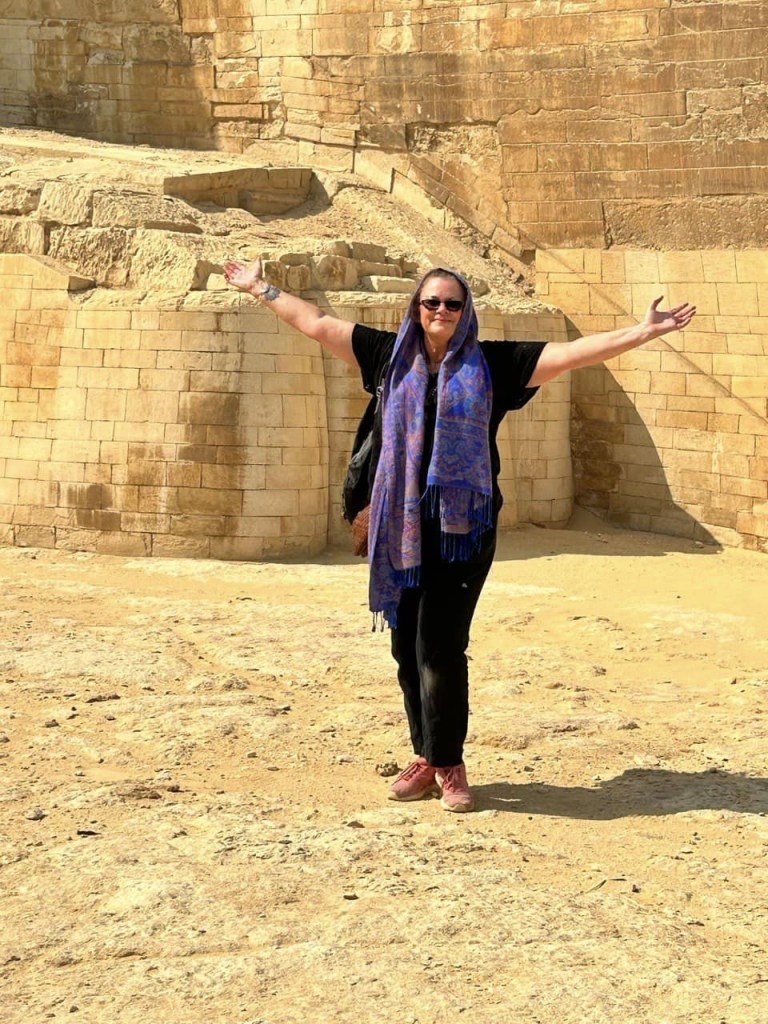
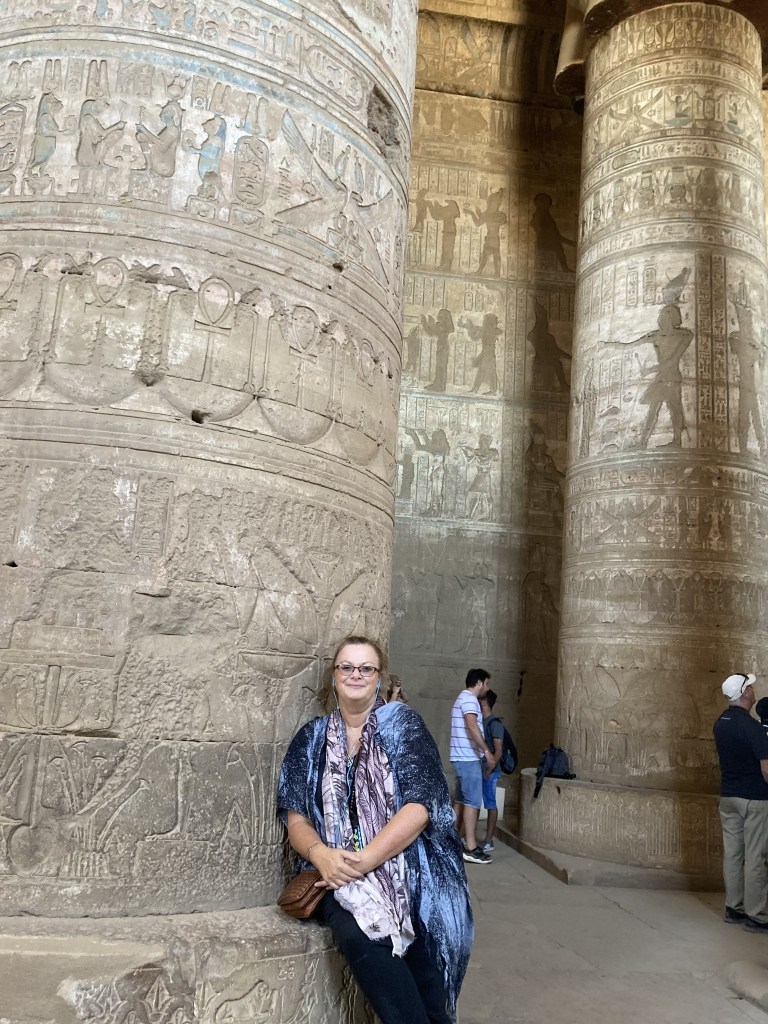
2023 – Egypt: Probably of all my pilgrimages or sacred journeys, this has been the major one as I have had a long fascination with ancient Egypt, and it felt as if I had been waiting some 30 years for the “right” tour and guide who had been a student of an indigenous wisdom keeper and whose tour included access to specific temples and sites that held a deeper spiritual meaning and experience.
2025 – Uluru: Spending New Year’s Eve in the central desert of Australia at one of the most sacred sites in this country, walking the dreaming tracks of the indigenous Anangu people’s, as well as the esoteric significance and connection between the imagery of this place and that of ancient Egypt that underpins some of the occult traditions the influenced the group of people I was with.
How long had you been planning to go on pilgrimage (Ie has it always been a dream of yours to go there, or a more recent calling?)
Britain/Ireland – I had been studying Celtic culture and mythology for a couple of years with the tutor when she announced she was going to arrange this trip. The other pilgrimages extended from already being in the UK or involved in trips that would take me to that side of the world.
India and Bali were spur-of-the-moment decisions to join those particular tours. I only knew about the facilitator of the first Bali trip through an acquaintance, so I had not actually worked with her personally. Likewise, the facilitator of the Indian trip, I had no connection with them save for joining that tour.
Egypt has been approximately 30 years. It was as if I had been waiting for the “right” tour to come along that aligned with my other interests.
Uluru – I found out that the group of interstate friends would be there about 6 weeks earlier when I decided to join them. So, this was very much spur of the moment. They had been planning this trip for a while, based around some rather significant dates and timings.
For the most part, when I travel, there often tends to be a consciously spiritual or sacred nature to where I go, as opposed to merely ticking things off a bucket list, so to speak. I also have a preference to embracing a deeper, more authentic practice or understanding of sites (especially when in other countries) as opposed to imposing a Western approach – a good example of this were the first and second spiritual trips to Bali where the first was more authentic in the practices and knowledge of the temples, whereas the second I felt was rather Western new aged influenced by comparison.
I also find that when you approach an area that has had a long spiritual history, sometimes it is best just to sit. This is what happened when I joined friends at Uluru for New Year’s Eve – the original intention was to perform a Western-influenced ritual in the desert; however, when the time arrived, that did not seem appropriate amongst the ancient landscape, so we meditated instead.
Could you tell us a little about the practical aspects of organising your pilgrimage?
The “pilgrimages” or spiritual journeys I have been on have largely been organised by other people; however, the personal input I do is to explore the sacred stories, mythologies, etc of the sites or areas, also to see whether there are other things that would interest me from a more spiritual angle, depending on the trip.
If opportunities arise to revisit sites after the tour, then I make these more personal. For example, I was able to return to Callanish for the summer solstice after the initial tour, having borrowed a friend’s car and arranged my own accommodation. I also investigated the timing of the solstice to ensure that I was at the site at the appropriate time.
Did you do any meditation/visualisation/journeying to guide you to specific places at your destination to visit? (for example, a stone circle, or other sacred site)
There have been occasions where this has definitely happened. One example was in Wales, where I had been walking along some back roads attempting to get to MynyddCarningli, or “Mount of Angels”, when a dog appeared out of nowhere and virtually guided me to the top and down again to where there was a track through a patch of woodland back to where I was staying. What I found interesting was when we passed a house, the occupants did not appear to know who this dog belonged to.
Other experiences have included people “turning up” who, when I have told them that I am visiting a site because I am interested in the history or folklore, impart a deeper knowledge or even show me something else that is often missed.
On other sites, I have had visions and more intense experiences, especially during my first trip to Bali. While meditating in one of the caves at the Gunung Kawi Temple complex, I experienced what could best be described as an out of body experience (which repeated yet more intense when I returned to this spot a few months later, this time with vocalisation), and while within the Goa Giri Putri Temple complex, I experience intensive throat restrictions (like I was trying to speak yet my vocal cords could not shape the sounds), body reactions, intensive visions/dreams afterwards etc.
While at a shrine dedicated to Shiva, I experienced the presence of something non-human.
The same happened while in Egypt, within certain temples are the specific “power spots” or portals where otherworldly experiences or sensations were felt.
How did you keep a record of your visit? Did you write in a journal or a notepad? (change to another format, if necessary) How did this help you after you returned from your pilgrimage?
Yes, I usually take photos and make journal notes whenever I am able to. Some notes are detailed, others are not. For Egypt, for example, as we visited a lot of temples, it was important to keep notes that can act as prompts to ascertain how such experiences have changed you when looking back at a later stage.
There are also experiences where the English language really is not able to describe the experience because it is an experience. In such instances, a sketch or something else is used to act as a trigger – unless of course the experience is so profound that such are not needed.
When you returned and reintegrated into your everyday life, how did it feel? Did you find it difficult to reconnect to your everyday life?
After my initial visit to Bali, it was extremely difficult to reconnect to everyday life due to the experiences that I had undertaken. I recall sitting in my car in the car park for about ½ hour before I could make it into work because I felt so disconnected – it was as if my soul was pacing around in a cage. It took literally months for me to completely process what I experienced, and even then, some were not able to translate it into logical understanding, which is not uncommon when you work in spiritual areas. As I have mentioned, this pilgrimage of sorts resulted in a deeply alchemical shift occurring within me – then again, as it came after my journey with cancer, maybe it marked the ending of that whole metaphoric period, as looking back, the person I am today is a completely different being to the one prior to cancer.
I feel I am still processing experiences that I underwent in Egypt, some two years later, due to the intensity of them. Also, my experiences have sparked a deeper level of enquiry and discovery into exploring a lot of these temples and the deities (neteru) associated with them from a more alternative perspective.
How has going on your pilgrimage changed you? What is the most significant memory you have of your pilgrimage that will stay with you?
One of the more significant memories is probably my experience within the Goa Giri Putri Temple complex. This is because these experiences pushed my logical understanding of reality and what I had considered to be “out there”; I was actually experiencing myself. They also encouraged me to simply accept that there is definitely more to this reality than our 3D understanding of it, and things that will continue to be beyond our rational understanding, because this in itself has been so limited in its perspective. These experiences also enabled me to continue to enhance various extra-sensory abilities.
Are you planning more pilgrimages, and if so, would you like to tell us about your plans? Would you do anything differently next time?
Definitely. In particular I am hoping to return to Egypt however I would like to spend more time at specific temples so that I am able to meditate and take in the atmosphere on a deeper level – this is because there is so much in not only the temples themselves (the physical structure) but also the artwork, their location, alignments with cosmic events as well as with other sites. Not to mention the simple fact that there is so much to ancient Egypt that we really do not know or properly understand.
Finally, is there anything else you would like to share about your pilgrimage journey or any other aspect of pilgrimage?
Be open to what is experienced. Some things simply cannot be explained by our logical, rational, scientifically driven minds. Anything is possible if you allow yourself to be open and let things land whenever and wherever they are meant to.
Thank you, Frances, for sharing your own unique experiences of pilgrimage with us.

https://www.collectiveinkbooks.com/moon-books/authors/frances-billinghurst
Thea is a Heathen and a pilgrim. She likes to think of herself as a Nemophilist, which means a ‘haunter of woods’. She spends most of her free time walking in the wildest remotest lands, places that still make the gods tremble, and she loves the challenge of finding connection through nature to the divine. She writes prolifically, read equally, has a passion for learning, taking photos, grow things, and spend time with her family. she works in education and lives in the south of the UK.
For more details: https://www.collectiveinkbooks.com/moon-books/authors/thea-prothero
 The Pagan Collective
Leave a comment