

These Pagan Portals are all current works in progress, serialised here on the Pagan Collective blog with each chapter being open for comment. In due course the entire script will be published as a Pagan Portal book.
Stone of Spell and Sight. What Hag Stones Do.
The Nature of Hag stone Magic
So, what do hag stones do? What happens when we invite them into our lives, our homes, our practice?
As soon as you spy such a stone, eye meeting eye, the magic begins. Pick it up, and the hag stone offers itself, readily, as a tool, a talisman, a trusted ally. And, there are many, many means and modes of working with it.
Not all hag stones are alike, however. Some pulse with warmth; others feel watchful. Each stone carries the signature of its particular making, whether that’s the rhythm of waves or weather, or the slow crafting of a critter over time. Every one has their own texture, feeling, and speech. The art of working with hag stones is, in part, the art of learning to listen. These stones are not merely tools to be used, but presences to be met, and honoured.
If we are to categorise ‘hag stone magic’, then I would say that its magic is:
Animist – Each hag stone possesses its own particular temperament. To hold one is to enter into conversation with the living world and the elements, and to work in communion with these, rather than to command them.
Sympathetic – A hag stone’s hollows mirror our own openings – eye, mouth, heart, womb – and so may be used symbolically.
Protective – The piddock’s patient act of self-sheltering leaves a signature of endurance and sanctuary. This energy of persistence and protection lives on at the stone’s centre.
Beyond this, however, working with a hag stone may branch out into many other styles of magic / magical usage, which we will endeavour to touch upon here.
Traditional Uses of the Hag stone
The hag stone’s traditional virtues may be gathered within three broad powers: protection, clarity, and sight. Together, these form a triad of practical uses that in turn reflects other, older triune (‘three-in-one’) mysteries: body, mind, and spirit; past, present, and future; the seen, the unseen, and the seer. Gods and goddesses, if you work with them, may also come in threes, as may the mysterious force of luck.
The lore surrounding these stones speaks across languages and cultures. Here are their three most common uses.
It’s long been believed that “only good things can pass through a hole” – “bad luck and evil thoughts are too big to be able to pass through […] and become stuck in the middle. This belief may be bolstered by the centuries-old belief that magic cannot work on moving water” (The Simple Things, n.d.).
Protection isn’t blocking off the world: it’s setting a boundary; rebalancing a relationship. When a hag stone is hung at a threshold, worn against the chest, or placed on an altar, it creates a gentle field of equilibrium. Its power steadies currents rather than walling them out, though some prefer to see it as a barrier. Whether creature- or current-made, water evolves a hag stone. And, water’s wisdom is flow – cleansing, carrying away what no longer serves, and smoothing the rough edges of experience.
Many of the hag stones along the shores where I live are formed by the piddock, a small bivalve mollusc that bores patiently into soft rock, hollowing out a home. The piddock lives enclosed within this stony chamber for the rest of its life. When it dies, it leaves behind the smooth tunnel of its dwelling: a space of safety carved by patience; by sheer, single-minded devotion. The stone retains the energetic imprint of this act – the vibration of persistence, self-sheltering, and endurance. To hold such a hag stone is to hold the memory of the piddock’s protected existence.
This lends a distinct quality to the stone. It does not merely symbolise safety; it is safety. The piddock’s instinct to create a sanctuary becomes the stone’s energetic resonance. When worn or kept close, that frequency surrounds you as a boundary. It is the magic of ‘home’ embodied in stone – a spell of safe dwelling, whatever magic you practice.
Historically, hag stones were protective of places. Today, we can reinvigorate these gestures: a hag stone at a windowsill to guard your dreams; another in your car to keep you steady on long journeys. Such acts reaffirm our ancient pact with the animate world, offering protection through partnership with its elements and creatures, its processes and principles, rather than domination.
Clarity is the second traditional hag stone gift. To look through the hole narrows your focus, whilst everything unnecessary falls away. In this time of constant information, distraction, and noise, the hag stone offers the sanctity of less. It teaches us to see through distraction, not by adding effort or effect but by clearing excess away.
In practice, this clarity becomes discernment. You might try carrying a hag stone in your pocket, holding it during moments of confusion or overwhelm, letting your fingers trace a circle until the mind steadies. Or use it in meditation. Sit comfortably, raise the stone to your eye, and gaze through it toward a candle flame or the moon. After a few minutes, colours sharpen and outlines soften. There’s a sense of clarity, a bit like that bright, still feeling you get just after a storm, when the whole world has been washed clean.
In symbolic magic, the hag stone’s hollow represents the void at the centre of all things – the place of potential before form arises. When we seek clarity, we return to that inner emptiness from which right action emerges. Try this: write a question or dilemma on a slip of paper. Pass the paper through the hole of your hag stone, saying something like “Through stone / Through sea / Bring truth / To me”. Then place both stone and paper under your pillow. Dreams that night may reveal insight, or the answer may surface for you the next day.
Clarity also extends to speech and conduct. A hag stone worn at the throat encourages honest communication, especially for those who struggle to voice their emotions. Its circular aperture corresponds with the throat chakra, the gate through which inner thought becomes outer word. Worn there, it reminds us to speak only what is true, necessary, and kind. The hag stone cultivates not only clear sight but clear speech. Any sense or situation can be clarified with its help.
Protection and clarity prepare the ground for our third virtue: sight. In folklore, to look through a hag stone was to glimpse the unseen – the realm of faery and spirit, or even simply truth. Scottish legends tell of shepherds who, peering through an adder stane, saw the Good Folk dancing on the hillsides. Welsh stories speak of the glain neidr, serpent-stones that revealed hidden treasure or allowed one to see the shape of one’s destiny. These tales, though poetic, hint at a deeper reality: that perception is not fixed. Through magical practice, mystical enquiry, and meditation, it widens.
Through the hag stone’s aperture, vision becomes both literal and metaphorical. The smallness of the hole draws the gaze inward even as it looks outward, focusing consciousness to a single point. In that narrowing, the veil of ordinary seeing grows thin. Psychologically, this mirrors trance induction, as the mind quiets, pattern recognition heightens, and intuition speaks more freely. Spiritually, the rock’s hollow becomes the threshold where visible and invisible meet.
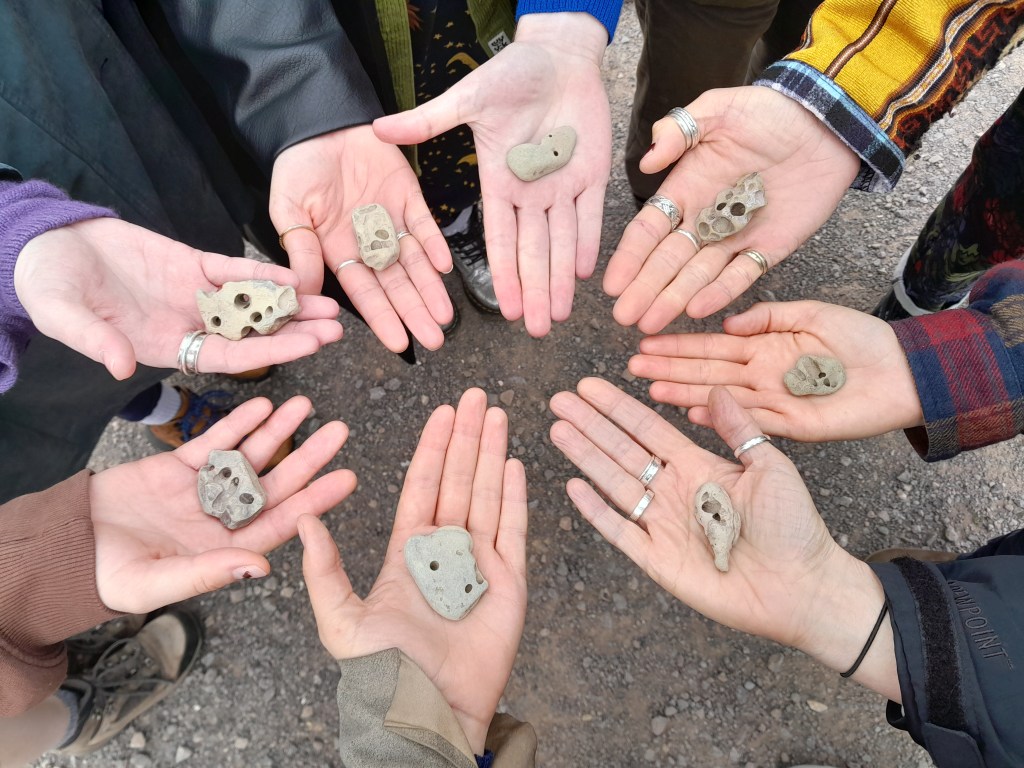
In my own practice, sharing hag stones with others deepened their power. During a series of guided walking events, participants had previously used small hand lenses or magnifying glasses to explore their surroundings. These were tools of curiosity: ways to look more closely at leaves, shells, or the frilled skirts of fungi. In one such event, held in the wetlands at Cardiff Bay, I replaced the lenses with hag stones. The shift was thrilling. Instead of magnifying outward detail, participants were invited to look through the hag stone’s natural aperture and notice how perception itself changed.
Standing among feather grass and grey, Welsh water, we lifted the stones to our eyes. What the lens had once revealed through enlargement, the hag stone now revealed through entrancement. It did not show more – it showed through. The world seemed to breathe differently: reeds swayed as if alive with intention; the water’s surface shimmered like a mirror between worlds; and even the smallest ripples seemed to pulse with meaning. Participants described feeling grounded, serene, and more connected to the landscape. It affirmed what I had long felt – that the hag stone is not simply a tool of vision, but of relationship. It teaches us to look until the boundary between seer and seen dissolves.
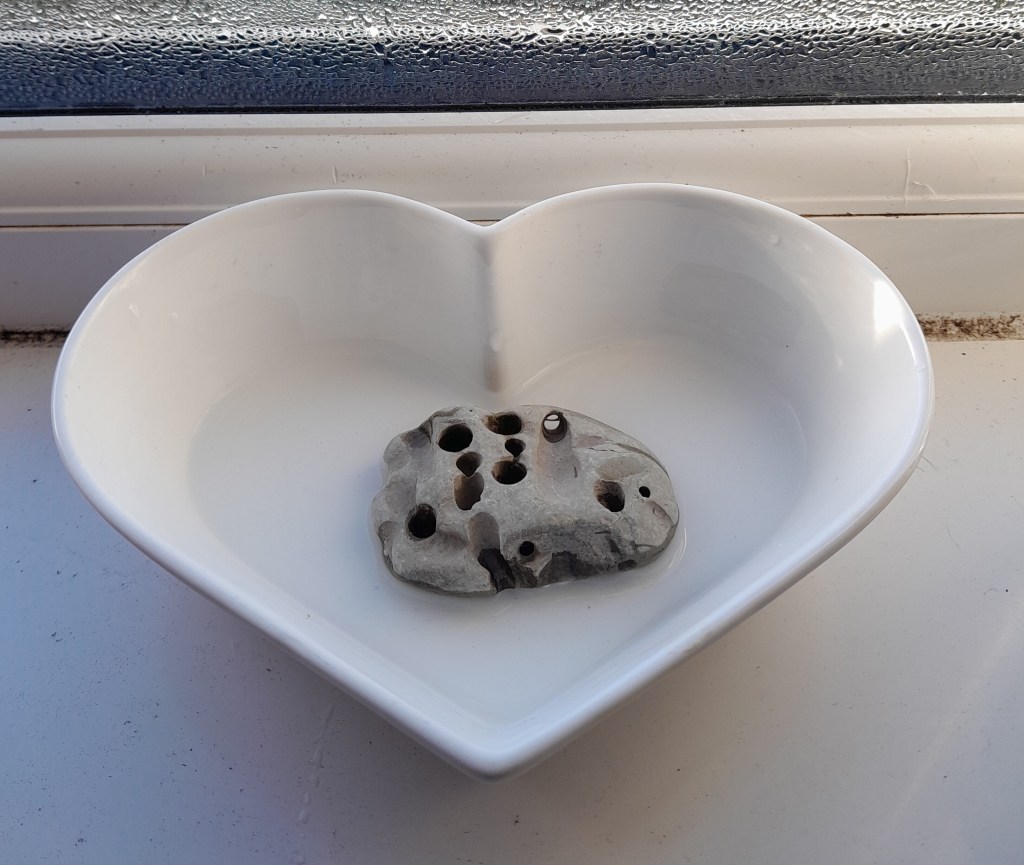
To work with sight in a solitary setting, try this scrying practice. Place a bowl of water on your altar/table and float your hag stone so its hole rests above the surface. Position a candle behind it so the flame’s reflection glimmers onto the bowl. Gaze softly at the stone’s hollow, not straining to see but allowing impressions to arise. Shapes might form, or feelings, or sudden knowing. End by closing your eyes and thanking the stone. Record what comes in a journal – even if it seems trivial, meaning often unfolds later.
Some practitioners use hag stones for dreamwork, to ‘see’ in dreams. Place one beneath your pillow or beside the bed, asking for insight during sleep. The dreams that follow often carry a crispness, as though filmed through clearer light, I find. Others use them in spirit journeying, holding the stone as a tether when exploring inner/other landscapes. The hole acts as an anchor point – a hollow cord linking body and soul so the traveller can always return safely.
I once used a small grey hag stone, smooth as skin, during meditation beside the sea. Looking through it at the horizon, I felt the distance collapse: the far line of light seemed to draw near, the stone’s edge glowing faintly. The sensation wasn’t of seeing more but of being seen by the world itself. That’s the essence of hag stone sight – a mutual recognition between observer and observed, as if creation itself glances back.
The hag stone acts as a meeting point between worlds. The hollow marks the point where matter thins, and the seen and unseen worlds overlap. To work with a hag stone is to work with that threshold (Ravenna, 2023). We will look at this in greater detail in chapter 8, but some understand the hag stone’s powers to come from its connection to the Otherworld. As well as those uses suggested, it may therefore be used to “send offerings or messages to the Otherworld” (Ravenna, 2023) or to deflect spirits who follow from that place.
Whether you journey to what you perceive as inner worlds, the Otherworld, worlds-within-our-world, planes of consciousness, or something else, the hag stone’s hollow can act as the meeting place between these realities.
Modern Uses of the Hag stone
Witches and seers have long known many ways to work with these stones, for protection, travel, offering, blessing, and vision (Ravenna, 2023). What follows are contemporary adaptations of these age-old modes.
These are suggestions, rather than rules. They come not from others’ research but are, instead, inspired by my own experience and exploration. Imagination is the magical practitioner’s first tool, and the hag stone rewards creativity. Let your stone guide you, and let your own soul lead you. The magic is in your relationship with these above all else.
1. The Hollow as Funnel – Releasing and Renewing
The hole in a hag stone needn’t only be a barrier. It can act as a funnel, drawing away what you no longer want. Some traditions suggest the hag stone’s hollow not only wards but redirects: for example, turning misfortune, or wandering spirits, back along the paths they came (Ravenna, 2023).
We can also redirect other energies. Place the hag stone between yourself and your phone or laptop. Breathe slowly through its opening and picture static, stress, or psychic hubbub flowing through it from your electronic device and dispersing. A bowl of salt water set behind the stone can absorb what’s released or visualise rays of light carrying it up and away. When finished, pour the water into the earth or a drain, and thank the stone.
This is everyday apotropaic magic – protection through movement and turning away rather than hard defence.
2. Portable Circle – Become a Living Piddock
A hag stone can serve as a circle you carry with you. Wherever you stand, hold it at your heart or place it at your feet. See the hole widening into a sphere of light that surrounds you. You are the living piddock – a soft body, and a soft soul, set within a wall of protective stone.
This is a useful boundary exercise for travel, work, or crowded places. The circle moves with you: flexible but firm. When you finish, breathe the light back into the stone and tuck it away.
3. Holy / Holey Mirror – The Body’s Apertures
The hag stone mirrors our bodily apertures and our psychological and emotional ones, inviting reflection on how we open and close to life. A three-holed stone can become a charm of feminine power, for instance (“three holes, all women” – James Joyce), mirroring the body as a tool for reclaiming authority in the face of shame or silencing.
Hold a stone where you sense its resonance would be strongest – womb, heart, or throat – and breathe through it, affirming: “Holey and holy, I claim my space wholly”. This is sympathetic magic – the body mirrored in stone, your whole and unapologetic selfhood reclaimed through its hollow.
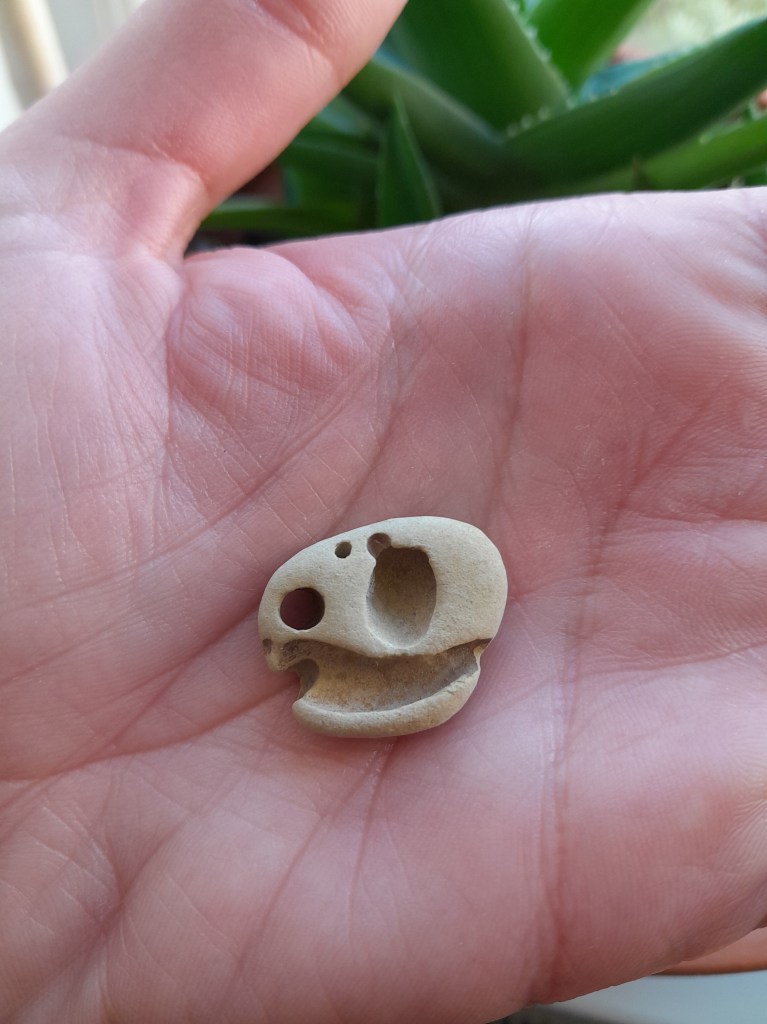
4. Stone-Face Dialogue – Seeing, Hearing, Speaking
Some stones possess the suggestion of a face – eyes, ear, mouth, even nose. These rocks can become tools for symbolic dialogue and are natural cousins to poppet magic or gestalt therapy.
If a stone looks like an ear, use it when you need to be heard; an eye for insight; a mouth for expression. Speak to the stone as if to the person or problem itself, then listen for any reply. This act externalises emotion and invites clearing, restoring balance. End by breathing once through the hole, sealing the exchange: “What is said is heard; what is heard is healed”.
5. Dream-Tether – Travelling Safely, Returning Well
Before sleep, place a hag stone beneath your pillow or beside your bed, asking it to tether you through the dream world. The hole becomes a symbolic cord between waking and sleeping states, ensuring safe passage and sure return, a bit like an inflatable rubber ring when swimming.
Or, thread a ribbon through the pebble’s hole and hang it above the bed, so the movement of air through the hollow keeps dreams clear and protective. This is liminal magic, bridging worlds through intention and trust.
6. Key-Keeper – Charm Against Loss
In some old lore, a hag stone kept travellers – both physical and spiritual – from losing their way, ensuring safe return from wandering paths. In this modern twist, the hag stone keeps your keys from wandering.
Tie a small hag stone onto your keyring with thread, wire, or cord. Folklore says “what the sea shapes, it keeps”, and so the stone helps ensure your keys – symbolic of access, safety, and belonging – don’t stray.
Every time you hear the keys jangle, think of the sea’s steady rhythm, the pull of the tide, and the tide’s return. The hag stone here acts as a luck charm, binding your belongings to you.
7. Focus Stone – Clarity in Work or Study
Set a hag stone on your desk or near where you write, read, or craft. Before beginning, look briefly through the hole, breathing once to centre the mind. Imagine the hollow drawing in scattered thoughts and returning them to focus.
This practice unites clarity with intent, and so the stone becomes a charm for creativity, concentration, or study. Some writers and artists keep a hag stone nearby as a ‘still eye’, a reminder that vision begins with quiet, internal attention.
8. Stone-Body Binding – Containment and Resolution
Again, some hag stones seem to hold the shape of a person – a face, a torso, or a limb. Such stones can be used in binding rites: not to curse, but to contain energy that’s become entangled or overwhelming.
If you need to set a boundary with someone or release a lingering tie, select a hag stone that carries their likeness. Gaze through the hole and softly name the person and what, in them, you are binding: an emotion, a habit, a tie. Then, with steady breath, wind a length of ribbon or cord around the stone, knotting it with calm intent. Whisper the words: “Bound to stillness, released from me” as you do so.
After this, bury the stone, cast it into the sea, or keep it in a hidden place until the energy feels settled. When you feel ready, unwind the binding and thank the stone for its service. This magic is that of containment and closure, rather than harm.
9. Incense Holder – Offering Through Smoke and Scent
Some hag stones will balance upright or cradle a small stick of incense within their hollow. Thus, they become vessels of offering, joining air, fire, water, and earth in a single act.
Set your hag stone on an altar or windowsill. Insert incense into the hole and light it. As smoke rises, imagine the scent carrying your gratitude or prayers through the stone’s hollow and out into the unseen.
When the smoke clears, whisper thanks and touch the stone to your brow. The hag stone, warmed by fire and fragrant with offering, remembers the exchange and keeps these energies within it.
10. Stone and Pen – Writing with Earth and Spirit
Bind a small hag stone to your pen or pencil with cord or fine wire so that it rests near your hand as you write. The stone becomes a conduit for the grounded voice of earth – its patience, precision, and wisdom.
Before you begin, breathe through the stone and murmur: “Through hollow and word, may truth take form”. Then write. The hag stone steadies inspiration, blending imagination with material presence and power.
In this way, you write with the world, not merely about it, each word a tide-mark between spirit and soil.
At that recent walk I led in the wetlands, I gifted each participant a hag stone. One received a stone shaped unmistakably like an ear. Without knowing them, I sensed they might be gifted in clairaudience. When I made this suggestion, they revealed that they often heard their name called on the wind. I encouraged them to use the stone to tune and clarify that gift – to listen and connect more deeply.
Such moments remind us that the universe – through sea and stone alike – recognises and supports us in our gifts. Magic is mutual, magnetic, mysterious, and interwoven with all.
These are only a few starting points. The hag stone’s power adapts to the person, the place, the powers that made it, and the moment itself. Some sensitives and empaths might find that keeping a hag stone close to the heart helps temper over-identification with others, lessening the pull of their emotions whilst preserving compassion. The stone can work to steady and restrict, so an empath can feel without being flooded.
Two or more hag stones can be bound together and later untied or cut apart as part of a cord-cutting ritual. As the string or ribbons fall away, the stones rest once more in natural, unknotted freedom.
If fear is “when the human aura meets an energy field whose vibration contains friction” (Bloom), the hag stone can serve as a mediator and balancing aid. Pass the stone slowly through your auric space, tracing slow spirals or figure-of-eights.
Similarly, the hag stone can discern holes and other disturbances in the aura. Pass it slowly through your or another’s energy field and ask it to respond – with a psychic-sensory thrill, sigh, or breath. Or draw an image of a body and an auric field and pass the pebble over that.
There are many other ideas to try when working with hag stones. The only limit is your imagination.
Two Notes When Working With Your Stones
Every act of magic begins with a moment of decision; the spark of intent. Whichever purpose you decide for your stone, intention is what empowers it. The hag stone, with its open centre, holds this truth literally. Its hollow is the vessel into which we pour our will, focus, and feeling. When we breathe through the stone, thread it, or gaze through, we shape energy with intention and set magic in motion.
To focus through the hag stone is an act of intention. The mind, like a lens, adjusts itself to meet the world differently. Attention becomes enchantment. Every act of looking is a spell – where we place our gaze, we place our energy. The hag stone teaches us that true sight begins not with the eyes but with the will.
Intention shouldn’t be strained or forced; it’s the confidence of knowing that what you request is possible, and trusting it to come about. Hag stone magic is less about commanding than communing. You breathe through the hollow; the stone breathes back. You gaze through the eye; the world gazes in. Each act of focus is a conversation with creation.
And so, magical intent is not something we add to the hag stone but something we remember through it: the insistence of our human will meeting the living world with reverence.
The hag stone’s magic seems strongest when it rests near the body. In amulet craft, proximity is part of the practice. A charm must touch flesh; absorb the warmth of blood; thrill from its bearer’s breath. Over time, the amulet becomes a kind of organ or body part in its own right, and a natural amplifier of strength and protection.
To make such a talisman, thread your chosen hag stone on a cord or wire. As you pass the thread through the hole, imagine drawing a filament of light through the heart of the world. Knot the ends with intention, saying aloud: “Thread through stone and strength through bone” or similar.
This is a practice of magical will. Every movement in the making becomes a declaration of purpose. Threading, knotting, anointing, and consecrating: each of these is a gesture that fixes energy in form. Crafting = casting. When your hands work with focus and feeling, the ‘spell’ comes to life. As someone who loves crafting as well as working with energy, I know this to be true.
Material choices matter, also. Linen or hemp cord is good for grounding; silver wire for lunar intuition; red thread for vitality; black for concealment and strength. If you’re crafting during a specific moon phase, align the purpose accordingly: waxing for growth; full for empowerment; waning for release. Let the process itself be ritualistic, with each knot the Earth’s heartbeat; each breath the Moon’s blessing, etc.
Those who wear their hag stones daily often find that the stones choose their moments. Some days the stone feels heavy, as though resting; on others it almost vibrates, eager to be worn. The more you listen, the more distinct the dialogue becomes. The hag stone, once an inert object, becomes a participant in your spiritual ecology and a companion on your path.
The Living Practice
To live with a hag stone is to weave its magic into ordinary life. Unlike the tools of high ritual, it asks for no ceremony beyond our attention. It is magic in miniature, and marvellously minimalist. Carry one in your pocket for a lunar cycle and notice how its presence shifts your days. Does it draw your gaze more often to the natural world? Do you feel a subtle steadiness beneath the rush of events when it’s with you? These are just some of its potential workings.
Over time, you might find that certain stones wish to remain in particular places – one beside the bed, one in the garden, one always on the body. Let them choose. Each has its own temperament. One might insist on sitting in a small bowl of rainwater by the window; another may prefer the warmth of your palm during meditation. Hag stones are teachers, and their wisdom unfolds over time, if you let it.
In modern witchcraft and shamanic paths, hag stones generally serve as gentle anchors to the animist truth that everything is alive. Their hollow centres further mirror the space within us that listens, dreams, and perceives. Through them, we remember that magic isn’t something done to the world, but worked with it. The hole in the stone isn’t an absence but an aperture; a meeting point for human energy and the Earth’s own.
Try this closing practice. Take your hag stone to a natural place like a beach, park or woodland. Hold it to your eye and look through at a single leaf, or wave, or blade of grass. Let the smallness of the frame teach you the power of close attention. Then lower it and see the world unframed again. Notice how the two ways of seeing – the focused and the open – complement each other. This is another lesson of the hag stone: the ability we all have to move easily between worlds. Magic is always there, but it’s this shift in vision that allows us to see it.
Over weeks or months, your relationship with your stone will deepen. It grows smoother from your handling; your energy imprints on it, and vice versa. One day, you might realise that the boundary between you and it has blurred. You no longer use the hag stone, then: you simply walk with it. You’ve become part of its story, and it’s become part of yours.
Stone of sea and silent tide
Turn my gaze from fear and pride
Through thy hollow let truth run
Bright as moonlight, pure as sun
Guard my path and clear my sight,
Hag stone, heart stone – steer me right
Closing Thoughts
To wear or work with a hag stone is to accept an apprenticeship to the Earth; to its patience, endurance, and capacity for transformation. Such a stone is both teacher and mirror, reminding us that magic isn’t always found in the grand or rare, but can simply be in what the tide leaves at our feet.
Free – found whilst idling or rambling – these are still stones of power. Each one invites conversation with the living world; a dialogue that deepens each time we return to listen. Over months and years, our energy settles into the stone. It becomes part of us, and we of it. Through this ongoing exchange, the hag stone continues its work along myriad magical lines that we explore together.
The hag stone so becomes an ally in apprenticeship, a mirror for transformation, and a companion on our long walk home.
For more details: https://www.collectiveinkbooks.com/moon-books/authors/mab-jones

Bloom, W. (1997). Psychic protection: creating positive energies for people and places. New York: Fireside Book.
Ravenna, M. (2023). 5 Ways of Hagstone Magic – Llewellyn Unbound. [online] Llewellyn.com. Available at: https://www.llewellyn.com/blog/2023/07/5-ways-of-hagstone-magic/.
The Simple Things. (n.d.). Folklore | Hag stones. [online] Available at: https://www.thesimplethings.com/blog/hag-stones.

 The Pagan Collective
Leave a comment