
Mari Lwyd, Lwyd Mari, a sacred thing through the night we carry,
Betrayed are the living, betrayed are the dead,
All are confused by a horse’s head.
In the depth of winter, time itself seems to pause. The great wheel slows, groans, and briefly stills. The modern world tells us that the dying year is already past once the lights of Mistletide go up and the songs begin, but the old knowing whispers otherwise. Dying takes time. Descent takes time. Winter is not an instant of darkness but a long initiation into it.
The year does not turn cleanly at Calan Gaeaf/Samhain. It bleeds, slowly, inexorably towards the dawning of new light at Midwinter. The land withdraws, the sun falters, breath crystallises in the air, and we are drawn inward, into hearths, into memory, into story. The Midwinter Solstice holds the promise of return, but promise is not fulfilment. The light is conceived, not yet born. We celebrate not certainty, but endurance. It is in this liminal stretch, between death and rebirth, between hope and fear, that the Welsh folk figure of the Mari Lwyd arrives.
Midnight. Midnight. Midnight. Hark at the hands of the clock. What shudders free from the shroud so white stretched by the hands of the clock?
She does not arrive as comfort; she arrives as truth. Her ghostly spectre in the dead of winter reminds us that death is still close in the silence, but that something listens. Whilst we tell ghost stories by firelight and call the names of our ancestors, the veil thins not as a doorway flung open, but as a membrane that is stretched taut. It is from that tension that the Mari Lwyd, the Grey Mare, emerges: not merely a folk curiosity, but an embodied reminder that winter has agency, that darkness has voice.
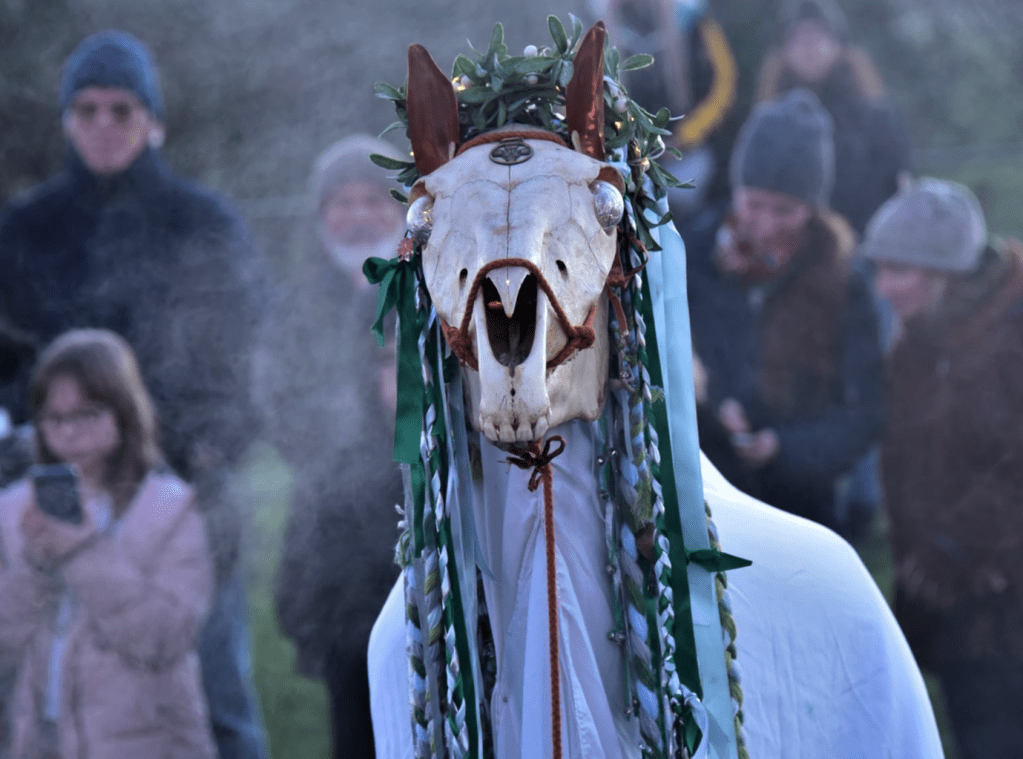
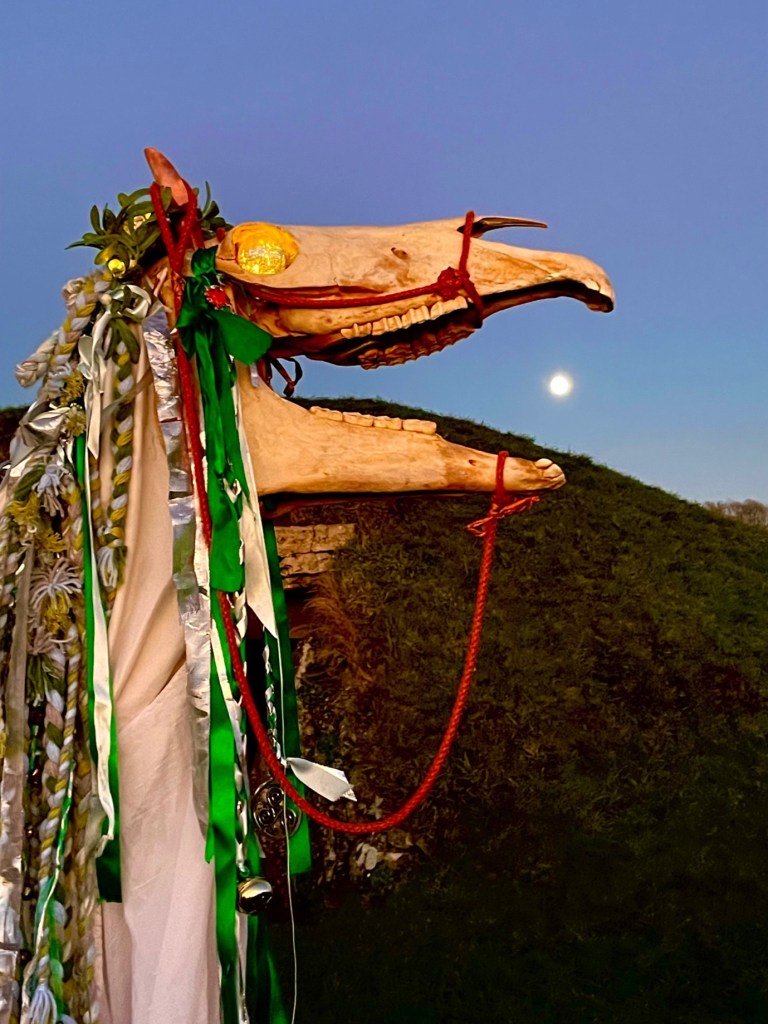
Led through the streets by her company, she is unmistakable, a horse’s skull starkly white, adorned with ribbons and rosettes, veiled in a shroud that both conceals and reveals. Her jaws snap, not in mindless threat, but in challenge. She comes to test wit, courage, generosity, and the willingness to engage; she demands poetry, beer and money. The Mari Lwyd is not a passive symbol; she demands engagement and relationship.
Much has been written about her origins, the fantasy of pagan survival, medieval customs, broken and mended folk traditions. Others claim a continuous practice deep in the valleys of South Wales; tantalising snippets from the book ‘A Tour through part of North Wales’ by John Evans in 1800 hint at her apparition in north-east Wales. These debates matter less now than they once did. What matters is that Mari lives. And there is mystery here, for living tradition does not fossilise; it adapts, responds and breathes with the people who carry it.
Continuity lies not in perfect preservation, but in ongoing meaning. She is a folk tradition, and the folk evolve, develop and change over time, and in turn she responds to those changes.
The horse has always occupied a liminal place in the Celtic imagination, a creature of sovereignty, power, fertility, and movement between worlds. In figures such as Rhiannon and Epona, the horse is both guide and threshold-keeper. The Mari’s whiteness, bone-white, frost-white, speaks not of purity, but of Otherworldliness. She is marked by death, yet animated. She is what remains when flesh has gone, yet meaning endures. She is the epitome of the undead, she is alive but dead, dead but alive.
O white is the starlight, white on the gate and white on the bar of the door. Our breath is white in the frost, our fate falls in the dull wave’s roar. O rhyme with us now through the keyhole’s slit, and open the door if you fail. The sea-frost, brothers, has spurred our wit, ay, and the killing hail.
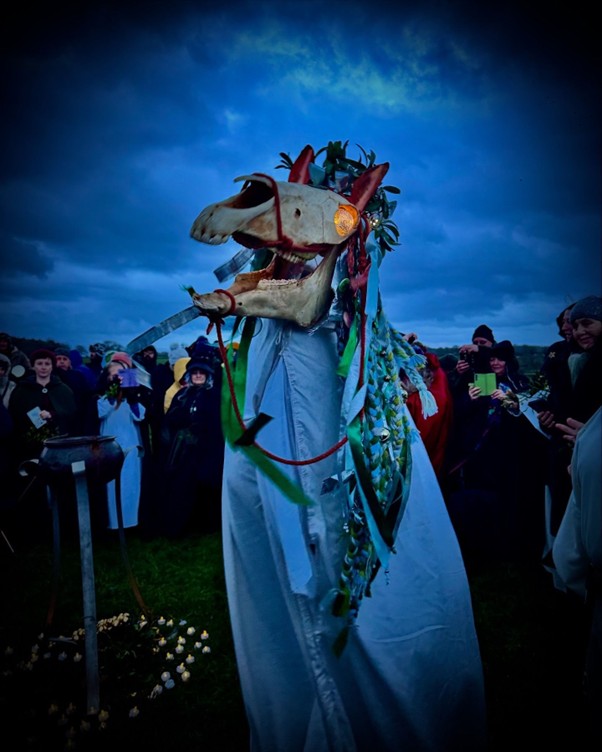
To encounter the Mari is to be reminded that winter is not simply a season to be endured, but a necessary descent. Her presence echoes the deeper structure of myth and mystery, the journey into the cauldron, the crossing of the threshold, the stripping away of certainty. She stands where worlds overlap, neither fully ancestor nor fully beast, neither goddess nor mere mask.
Within the pwnco, the ritualised battle of verse which swims at the heart of the tradition, something ancient is rehearsed. This is not performance alone, but an ordeal. The household must answer the knock. They must meet challenge with creativity, fear with humour, scarcity with hospitality. Lose the exchange, and the Mari enters, bringing misrule, laughter, disruption, and renewal. However, misrule is not chaos for its own sake; it is a controlled inversion that reminds us that social order is fragile, negotiated, and ultimately human. In winter, when survival once depended upon cooperation, generosity mattered more than hoarding. The Mari tests this ethic. Will you open the door, or bar it?
O white is the frost on the breath-bleared panes, and the starlike fire within, and our Mari is white in her starry reins starved through flesh and skin. It is a skull we carry in the ribbons of a bride. Bones of the Nightfrost parry, bones of the Fire inside.
Her snapping jaws are often treated as farce, but beneath the laughter lies an older anxiety. Winter threatens fertility. It threatens continuity. The snapping mouth is not merely comical; it gestures toward the fear that the wheel may not turn, that life may not return. The Mari holds that fear, so the community does not have to carry it alone.
She is not simply the Night Mare of nightmares, nor solely a Mare Queen to be placated. In contemporary understanding, she might be approached as a psychopompic figure, one who mediates between states, guiding awareness across thresholds. She carries us into winter consciously, rather than letting us stumble through it unconsciously. Offerings of song, poetry, coin, and beer are not bribes, but acts of reciprocity. The Mari does not want perfection; she wants sincerity, engagement, and presence. The wit must be alive, the beer worth sharing, the welcome genuine.
Out in the night, the nightmares ride, and the nightmares’ hooves draw near.
Bring to mind a cold winter night, a family huddled around the hearth for comfort and surety, the flickering flames shining from the stark, green leaves of holly, ivy and mistletoe. Suddenly, a sickening knock hammers against the door. The heart quickens, the breath is caught between what was, what is and what may be. When the knock comes, a song rises, muffled through the barring door, and in return, a song must be readied. This is the pwnco –
Wel dyma ni’n diwad (Well here we come)
Gy-feillion di-niwad (Innocent friends)
I ofyn am gennad (To ask leave)
I ofyn am gennad (To ask leave)
I ofyn am gennad i ganu (To ask leave to sing)Mae Mari Lwyd yma, (Mari Lwyd is here)
A sêr a ribanau, (In stars and ribbons)
Yn werth I rhoi goleu, (Worthy of giving light)
Yn werth I rhoi goleu, (Worthy of giving light)
Yn werth I rhoi goleu nos heno. (Worthy of giving light tonight)
Mae Mari Lwyd lawen, (Merry Mari Lwyd)
Yn dod yn y dafarn, (Is coming to your tavern)
I ofyn am arian, (To ask for money)
I ofyn am arian, (To ask for money)
I ofyn am arian a chwrw (To ask for money and beer)
This battle of wits and improvised poetry challenges the living, questions existence and the fragility of life. Faced by the deathly yet deathless countenance of the Mari, the words still work. They still open something.
In recent decades, the Mari Lwyd has re-emerged across Wales, not as a museum piece, but as a community practice. Folk groups, pagan circles, secular revellers, and ritual practitioners all carry her in different ways. Some approach her as heritage, others as sacred embodiment. These approaches need not conflict. A sure sign of a living tradition is its ability to hold multiple layers without collapsing.
Attempts to silence the Mari have failed before. In the nineteenth century, the Reverend William Roberts sought to expose and extinguish what he saw as dangerous superstition, only to preserve the very songs that would feed her revival. He lived as her sworn enemy, but in death, the Mari consumed that loathing and transformed it into a living tradition that would surpass his contempt. She has always survived attempts at erasure; she is resilient because she answers a need that does not disappear. What she offers now is not nostalgia, but depth.
In an age that rushes past darkness, the Mari insists that we pause, that we acknowledge grief, uncertainty, and the long night of the soul. She reminds us that community is forged not only in joy, but in shared endurance. That poetry still has power. Those doors matter especially when they are opened deliberately and consciously.
We do not need to prove that the Mari is ancient in order for her to be meaningful. Myth does not require archaeology to function. What matters is that when she knocks, something in us recognises the sound.
She is bridled with shadow and saddled with song, but she asks a pertinent question: when the Mari Lwyd comes to your door, will you answer, will you let her in?
Mari Lwyd, Lwyd Mari, a sacred thing through the night we carry,
Betrayed are the living, betrayed are the dead,
All are confused by a horse’s head.
Italicised verses adapted from The Ballad of the Mari Lwyd by Vernon Watkins (1906–1967).
For more details: https://www.collectiveinkbooks.com/moon-books/authors/kristoffer-hughes
Kristoffer Hughes is Chief of the Anglesey Druid Order. He is the author of several books, including ‘Pagan Portals: Arianrhod, goddess of fate, fortune & destiny; The Book of Druidry, The Celtic Tarot, Bee Tarot & Yuletide Tarot. He is a BAFTA and RTS-winning television presenter and documentary maker, and lives on the Isle of Anglesey.
Images from the archives of the Anglesey Druid Order.

 The Pagan Collective
Leave a comment