

Today we will unravel an ancient and mysterious knot (before tying it securely again, so the Universe does not fall apart)!
In most countries, the larger Christmas period ends with Epiphany (Trettondagen Jul in Swedish, literally the thirteenth day of Christmas), but Sweden adds another event to the calendar: Tjugondagen Knut, the 20th day of the Knot.
Swedish people “plunder” their Christmas tree (Julgransplundring) on January 13th, the Day of Knut.
Nordiska Museet (the Nordic Museum), in Stockholm, offers the following explanation:
January 13th arrives exactly 20 days after Christmas, and that is what the title of this event means: Tjugondag translates as “Twentieth Day”. The expression is: “På tjugondag Knut körs julen ut!“: “On the twentieth day Christmas is driven out!”
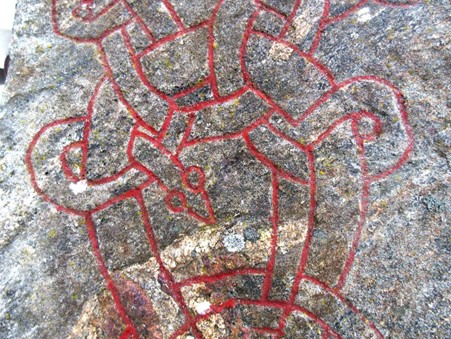
Knutdagen, the Day of Knut, is said to derive its name from the Danish duke Knut Lavard (1096 – 1131). He was murdered, just outside Ringstedt in Denmark, on the 7th of January in the year 1131, by his cousin Magnus. Magnus viewed Knut as a rival, well-positioned to rise to power as the successor of King Nils (the father of Magnus). Knut was canonised and declared a saint near the end of the 17th century. The Christmas period was extended by one week, and the week of Knut now lasted from the 7th to the 13th of January.
A new (or ancient?) tradition then arrives on the scene. The researcher Olof Rudbeck Senior (1630 – 1702) is the first person to describe a so-called “gästabudskrig” (war on hospitality, literally “the war on guests”) where the Christmas guests were symbolically driven out of the house, so life could return to normal.
During “Julgransplundring” the tree is stripped of all its decorations. In times past, most of those decorations were homemade and edible (gingerbread people, oranges, candy, etc.), not the plastic baubles and “rainbow unicorns” we find in the shops today. Today Swedish children still get candy on the day that the tree is thrown out.

Tjugonday Knut is celebrated only in Sweden, Norway and Finland. Knut (Norwegian and Swedish), Knud (Danish), or Knútur (Icelandic) is a male first name. This name is derived from the Old Norse Knútr, meaning “knot”.
This appears to be connected to the much older Scandinavian tradition of the “Granny Knot”. I highly recommend the following article by Kirsten Brunsgaard Clausen: The Scandinavian Cailleach – The”Kælling/Kärring”.
Her article explains that the Kaelling (Danish) or Kärring (Swedish) is the Scandinavian version of the Cailleach. She reigns from “Hel’s Eve” (Hellemisse, All Saints, Samhain) to Disa Dag (Kyndelmisse, Candlemas, the feast day of St Brigit).
This phase of the cycle is about Death birthing New Life, the most crucial (and most dangerous) part of the greater Life Cycle. Not just that, she is the lock, or knot, linking winter to spring and death to new life. When Death cuts this thread (during the risky time of Twelvetide), the steady hands of the Kärring tie the ends back together, using a Granny Knot, or Kællinge-knude” (in Danish). A knot that is almost impossible to undo when tightened properly!
Knut’s Day is scheduled for January 13th on the Swedish calendar. Many locations had old pagan traditions linked to this day. Children (especially) would dress up in costumes and wear masks. They would go from door to door carrying a male doll made of straw, the Knut’s Gubbe (Old Man Knut or Old Man Knot). The idea was to be invited in for treats and a drink, but stay in role without your real identity being revealed. Dolls of straw, made to resemble old women (the so-called Gumma or Crone), were carried around as well, and they pose a direct link to the Grandma Goddess tying her cosmic knot.
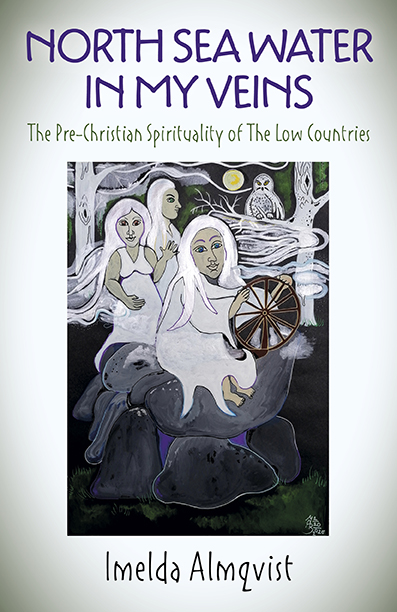
I agree with Brunsgaard Clausen that a much older, female and pre-Christian occasion lurks behind the public feast day of a male Christian saint. For a larger collection of examples, please read my book North Sea Water In My Veins, about the pre-Christian spirituality of the Low Countries.
For more details: https://www.collectiveinkbooks.com/moon-books/our-books/north-sea-water-in-my-veins

Imelda Almqvist is an international teacher of Sacred Art and Seidr/Old Norse Traditions (the ancestral wisdom teachings of Northern Europe). She has published three books: Natural Born Shamans: A Spiritual Toolkit for Life (Using shamanism creatively with young people of all ages) in 2016, Sacred Art: A Hollow Bone for Spirit (Where Art Meets Shamanism) in 2019 and Medicine of the Imagination – Dwelling in possibility (an impassioned plea for fearless imagination) in 2020. She has presented her work on both The Shift Network and Sounds True. She appears in a TV program, titled Ice Age Shaman, made for the Smithsonian Museum, in the series Mystic Britain, talking about Neolithic arctic deer shamanism. Her fourth book, about the pre-Christian spirituality of The Netherlands and Low Countries, has just gone into production. She has already started her fifth book: about the runes of the Futhark/Uthark. In response to the 2020 pandemic she has opened an on-line school, called Pregnant Hag Teachings, to make more of her classes available on-line. Website: http://www.shaman-healer-painter.co.uk Online School: Pregnant Hag Teachings https://pregnant-hag-teachings.teachable.com/courses/

 The Pagan Collective
Leave a comment