

“Get on your knees and open your eyes and let Brigit in!”[1]
This time-honoured ritual command, recorded by Séamas Ó Catháin in The Festival of Brigit, was once commonly heard in traditional households of Irish-speaking communities. It speaks volumes in both its direct and metaphorical messages. On Imbolc, on St. Brigit’s Eve, we unlatch our doors literally and invite her in to bless our homes, opening our eyes to her presence, and by kneeling, we honour her with a heartfelt entreaty to enter, as opposed to commanding her in from a brash height, as is sometimes perceived in the idea of invocation. This, rather, is an invitation and request.
These words also beckon us to move downward within ourselves, to a level where we can escape our whirling thoughts, open our inner eyes to what is truly important, and let Brigit and all she symbolises — protectiveness, healing, justice, compassion, generosity, renewal, and much more — to enter us fully and imbue us with her gifts.
When she enters our homes, blessing them and protecting those who dwell within, we proclaim our joy. “She is welcome! She is welcome! The noble woman is welcome!”[2]
Our lives are so vulnerable to threats and anxieties. We face loss and sorrow, disappointment or deprivation, on a regular and ongoing basis. We are strong and intelligent beings. We can learn from our challenges, grow in many ways, aid each other and bring compassion to ourselves as we continue to meet life’s difficulties. Knowing that there is a saint of abounding wisdom, with intense concern for those who suffer, a sovereignty goddess who is herself the land that bears us, bound to the beings of that land, large and small, is a great aid to us. Having her traditions and tales to draw on to guide us in our lives is a profound gift, and knowing that once every year, with her physical return to our realm to dispense her blessings, we are able to renew the protection of our homes, families, and communities from one who cares so deeply is a mighty defence against despair.
I speak to you as ones who have familiarity with Brigit and the customs of Imbolc, of the brat Bhride left out for blessings in the dew, the rush crosses and the brídeóg, of snowdrops and ewes lactating and the small feast in the small of the year when times are at their leanest, and of the ushering us into spring that Brigit brings.
As modern Pagans, many of us push hard against the Christian saint. The customs attached to her, we either dismiss entirely or justify our use of them by claiming a pre-Christian origin that is as likely as not to be false. We don’t need to do this. Cultures have long adapted to one another, adopting what is useful, letting go of what is not. While it’s important for us to acknowledge where our goddess came from and the origins of the customs we adopt, we can freely enjoy these customs without seeing this as an uneasy compromise with Christianity, if that is a faith we no longer want any connection with.
Or we can, as I do, welcome Brigit in both her saintly guise, irrevocably tied to Christianity, and her goddess form, in both its pre- and post-Christian aspects. And we can give unreserved thanks, our eyes fully open, to the Christians of Ireland and beyond, monastics and folk alike, who preserved texts and lore, customs of welcome and veneration, prayers of depth and surprising turns that have given us so much that we may offer her now — though not as exact reproductions of rituals done in a context we can’t duplicate.
Instead, we create forms that speak to us today, of giving to our goddess, Brigit, who we have merged irreversibly with the saint. We may make elegant figures instead of a brídeóg from a doll and children’s clothes, take the offering of milk across a threshold and transform it — why would a goddess so tied to the land baulk if a vegan pours oat milk rather than the breastmilk of a mother cow? Why would she argue if we made our rush crosses for the house in the three-armed fashion once reserved for the cow-byre, because it resonates with our appreciation of her as three sister goddesses? She would no more protest this than she would frown at our two-mother families, our chosen families with not one person related, our ensconcement in cities rather than rural communities.
Brigit as saint was always able to move with her people, wherever they went. As modern goddess, she is equally adept. So, where some may balk at the lack of tradition or connection to the land in our rainbow hued pipe-cleaner crosses, I say: make them. Find expression in the crafts and foods and social framework that you have available to you, and let your gifts to her come from your heart. Honour the past and the people who have brought Brigit and her traditions to this century. Find blessings, nourishment, and succour with her now.
A final thought. Imbolc is a rite of community. Just as Saint Brigit and her cow travel the countryside blessing farm and household, traditionally her people would be blessed at every fireside by the arrival of young people carrying an effigy of her, the brídeóg. Many of us, like myself, live alone these days, and many more have no access to a community that shares our love of Brigit. That is a loss, but it doesn’t need to be a limitation. As much as we can, let’s remember our connection to the world around us on this sacred night. Let’s make offerings to Brigit, not in our own name alone, but on behalf of family, friends, and strangers, those who make up our vast communities. Let’s ask blessings for us all, friend and foe, that we may bring her greatest gift into our world.
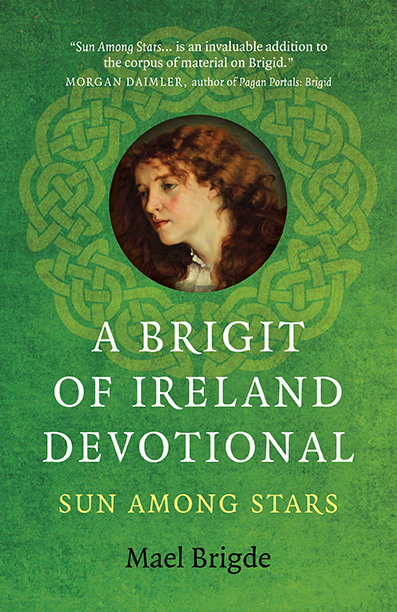
For more details: https://www.collectiveinkbooks.com/moon-books/our-books/brigit-ireland-devotional
Mael Brigde is the author of A Brigit of Ireland Devotional – Sun Among Stars, and founder of Daughters of the Flame, an international, interfaith Brigidine flame-keeping group for women. She lit their initiatory candle on Imbolc 1993, unaware that on that same day in Kildare the Catholic Brigidine Sisters were also relighting her flame.
Mael Brigde leads classes, meditations, and webinars on Brigit. She publishes a general interest Brigit blog, Brigit’s Sparkling Flame (2004), and a blog of Brigit poetry, Stone on the Belly (2015). (Submissions are welcome.) https://linktr.ee/maelbrigde#
[1]“Gabhaigí ar bhur nglúna, fosclaígí bhur súile agus ligigí isteach Bríd!” The Festival of Brigit – Celtic Goddess and Holy Woman by Séamas Ó Catháin (1995).
[2] “Is é beatha! Is é beatha! Is é beatha na mná uaisle!” Ibid.
 The Pagan Collective
Leave a comment