

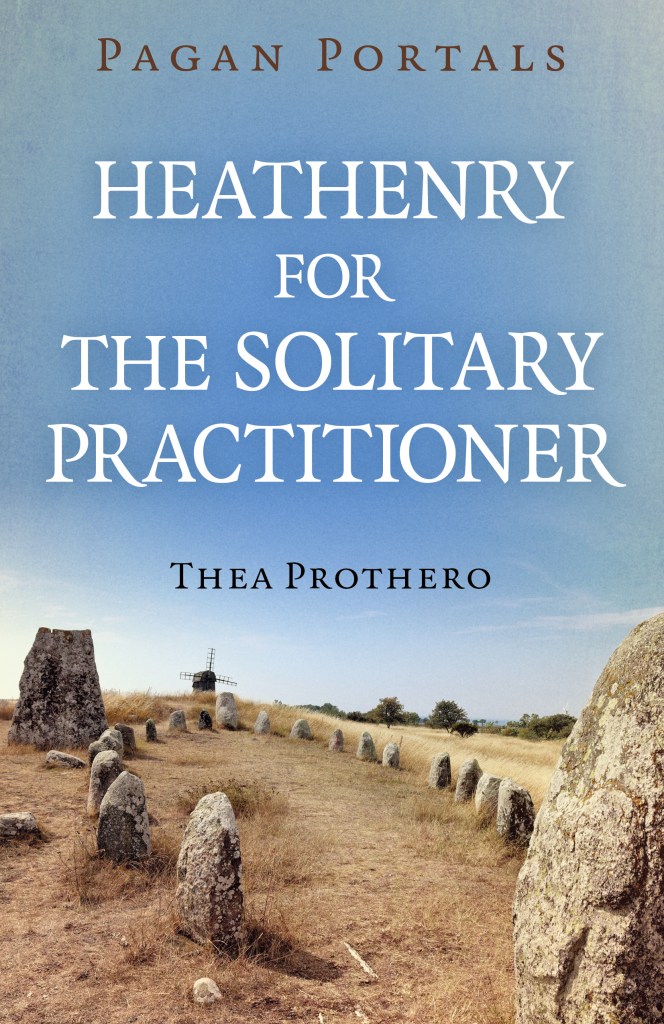
To celebrate the release of Heathenry for the Solitary Practitioner, here is an extract from the introduction to give you a flavour of the book and encourage you to delve further into Heathenry and the Norse Worldview.
Early of ages
When nothing was.
There was neither sand nor sea
Nor cold waves.
The earth was not found
Nor the sky above.
Ginnungagap was there,
But grass, nowhere.
(Sturluson. Snorri. Prose Edda. 2005. p.12)
There was nothing, a void in space and time, a great gulf of blackness. This was Ginnungagap (The gaping abyss). To the north of this vast emptiness was a land of ice called Niflheim, and to the south a land of fire called Muspelheim. A great river ran through Niflheim and divided into twelve smaller rivers, each flowing into the abyss of Ginnungagap. Slowly over aeons, these rivers began to fill the great gulf with a huge frozen plane which grew ever closer to the fires of Muspelheim. In due course, the volcanic drops of fire fell onto the ice plane and melted it, and from this the first primordial being was created; Ymir, the first jötunn – frost giant. As he slept, he sweated and from his armpit and from the flesh on his leg, gave birth to three more jötnar. These were the first beings. From the ice and snow came another being, the great cow Audhumla, who fed the giants with her milk and licked salt from the rocks. After nearly three days of licking the rocks, she revealed the head of a being so beautiful and strong: the first god, Buri.
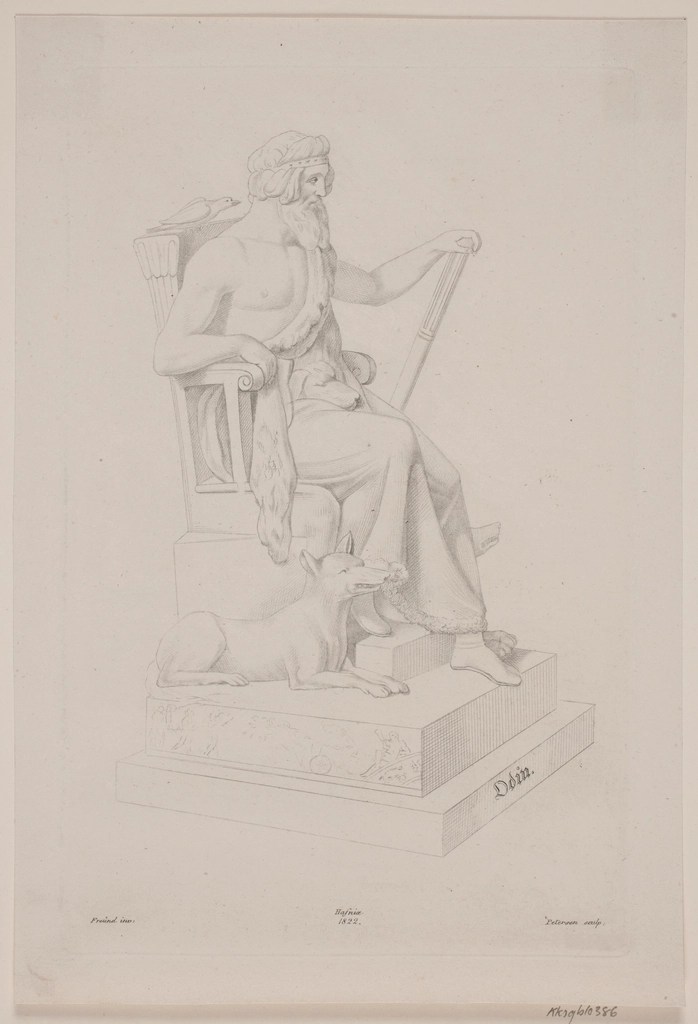
Buri was kind and good, and looking about him, saw the jötnar as evil and cruel. Aeons passed, and from Buri sprang Bor, his son, who wedded a giantess called Bestla, and therefore mixed the races of jötnar and god. They, in time, had three children: Óðinn, Vili, and Ve. (Other stories name them as Óðinn, Hoenir and Lodurr, which I will examine later in the “Gods” chapter.)
After ions of time had passed, Óðinn and His brothers grew older. They could not live in the world of Niflheim, with its ice or in the world of Muspelheim, where they would burn. They knew that the giants, especially Ymir, were a threat to their existence and were their natural enemies. The brothers decided to destroy Ymir.
When the deed was done, salty grey blood poured from the giant in vast quantities, which formed the seas. The soil was created by Óðinn and his brothers from Ymir’s flesh, and his bones became the mountains. Rocks were formed from Ymir’s teeth. When you look into the sky, this is the inside of Ymir’s massive skull. The stars and planets are flashes of the fires from Muspelheim, and clouds are bits of Ymir’s brain. To keep the giants at bay, Óðinn and his brothers used Ymir’s eyebrows to form a vast wall that surrounds the middle of the world, a place known as Midgard.
All mythologies have a creation story. All beliefs begin somewhere, so the Norse creation story is a good place to introduce a book on Heathenry for the solitary practitioner. Of course, the story continues with the further creation of the world, of humankind and the other realms and beings. All of this can be found in the Voluspa, the Seeress’s prophecy, the first offering in the Poetic Edda. Modern Heathenry is basically a reconstruction of ancient Northern European religion and beliefs. The original Heathens were pre-Christian and lived over a thousand years ago in areas around the North Sea. This included Scandinavia, Anglo-Saxon England, Germany, parts of Scotland, Ireland, Friesland, and Jutland.
Today, Heathens exist around the world, reviving and interpreting these ancient beliefs, all of which derive from archaeological data, the Eddas, Sagas and Anglo-Saxon poems. Many people today follow the Heathen worldview (I like this term, which is far better than calling Heathenry a religion, with all its associated dogma and connotations) either in groups, sometimes called kindreds, through organisations such as Asatru UK, or individually, like myself.
For more details: https://www.collectiveinkbooks.com/moon-books/our-books/pagan-portals-heathenry-solitary-practitioner
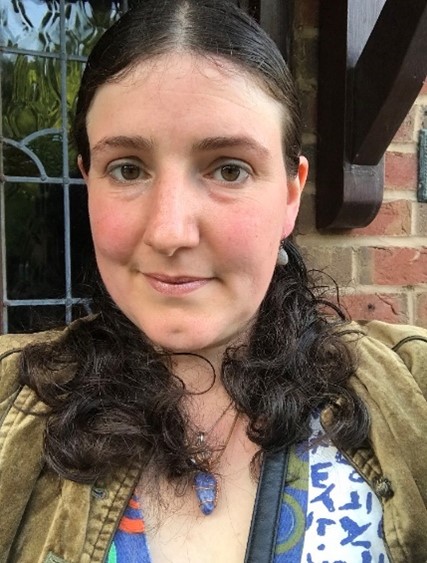
Thea is a Heathen and a pilgrim. She likes to think of herself as a Nemophilist, which means a ‘haunter of woods’. She spends most of her free time walking in the wildest remotest lands, places that still make the gods tremble, and she loves the challenge of finding connection through nature to the divine. She writes prolifically, read equally, has a passion for learning, taking photos, grow things, and spend time with her family. she works in education and lives in the south of the UK.
 The Pagan Collective
Leave a comment