
When we talk about accessibility, the conversation is often dominated by discussions of physical accessibility: things like wheelchair ramps, automatic doors, and accessible restrooms. But accessibility goes way beyond just physical access. To be truly accessible in our spiritual communities means to make our practice accessible to everyone by eliminating barriers to entry.
Financial limitations are one of the most often overlooked access barriers.
If you read the news, you’re probably already aware that a lot of people are suffering financially right now. The United Kingdom has officially been in a cost-of-living crisis for four years, and the United States isn’t far behind. According to the Guardian, economic concerns were a driving factor in the recent US midterm elections. As the November shutdown in the Supplemental Nutrition Assistance Program (SNAP) made painfully clear, many Americans are not able to afford basic necessities like food.
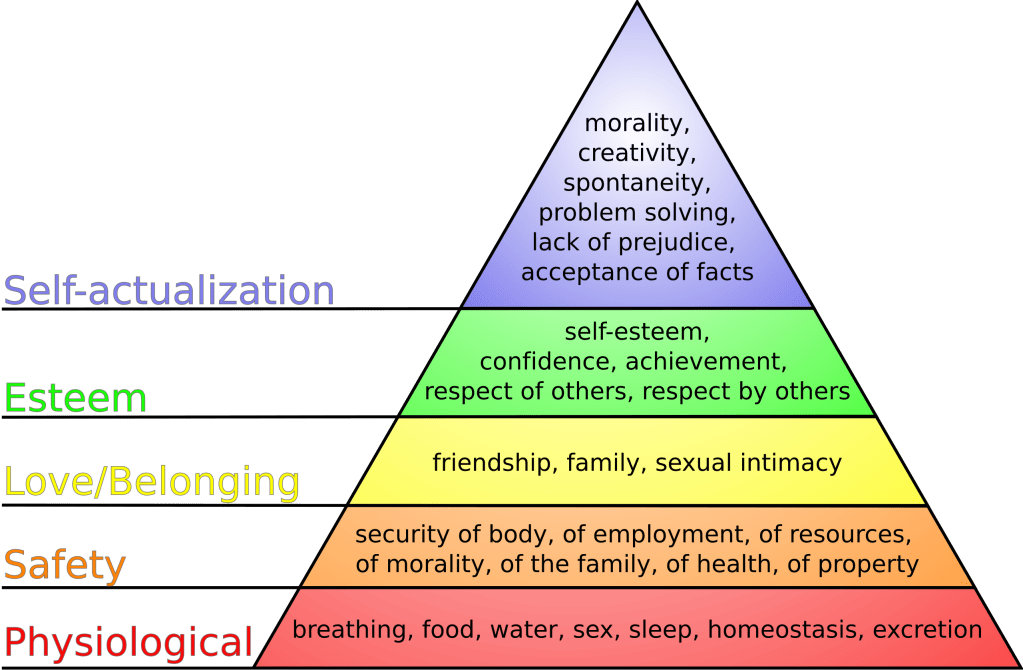
Someone who is struggling to afford groceries is not going to spend money on their spiritual practice. They just aren’t. It goes back to Maslow’s hierarchy of needs. When our basic survival needs aren’t being met, we don’t have the resources to worry about more abstract spiritual needs.
If we truly want to create inclusive spiritual communities, we have to eliminate financial barriers as much as possible.
I know this is a big challenge. Teachers and community organizers deserve to get paid for our work. (After all, we are also humans who are navigating the cost-of-living crisis!) And beyond that, running a community costs money. It costs money to rent venues, apply for permits for public rituals, and buy supplies for classes. In a perfect world, we would be able to offer these resources for free out of pure love for our gods and fellow worshipers. But we do not live in a perfect world.
I won’t pretend to know all the answers, but I can tell you what has worked for the communities I am a part of.
Sliding-scale and pay-what-you-can pricing models can be one way to address financial inequality. Sliding-scale pricing means the price each person pays is based on their available resources. Typically, a range of prices is offered for people of different income levels. (For example, students might choose to pay $50, $100, or $150 for a class.) Pay-what-you-can pricing is similar, but there is no set price or price range. Each person determines for themselves what they are able to pay at this time.
Both of the large pagan communities I am a part of (Reclaiming and the Fellowship of Fire & Ice) use sliding-scale pricing for classes and camps. I personally use a pay-what-you-can model and encourage barter (trading goods or services instead of money) when I read tarot and do Reiki for clients.
This means I sometimes get paid less than minimum wage. It means sometimes my “payment” is a piece of art or a home-cooked meal. But it means I never have to turn someone away for not being able to pay.
The problem with sliding-scale payment on its own is that some people genuinely can’t spare anything. Even the low end of the price scale is going to be too high for someone.
This is where scholarships and waivers come in. We can keep a few free spots open in our classes and rituals for people who can’t afford to pay. We can prioritize scholarship spots for people who hold marginalized identities, such as queer people and disabled people, who are more likely to be affected by poverty.
Planning for a few free spots may mean that we need to raise prices for those who are able to pay, but it will ultimately lead to more diverse and inclusive community spaces. If we have the resources, it is absolutely worth it.
If our community doesn’t have the resources to give away scholarships or waivers for in-person events, online events can be a great way to make our offerings more accessible. Online events are not only more affordable, but they also eliminate other access barriers for disabled people and those without access to reliable transportation.
Online events usually cost little or no money to host. We can invite members to donate a Zoom subscription for the community’s use, or we can use a free service like Discord or Google Meet. If we have volunteers who are willing to donate their time and expertise, we may be able to offer online rituals or workshops without any monetary cost.
Even in situations when making an offering free isn’t possible (such as a multi-week class), hosting online cuts back on costs like venue rental and ritual supplies, which means we need to charge less to break even.
Outside of these changes, we can work to address financial inequality in our communities by directly helping community members living in poverty. “Mutual aid” can be a loaded term, but it really just means coming together to support the people in our network. Everyone gives what they can and takes what they need. Mutual aid is different from charity because the people doing the work on the ground are part of the community they serve.
Mutual aid in our in-person pagan communities might look like: members who have more resources signing up to buy groceries or donate meals for members with less; operating a food pantry or community kitchen out of a temple space; hosting a clothing swap; members of the community helping each other out with specialized tasks like home repairs or childcare; and so much more!
Mutual aid in our online communities might look like: raising money to pay for a community member’s unexpected medical bills; creating a free virtual library of books and resources; members volunteering to create visual aids for online rituals to make them more disability-friendly; asking for donations to fund scholarships for online classes; and so much more!
Mutual aid goes beyond eliminating access barriers and works to address the underlying cause of those barriers. It’s the difference between a community that is polite but distant and one that truly embraces and supports its members.
Financial access is a huge, messy, complicated topic, and this article’s discussion is only the tip of the iceberg. But when we come together in community and dedicate ourselves to change, we can make a difference. And isn’t that what magic is all about?
For more details: https://www.collectiveinkbooks.com/moon-books/authors/sam-wise
Sources:
- Crisis UK. (n.d.). The cost of living crisis | Crisis UK. Crisis. https://www.crisis.org.uk/ending-homelessness/about-homelessness/the-cost-of-living-crisis/
- Aratani, L., & Smith, D. (2025, November 23). Americans are feeling the pain of the affordability crisis: ‘There’s not any wiggle room.’ The Guardian. https://www.theguardian.com/business/2025/nov/23/affordability-crisis-inflation-costs
- Ludden, J. (2025, November 13). SNAP funding pause to soon end, but anxiety and anger may linger. NPR. https://www.npr.org/2025/11/13/nx-s1-5604788/snap-shutdown-anxiety-anger-may-linger
- Understanding poverty in the LGBTQ+ community. (2024, January 26). HRC. https://www.hrc.org/resources/understanding-poverty-in-the-lgbtq-community
- American Psychological Association. (n.d.). Disability & Socioeconomic Status. Retrieved November 24, 2025, from https://www.apa.org/pi/ses/resources/publications/disability


 The Pagan Collective
Leave a comment