

Most people know the goddess Demeter only as Persephone’s mother. This is a large part of her story, yet there is so much more to this Earth goddess than many realize. Demeter is the Greek goddess of agriculture, grain, and fertility. She is one of the twelve great Olympian deities in Greek mythology, and is associated with motherhood, given her nurturing qualities. She was celebrated and honored in ancient Greece in the festival known as the Thesmophoria and in the Eleusinian Mysteries, the latter of which were rites that played a critical role in ancient Greek society.
Demeter was an empowering goddess for all women and for those wanting to better understand the cycle of life, death, and rebirth. The rites of the Thesmophoria were only open to women. In fact, it was said that men who attempted to participate in the Thesmophoria were subject to severe consequences, including violent attacks. Conversely, anyone could attend the Eleusinian Mysteries as long as they were citizens and/or spoke the Greek language and had not committed crimes such as murder.
Because participants were sworn to secrecy, we don’t know the exact details of what the rites consisted of. However, there is a strong reason to believe that participants observed a re-enactment of the story of Persephone being taken to the Underworld, Demeter searching for her daughter, and ultimately Persephone having to spend part of the year in the Underworld with Hades and the other portion on Earth or in Mount Olympus. It has been reported that those undergoing the Eleusinian Mysteries felt a stronger connection with the divine and were less afraid of death. The Eleusinian Mysteries and how they are connected to the story of Demeter and Persephone have been a topic of fascination for thousands of years. What is talked about less frequently is how incredibly powerful Demeter truly was, and she, like all of humanity, possessed qualities which were very multifaceted and sometimes contradictory.
Demeter spent a great deal of time and energy protecting her daughter Persephone from the time Persephone was born, to the point of declining suitors on Persephone’s behalf and ensuring that she had chaperones when Demeter wasn’t there. When Demeter learned that her daughter had been taken by Hades, she became distraught and refused to eat, bathe, or comb her hair. Zeus sends various deities to appease her to no avail. In this aspect, Demeter has a great deal to teach us about grief and loss. Demeter’s lack of motivation and her feelings of hopelessness are something that anyone who has ever dealt with grief or depression can relate to. We need space and time to heal from a loss, and Demeter’s willingness to be hurried in this process after the loss of her daughter presents an interesting lesson about boundary setting and allowing ourselves to feel the pain and sadness that comes from losing someone or something we love.
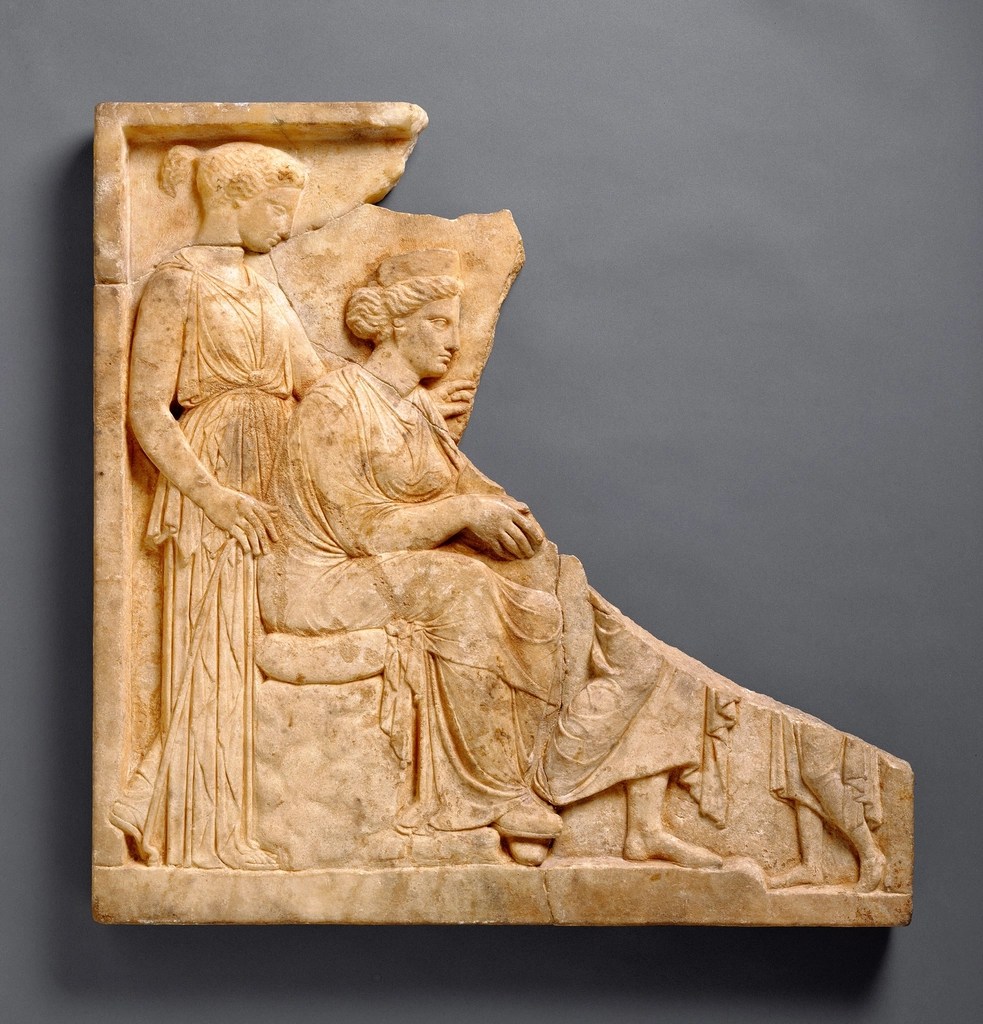
Demeter demands that her daughter be returned to her and refuses to allow anything to grow on Earth until she is reunited with Persephone. Demeter’s power is perhaps more subtle than many of her siblings, but she is able to bring the gods to their knees nonetheless, for even Zeus is forced to realize that humans cannot survive without crops, and without humans, there will be no one to worship the gods. It is her willingness to stand her ground, even in the face of cajoling and pleas from the other gods, that ultimately brings a resolution to the situation.
Demeter’s power is demonstrated in other stories, as well. Despite being well known for her nurturing qualities, Demeter also illustrates another aspect of the mother archetype, which is the mother bear that will do whatever is necessary to fiercely protect those within her care. She has also been known to avenge wrongs committed against the people and places she cares for. In one story, Demeter punishes Erysichthon of Thessaly for cutting down her holy grove of trees and killing a nymph in the process. Demeter curses Erysichthon with an unquenchable hunger that ultimately causes him to devour himself. Demeter is associated with the Erinyes, the terrifying ancient Greek chthonic goddess of vengeance.
What is perhaps even less known about Demeter is that she was also associated with policy-making in ancient Greece. Under her epithet of Thesmophoros, Demeter was considered the goddess of law and order. Just as a mother teaches her children about right and wrong, so, too, was Demeter said to teach mankind about the importance of establishing laws and effective governance. Having been subjected to the sometimes inequitable laws of her brother, Zeus, it’s easy to see why Demeter would be concerned with helping mankind to formulate policies, laws, and processes that were fair and just.
As both a mother goddess and a deity of the life cycle, manifesting is another of the magical aspects that Demeter can assist with. As a mother and as the overseer of agricultural cycles, she possesses an ability to create abundance and make things grow. Life and growth can happen in even the darkest of times, as illustrated by the creation of the Eleusinian Mysteries in the midst of Demeter’s depression and the Greek agricultural cycle, which fosters the growth of certain crops, such as pomegranates, in the fall.
Demeter is one of the most overlooked of the twelve Olympian deities, yet she is also one of the most fascinating. Her relevance is just as strong today as it was thousands of years ago. Demeter can help us to deal with our pain and heal what is commonly referred to as “the mother wound”. She can help us tap into our creative abilities and teach us about mothering ourselves and others. She is a powerful guide in helping us to stand our ground, advocating for ourselves and others, and recognizing and repairing ineffective and inequitable systems. Demeter’s lessons aid us in setting and keeping boundaries necessary to our physical and mental health. Perhaps most importantly, she aids us in navigating and grounding in an uncertain world.
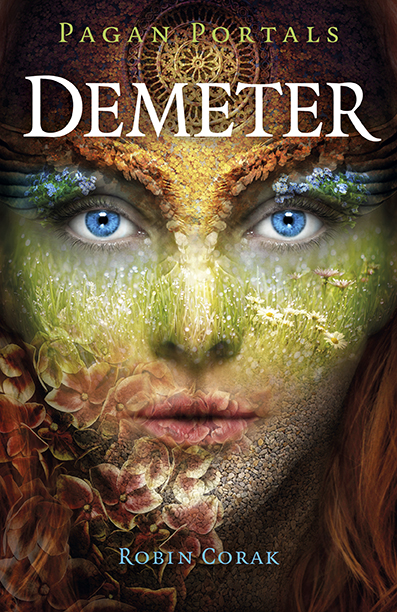
There are many ways that you can learn more about and develop a relationship with this multifaceted, powerful goddess. You can read about her many myths and explore her attributes and magick through books such as Pagan Portals’ “Demeter”. Gardening is a great way to make a connection with Demeter, as is learning more about policies and the law-making process in your local area. Setting up an altar or shrine with Demeter as the focus is another great way to get to know her better. Working with Demeter can provide rewards as bountiful and nurturing as the vegetation that she helps to flourish and the nurturing she offers, so that we may make manifest the sustenance and fuel necessary to thrive.
For more details: https://www.collectiveinkbooks.com/moon-books/authors/robin-corak
The goddesses and their myths have long been powerful forces in Robin Corak’s life, leading her to a passion for helping others to transform their lives by unleashing their full potential and recognizing the unique divine gifts that lie within. As a practicing pagan for nearly 20 years, Robin has been trained and initiated in the Taibhsear and NROOGD traditions and has been a member of the Sisterhood of Avalon since 2002, where she currently serves as its Board Secretary. She is also a skilled Tarot reader, a Reiki Master, a Priestess, and a leader in both the spiritual and non-profit community.
Since 2012, Robin has been the CEO of a non-profit, social services organization with a consolidated budget of $66 million. Throughout her 22 years in the non-profit field, she has helped thousands with diverse challenges to discover their often long neglected talents, take control of their lives, and achieve their dreams A leadership development coach and instructor for both adults and youth, Robin has won leadership awards such as Advancing Leadership’s 2017 Bob Wroblewski Servant Leadership award and Soroptomists of Federal Way’s Woman of Distinction and Women Helping Women awards Robin is a graduate of the University of Washington Non-Profit Leadership Institute, a member of the Forbes Non-Profit Council and possesses a Master’s Degree in Organizational Management.
Robin has had her writing featured in publications including Goddess, When She Rules, Flower Face Bloduewedd Anthology, Her Sacred Garden: An Avalonion Herbal Journey, and Pagan Writer’s Press Yule Anthology. In addition, Mrs. Corak has been a frequent contributor to online publications such as the Tor Stone, Forbes, Buddha Groove and The Call of the Morrigan. Robin was a presenter at the 2018 Pantheacon conference (SOA Hospitality Suite), Land, Sea, and Sky’s Year With Our Gods online conference series and the 2017 and 2018 Avacon conferences. She is scheduled to be a presenter at the 2019 Paganicon and has taught classes locally and online on topics such as Reiki, Divination, Incense Making, and Gods/Goddesses. Robin is the owner of Phoenix Awen Rising, an organization which provides transformative tarot readings, presentations, and coaching services designed to help individuals identify and achieve the life that they desire. You can find Robin at her website: http://www.phoenixawenrising.com. Phoenix Awen Rising can be found on Facebook at https://www.facebook.com/phoenixawenrising. Robin resides in Washington state.

 The Pagan Collective
Leave a comment