
These Pagan Portals are all current works in progress, serialised here on the Pagan Collective blog with each chapter being open for comment. In due course the entire script will be published as a Pagan Portal book.
This chapter is longer than most of the others because a lot of material needs to be covered, so it has been split into two parts. Last month was the first part and here is the second, a further exploration of Macha of the Tuatha De Danann. We’ll be looking at Macha’s family connections, her role among the Tuatha De, and how she fits into or with the Morrigan.
Family Connections
Macha of the Tuatha De Danann is the daughter or Ernmas according to the Lebor Gabala Erenn: “Three other daughters moreover had Ernmas, that is Badb and Macha and Morrigu, that is Anand her name.”. These three sisters are often grouped together and form the ‘tri Morrignae’ or three Morrigans referenced in sources like Cormac’s Glossary. Her most significant relationship throughout mythology is definitely with her two sisters. Her father is Delbaeth, who is at one point was a king of the Tuatha De Danann, and her mother is Ernmas, described as a farmer. Below we will explore some of her relatives and close connections.
Badb – another of the three Morrigans, Badb is Macha sister. Her name means hooded crow but late came to also mean a supernatural woman, witch, or night terror. These three meanings – Badb the goddess, crow, and supernatural woman/witch – can cause a lot of confusion in a story if the context isn’t entirely clear. Badb is particularly associated with the slaughter and cranage of war and with prophecy.
Morrigan – The Morrigan is the most prominent of the three sisters and the one that appears in most stories. Her name may be understood as either ‘great queen’ or ‘queen of phantoms’ and she is a driving force in most of the stories she appears in. Although not referred to by her personal name, only by title, the Morrigan is clearly a distinct individual in stories, often acting alone and sometimes acting with her two sisters. Macalister on his notes in the Lebor Gabala Erenn suggests that the Morrigan and Badb originally acted as paired deities and that Macha was added in later, but whether or not that’s the case they are strongly linked with each other now. The Morrigan is a complex goddess who is associated with war, battle, prophecy, incitement, satire, sovereignty, magic, and victory.
Ernmas – One of, if not the, most prolific of the Tuatha de Danann, Ernmas had at least 11 children including Macha. Of her four sons and seven daughters, the trio of Morrigan sisters and the trio of sovereignty goddesses (Banba, Fotla, and Eriu) are the most well-known and often discussed. Ernmas’s name means ‘iron death’ in older Irish and although she is named as a farmer in the Lebor Gabala Erenn she falls in battle against the Fir Bolg suggesting that she was a warrior which would make sense with her name.
Delbaeth – there are multiple beings named Delbaeth in Irish mythology; the one who seems to be Macha’s father was a king of the Tuatha De Danann at one point and is the son of Ogma. Listed as her father in some versions of the Lebor Gabala Erenn, he is also the father of many of her siblings. The meaning of his name is uncertain, but the Dindshenchas break the name down to ‘dolb aed’ or roughly ‘magical fire’.
Midhir – alternately the Dindshenchas names Midhir as Macha’s father; although this is a reference to a different Macha, Macha the Fairy woman (who will be discussed in the next chapter) I did want to mention this here as both are members of the Tuatha De Danann. Midhir is one of the Dagda’s sons and possesses the sidhe of Brí Leith in Ardagh.
Deala mac Loich – a final option for her father is mentioned by Elizabeth Grey in her notes on the Cath Maige Tuired. He is an obscure figure that we don’t know much about. The first part of his name is uncertain, deala may be related to a word for greediness or for affection or even for the proper order, each of which would give a very different tone to the character. ‘Mac Loich’ is easier and means son of Warrior.
Banba, Fotla, and Ériu – Macha’s three other sisters (who also, like her, appear within a grouping of three) are the main sovereignty goddesses of Ireland. According to the Lebor Gabala Erenn the Gaels [read: humans] only attained possession of Ireland because these three goddesses granted it to them in exchange for the island bearing their names. Fotla and Banba are now considered archaic terms for Ireland, but Ériu is the root of the modern name Eire. According to Foras Ar Erenn these three worshipped the three Morrigan sisters, although Keating offers no explanation as to why.
Nuada – Nuada was the king of the Tuatha De Danann when they first arrived in Ireland. In the battle against the Fir Bolg he lost his arm, which was replaced with one of silver , and because of this injury could no longer be king. Seven years later the original arm was restored allowing him to return to kingship and he stepped up to overthrow the king who had followed him, Bres, because of his poor rulership. According to the Cath Maige Tuired he died in the fight with the Fomorians, alongside Macha. Although she is never named as his wife in any story it is widely assumed to be true, and has become a common modern piece of folklore. At the least we can say that they fought and died together at the battle of Maige Tuired.
Macha of the Tuatha De Danann is a complex figure, more so perhaps than the other versions we’ve already discussed because we have more information about her. We know that she arrived with the Tuatha Dé Danann when they first came to Ireland and that she acted with her sisters during this time to magically attack the Fir Bolg and to go to the battle field with the warriors. There is no question that Macha is a member of the Tuatha De and that she acts in alignment with that, fighting in the battle against the Fomorians and falling with Nuada there (although we should keep in mind the transient nature of death with the Irish gods). This gives us a good amount of evidence that Macha was a warrior herself and would fight in the battle directly. Whereas the earlier iterations of Macha we discussed in chapter one and two had connections to creation and civilization, Macha of the Tuatha De Danann is linked to the opposite energy, to that of battle and death.
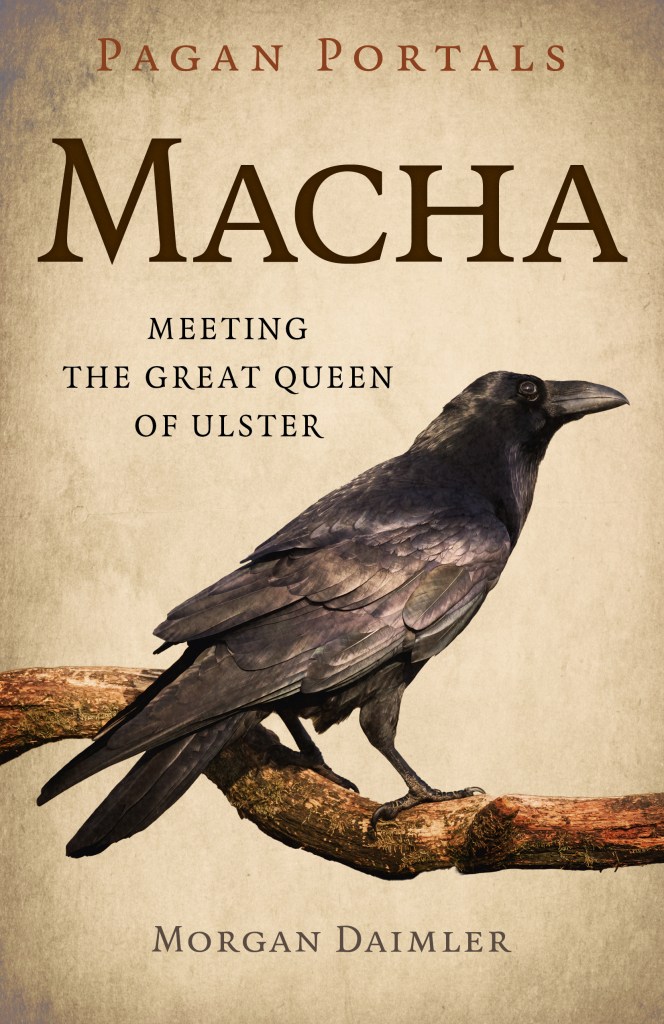
Macha as Morrigan is a more difficult topic, because there are some strongly divergent views on the subject. For some modern pagans Macha is understood as one facet or face of the Morrigan, one piece within a whole; in this understanding she exists within the Morrigan, who is an individual being that can manifest three different identities or personalities. In older sources she is never described this way but always mentioned in the context of an individual who is one of three distinct beings given the title of Morrigan. In this view the sisters act as a cohesive group but exist separately from each other as unique individuals. The three-in-one view is fairly widespread now, and the one-of-three view is less widely discussed.
Macha’s connections to her two sisters is a significant aspect of who Macha of the Tuatha De is, and I don’t think we can easily separate out her as a part of this triad and her as one of the Tuatha De Danann, because both identities are linked to each other; in almost all the references we have to her in mythology she is mentioned with the Morrigan and Badb, with the three presenting as a unit. In any case Macha is widely understood in this material as a deity of war and battle.
Macha in my Life – The Mound of Hostages
The main way Macha tends to be understood today is as one of the three Morrigans, as one part of a greater whole, but I have always found her to be a powerful goddess in her own right, and one who can appear with the Morrigan without being eclipsed by her. I experienced this for myself once in 2016, when I was visiting Teamhair [Tara] with a group. We wandered around the site, taking our time so we could experience as much of the amazing landscape as possible. I recited the Morrigan’s peace prophecy for the group near the Lia Fal and at one point I went to Dumha na nGiall [mound of hostages] the place in the Cét-Cath Maige Tuired where the Morrigan, Badb, and Macha had stood to curse the Fir Bolg. Standing there I had a visionary experience of all three of the Morrigans on the grassy dome of the mound, each distinct but clearly working together. Badb was on the left, clad in a cloak of black feathers, looking down and murmuring; the Morrigan stood in the middle, a fierce looking red-haired woman in leather armour, looking up with her arms raised, singing; Macha was on the right in a red tunic , arms stretched out towards the horizon, chanting. They were each very different and doing slightly different things, but at the same time they were united and somehow it all flowed smoothly together. I didn’t feel like Macha was eclipsed by the Morrigan or there in a supportive role, but rather that the three were on equal footing and working together.
It was one of many intense experiences I had on that trip, and one that stands out even today. It helped me see the three Morrignas in a new way, as deities who worked closely together but not as interchangeable names for one being. It also helped me to appreciate Macha, even within this triad, for herself and to see her magic and power not as part of the Morrigans but as complimentary to it.
For more details: https://www.collectiveinkbooks.com/moon-books/authors/morgan-daimler

 The Pagan Collective
Leave a reply to Lauren Johnson Cancel reply