

These Pagan Portals are all current works in progress, serialised here on the Pagan Collective blog with each chapter being open for comment. In due course the entire script will be published as a Pagan Portal book.
“My name,” said she, “and the name of that which I shall bear, will forever cleave to the place of this assembly. I am Macha, daughter of Sainreth mac Imbaith.”
The Debility of the Ulstermen
The Story – the Noinden Uliad
Once there was a wealthy farmer in Ard Macha [Armagh] named Crunnchu son of Agnoman who had four sons with his wife before she died, leaving him a widower. One day he was alone in his house when a beautiful, well dressed young woman came in. she spoke to no one, but tended the fire, cooked the afternoon meal, and milked the cow. When she came back in she turned around to the right then went into the kitchen and began instructing the servants, before going to sit next to Crunnchu at the table. After the meal she sat up until everyone had gone to bed, then banked the fire before turning around to the right a second time and then joined Crunnchu in his bed where they lay together. She found him very attractive and with her as his wife his wealth grew even greater.
Then the day came for Ulster’s assembly and Crunnchu said that he would like to go. Macha advised him not to, saying that their marriage would continue only if he never spoke of her at the assembly. He swore he wouldn’t do so, and so he left to go to the gathering with the rest of the local people. Once there he saw all manner of contests and entertainment, and well into the long day the king’s chariot horses were brought out to race; they were the finest par of horses seen in Ireland and all the people praised their beauty and speed. Hearing this Crunnchu couldn’t stop himself from saying that his wife could run even faster than these animals.
King Conchobar overheard this and angrily ordered Crunnchu to be seized by his soldiers and held until Macha could be brought to show the truth of the matter. The king sent messengers to Macha, to bring Macha back and she welcomed them when they arrived, asking why they had come, only to be informed that she had to go to the assembly to free him. She protested that she was in labour and about to give birth and couldn’t go, but agreed after the messengers told her Crunnchu would be executed otherwise.
When she arrived at the assembly the people crowded around, despite her pleas that it was shameful for her to be seen so heavily pregnant and labouring. She asked why she had been brought and the crowd yelled that it was to race the horses, to which she replied that she was soon to deliver her child – but hearing this Conchobar ordered Crunnchu to be killed. She begged the crowd to show her mercy, reminding them that each had been born of a mother and asking for only a small delay to give birth. The king refused and order her to race, and hearing that she told them that their treatment of her was unacceptable and that they would be infamous for it. The king asked her name then and she told him she was Macha daughter of Sainreth son of Imbaith, and the her name would forever be on that place. The race began and she ran faster than the wind, passing the horses easily and crossing the finish line well before them. She fell to her knees then and cried out, giving birth to a son and a daughter before the horses passed her.
Everyone who heard her cry out was seized with the same weakness of a woman in childbirth, and she proclaimed that because of their hard heartedness the whole province of Ulster would be afflicted the same way for five days and four nights whenever they were in the greatest need, with only women, children, and Cu Chulainn exempt from the curse. After pronouncing this fate on the assembly Macha and her children disappeared into the Otherworld.
Because of the twins she bore there the place was named Emhain Macha, a name it still bears today.
This is the story that we have for Macha of the Sidhe sometimes called Macha the Fairy Woman, and unlike Macha of the Tuatha De Danann she appears only in this single myth. Despite that there is a good amount of information provided in the story and a lot to discuss about this figure. We will look at the family associated with this Macha and then dive into some context for Irish fairy beliefs and how Macha fits into that.
Family relationships
Macha as daughter of Midhir – this is a claim we find in the Edinburgh Dindshenchas, which calls Macha ‘the sun of womanhood’ and daughter of Midhir. Midhir is one of the Tuatha De Danann, a son of the Dagda, and king of the sidhe of Brí Leith in Ardagh.
Macha as daughter of Sainreth – Sainreth is an obscure figure whose name may translate to ‘a particular characteristic’ or defining quality in a person.
Fír – Macha’s son according to the Dindshenchas, his name means ‘truth’.
Fíal – Macha’s daughter, twin sister to Fír, her name means ‘honour’.
Crunnchu – his name appears in a few variants across the stories; the meaning is uncertain. He is described as a wealthy farmer, a man who wouldn’t have been nobility but would still have held a high social standing. We know from the story that he was a widower and had at least four children prior to Macha’s arrival.
Fairies in Irish Myth & Folklore
This is of course a massive topic that entire books can be written about, so here we will only be focusing on a few highlights. I have a book, Pagan Portals Aos Sidhe, for those who would like a deeper dive into these beliefs.
Macha appears in this story as a woman of the Sidhe, coming into the human world for her own obscure purpose and choosing to become the wife of a mortal man. It is important here then to give some context to beliefs around the sidhe [otherworldly hills] in Ireland which are different from ideas about fairies in popculture. The Irish sidhe often appear very similar to humans, but with an Otherworldly aura to them; they are sometimes said to be extremely beautiful but in other stories may be described as looking just like any of the local human population. They are said to live in the sidhe, the Otherworldly mounds, and can travel between the human world and Otherworld freely. In various stories they may also live on mythic islands found in the sea and, in some others, they are associated with particular trees. In all cases they are seen as beings who are adjacent to but distinct from humanity, in the same way their world is.
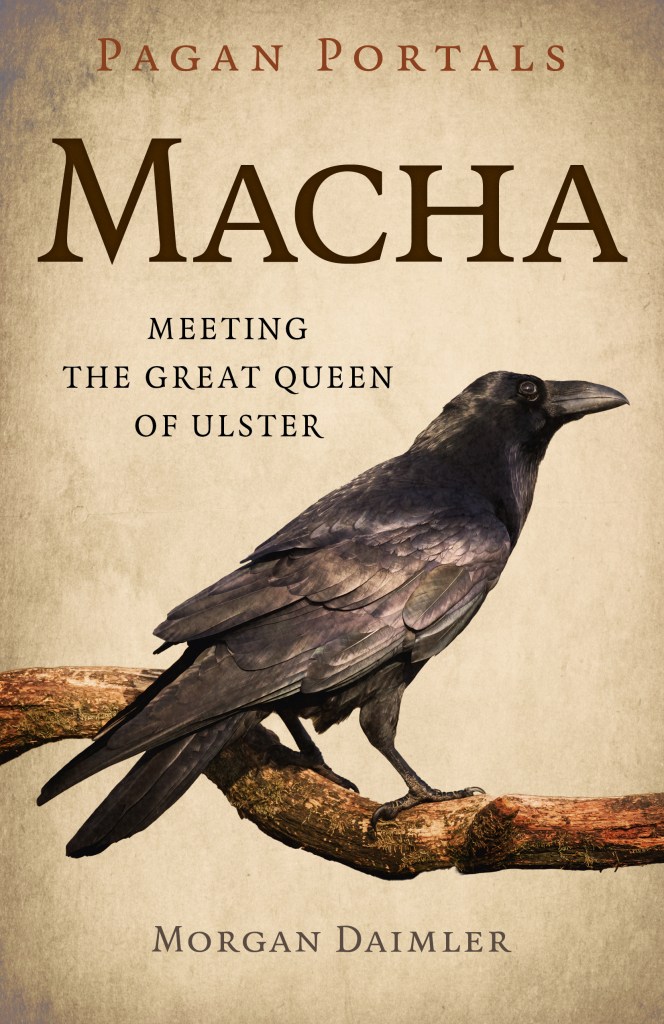
The Aos Sidhe [people of the otherworldly hills] are powerful beings who can influence humans in various ways, from effecting their luck to health, for good or ill. They can do this directly via elfshot, an invisible fairy arrow which can make a person or animal sick, and the fairy-touch which can drive a person mad, or they can use their magic. In most stories the Aos Sidhe only cause harm in response to some offense – although what they consider offensive isn’t what a human might – but in some cases they don’t seem to need any motivation. They are known to occasionally steal humans, from infants to young people, to new brides and new mothers, to add to their own population or to serve them in some fashion. The Aos sidhe also possess a kind of magic that distorts human sense and can cause a human to perceive the world around them in whatever way the aos sidhe want. They are respected and feared, and many protections exist to prevent their interference in human life.
It is also established across folk belief that both the Tuatha De Danann and the aos sidhe can and may reproduce with humans. Various families trace their lineage back to members of the Tuatha De and some families share stories of ancestors among the sidhe-folk. This is an important thing to understand when listening to or reading the story of Macha of the sidhe, who takes a mortal husband and bears him children, because those aspects of the tale are not unique to Macha.
Macha as a Fairy Bride
Macha here fits the description of a fairy bride, a woman of the sidhe who marries a mortal (Clark, 1991). Fairy brides always bring blessings with them and also a prohibition that cannot be broken or the marriage will immediately end. In this case that prohibition is that Crunnchu must not speak of her to the people of the assembly, or perhaps to anyone outside the household. When he breaks his promise not to do so Macha must leave him, although luckily for him she chooses to go to race first, thus saving his life. In most tales like this the fairy wife or lover leaves immediately and the human spouse is unable to stop them going. The only other tale I am aware of where a fairy bride acts to save her lover even after he betrays his promise is found in the Arthurian tale of Sir Lanaval, where – like Crunnchu – Lanaval has been put under a prohibition not to speak of his fairy mistress but does so anyway; he is told to either produce this fairy woman to prove his story or die and moved by some love or pity for him the fairy woman chooses to come and save his life. In the same way Macha is given the option to simply leave but chooses instead to go to the assembly to save her mortal husband.
Generally when a fairy bride leaves she also takes with her both the luck she brought as well as any property; she may or may not take her half-human children with her. Briggs describes fairy brides as both tragic and wonderful, as they emphasize the enchantment of the fairy world and its inhabitants but also always end in tragedy for the human (Briggs, 1976). In Macha’s case she doesn’t take anything away with her except her children, although there are versions of the story where only she leaves or is said to die, however even in the versions where she lives one can easily argue that her curse on the men of Ulster, while justified, counts as a tragic ending of the story.
Macha of the Sidhe is a unique figure, one who isn’t connected to either colonization/cultivating a new place or warfare but to the domestic sphere, despite being the quintessential outsider. However in this story as in the earlier iterations of Macha she is strongly connected to magic, in this case specifically cursing. Her curse echoes the battle magic of Macha of the Tuatha De, by impacting the Ulstermen when they are in a time of great need and physically weakening them. Here we see Macha as a force of justice, where her curse isn’t given from maliciousness but from righteous anger at being greatly wronged. She is humiliated in front of the crowd and forced to give birth in the dirt of the race track, and her curse enacts justice by making those who caused her pain feel for themselves what it is to give birth, to be weak, to be helpless when facing difficulties. The names of her two children – truth and honour – reflect this as well by showing that she is in the right, following a pattern in Irish myth where children born in a story often have names reflecting their circumstances or nature. This Macha is a strong figure who embodies perseverance and determination against great odds which ties in to her other iterations as well. Macha of the fairies could very easily be the same figure as Macha of the Tuatha De Danann, because when humans arrived in Ireland all of the Tuatha De went into the sidhe and became aos sidhe, joining the population that was already there. Macha of the Tuatha De is said to have died in the Cath Maige Tuired, but death is ephemeral and impermanent for the Irish gods, so it isn’t a stretch in my opinion to see her as eternal and as one of the Aos Sidhe in the same way all the other Tuatha De Danann are. It is true she is given different parentage in these myths, but the genealogy of the gods is convoluted and often contradictory so I’m not sure that alone is enough to differentiate these figures. In the story Macha is called a ‘banscál’, a complicated term which can mean a warrior woman or woman in general, but the term scál has older connotations of a supernatural figure or phantom. So banscál could also mean supernatural woman, further connecting her to the sidhe but also perhaps to the gods within the Otherworldly mounds. It is food for thought at least.
Macha in my Life – Emhain Macha
I was able to visit Emhain Macha – also known as Navan Fort – in 2016 when I was in Armagh with a group tour. Emhain Macha historically was the site of the seat of power of Ulster, from which kings ruled and it shows continues occupation since the neolithic. The location includes several important sites: two mounds, one of which is believed to have been a main ceremonial site; what is said in local folklore to be the racetrack from the story; a stone that folklore claims is where Macha gave birth; and a modern recreation of a small iron age settlement .
I visited on the first of November, Samhain , and went first to the iron age settlement area. It was fun to hear the re-enactors telling stories and to experience what life in that time may have been like. After this we walked towards the mound itself and on the way we passed the place that is, according to local belief, the location of the racetrack where Macha ran and near that a stone that (also according to local folklore) marks the place where Macha gave birth. I paused here for several minutes, just looking at everything and thinking of how strongly Macha’s story is embedded in that land. It was very moving to stand where tales say Macha herself stood, to stand where she raced, and birthed, and left the human world. Although I don’t believe the myths are literally true there was still a numinous feeling there, enmeshed with the trees, and stones, and earth by the countless generations who had been there and talked of Macha, who believed that she had stood there, run there. It is impossible to properly put the feeling into words.
Eventually we moved on to the main mound at the site, the location of the original fort. It is a small, steep hill surrounded by trees, somewhat challenging to climb but worth the effort. Standing at the summit I found myself drawn to a smaller site just to the side of the main one, and I went over there to connect to the place. It was a moving experience but the feelings at the stone were more intense. There was something about standing there imagining the race and the curse that moved me more deeply than visiting the main archaeological site nearby.
With the Irish gods I believe it is important to try to visit the places that anchor their stories, to see and experience for one’s self what it is to stand where these beings are once said to have stood. I know that isn’t possible for everyone, for a variety of reasons, and if you can’t have this opportunity I think that utilizing online virtual tours or pictures may also work. Too often, especially as Americans, people may not grasp how entrenched Irish myth is in the landscape, the way that story and place intertwine, and I think that understanding is vital. The Gods and spirits can and do go where they please but nonetheless appreciating the earth and stone and tress that anchor their stories in this world is vital. It makes the gods immediate and present in ways that simply hearing the stories doesn’t.
References
Briggs, K., (1976) A Dictionary of Fairies
Clark, R., (1991) The Great Queens: Irish Goddesses from the Morrigan to Cathleen ní Hoolihan
Gwynn, E., (1926) Metrical Dindshenchas vol 4
Stokes, W., (1893) ‘The Edinburgh Dindshenchas’, Folklore 4



 The Pagan Collective
Leave a reply to Morgan Daimler Cancel reply