

These Pagan Portals are all current works in progress, serialised here on the Pagan Collective blog with each chapter being open for comment. In due course the entire script will be published as a Pagan Portal book.
The Conclusion
“The furies and monsters and hags of doom cried aloud so that their voices were heard in the rocks and waterfalls and in the hollows of the earth…. In the van of the Tuatha De advanced the [warriors and] the three queens, Ere, Fotla and Banba, and the three sorceresses, Badb, Macha and the Morigan, with Bechuille and Danann their two foster-mothers. They fixed their pillars in the ground to prevent any one fleeing till the stones should flee.”
The First Battle of Moytirra, Fraser, 1916
Macha is a complex goddess, as we have seen throughout this book. She appears in stories as a primal being, a creatrix, a war goddess, a woman of the Sidhe, and a human queen, with each version ambiguously related to the others leaving a lot of room for debate and personal belief. However, when we look closely at each of these appearances we can find threads that connect them, deeper themes and purviews that they share, and story motifs that echo each other. Each story can be read and understood separately, taken as a cohesive whole, or stitched together from specific pieces, yet Macha remains the driving force behind them. She is different in each yet also the same, in a contradiction that is foundational to understanding her. Macha is more than the sum of her individual stories; she is a constant presence throughout the wider story of Irish myth and is solidly anchored in the modern world, embedded in the land and living within the human heart.
This book hasn’t been about dictating to the reader what to believe about Macha, but rather about offering the mythology and modern ideas so that the reader can decide for themselves. No one can tell you what you believe or how this information will make sense to you, and as shown in the introduction even scholars don’t agree on these things. Macha, no matter how well we know her, is a mystery who defies precise definitions. Her strength lies in that fact, in her inability to be easily understood or reduced down to a simple view. There is no right or wrong in how you as an individual conceptualize Macha or how you believe her stories join together – or don’t. Even after decades of studying her, honouring her, and acting as her priestess I still question things and work – and re-work – these pieces together in new combinations.
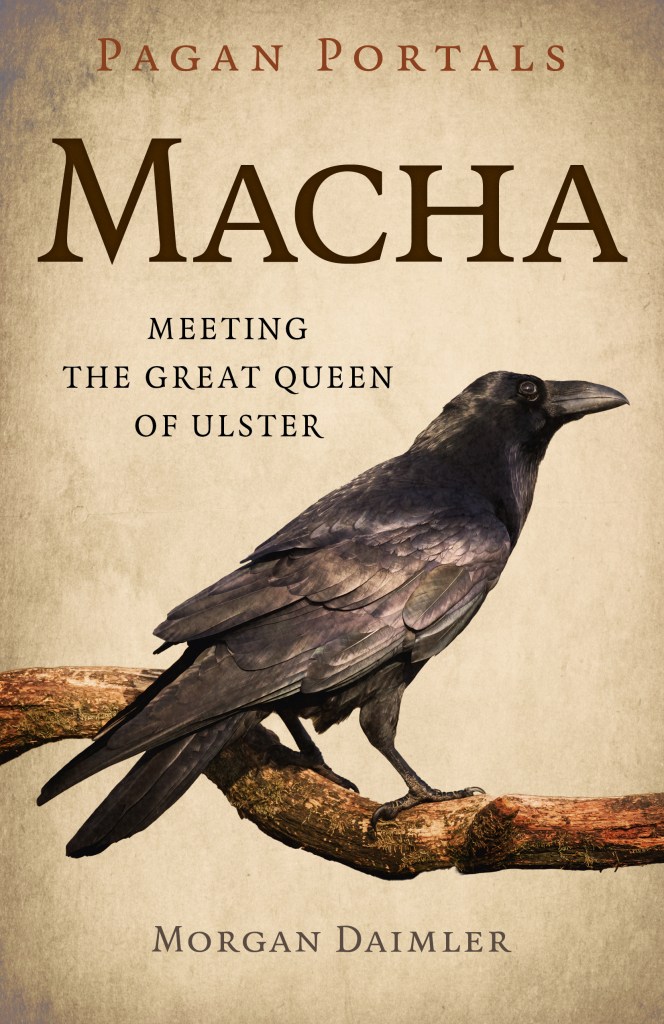
In many ways the wider story of Macha is the story of the Tuatha De Danann because they also are more complex and convoluted than they first appear. Across history and into today people have endlessly debated who and what the Tuatha De are, what role they played in pagan Ireland, if they existed as gods there, and how people would have understood them in the past. Were they literary inventions of the Middle Ages? Were they ancestral spirits? Were they gods imported from continental Celtic cultures or were they born in Ireland? Each of these questions has been asked of the Tuatha De and also of Macha herself as various writers wrestle with her stories and try to find cohesive answers to her place in myth and in human belief.
At the start of this text I said that when people hear or see Macha’s name they often immediately think of the Morrigan, subsuming her as an individual into the grouping she is part of with her sisters. I hope that this book has shown that Macha is much more than just one of the three Morrigans, that she is a force in her own right and a powerful deity with a distinct personality. She is one of the Morrigans but she isn’t only that, and her connection to her sisters offers just one small piece of her to those seeking. As powerful and important as that role is for her, and it is an essential aspect of Macha, she isn’t limited to or by the title Morrigan, rather it forms a foundation that is built on from there. In the same way that she is a battle goddess but also more than just a battle goddess, she is one of the Great Queens but also much more than just one face of the Morrigan. Understanding her means looking beyond the surface and beyond the Morrigan to find the depth of the individual within the group.
Macha is the wife of Partholon who helped to settle Ireland and bring civilization to the wilderness. She is the wife of Nemed who shaped the land and foresaw the distant future. She is one of the Morrigans who with her sisters brought battle magic and victory to the Tuatha De Danann. She is the fairy woman who cursed the men of Ulster for their cruelty to her and set the stage for the greatest Irish epic, the Cattle Raid of Cooley. She is the human queen who wouldn’t accept her place being limited by powerful men and who ruled by her own might. She is all of these things, and she is more than these things. Her stories are a beginning to understanding her, not an end, just as the myths are a beginning to understanding the Irish gods but not an end.
The Dindshenchas calls Macha ‘the sun of womanhood’; may she light your way as you seek to understand her through the complex layers of story that surround her.
For more details: https://www.collectiveinkbooks.com/moon-books/authors/morgan-daimler

 The Pagan Collective
Leave a comment