
Let me start by introducing myself, as this is my first blog here. My name is Imelda Almqvist. Moon Books has published my five non-fiction books so far. Portals, Patterns and Pathways, my upcoming handbook for rune magicians, will be published on 26 May 2026.
In many cultures today is the Day of the Dead: Hallowe’en, Samhain, Día de Muertos, Álfablót. The Old Norse word Álfablót literally means the Sacrifice to the Elves or the Offering Ceremony for the Elves.
Hallowe’en has recently become “a thing” here in Sweden. Swedish supermarkets now sell the standard Hallowe’en decorations. I have mixed feelings about this. Obviously, Swedish children watch TV and movies. They want to go trick-or-treating, just like children in the UK and the US do. I get that.
Yet, what that saddens me is that many Scandinavian people do not seem to realise (or even care) that Scandinavia had its own festival and rituals at this time of year. I would love to see more people opt for reviving ancestral celebrations – or even organising a mixed celebration: Hallowe’en decorations, costumes and trick-or-treating for the kids (why not in a global village?) but also a genuine ritual, dedicated to honouring the Ancestors, for the grown-ups.
These days, I observe two prevailing attitudes when it comes to Ancestors. One is: “They are dead and nothing to do with me!” It is true that they are dead, but once they were as alive and vivid as you are right now. You only exist because they passed on the Gift of Life, as well as the genetic material required to grow a human body.
The second attitude goes something like: “My Ancestors weren’t very nice people while they were alive, so dying did not turn them into Saints overnight. Most of them are probably toxic, so I am going to stay well clear!”
Well, Ancestors and Saints are not the same thing, that is correct. Dying does not miraculously turn a “bad” person into a “good” person. However, I do believe that human consciousness continues to evolve after death. I also believe that there is greater clarity of vision (at least for some souls) when earthly and karmic attachments drop away, and a higher (soul) perspective appears.
Finally, we can never fully see where a person comes/came from, because we have not walked the proverbial mile in their shoes. It is easy to judge a person’s failings and failures. It is only “too easy” to believe family stories (which often represent a very one-sided or biased point of view because families are cruel to those who do not fit in). For that reason, I am willing to give my ancestors some benefit of the doubt (and second chances). When I do shamanic or ancestral healing work, many of my ancestors loyally arrive to support me, and I could not possibly do that work without them.
The Nitty Gritty of the Álfablót
The Elves (or Álfar) of the Northern European Tradition are not “fairies”, but the souls of male dead ancestors who choose to live on as nature spirits and guardians of home, land, barns and livestock. They often live in burial mounds, though we also find them under big rocks, in caves or in the mountains. Making offerings is one respectful way of communicating with them.
We acknowledge that they, too, once walked the land and that they have now become part of the spiritual weave of the land. By honouring them (and leaving food and drink out for them), we ensure that they are “on our side” and that we have their cooperation and protection during the winter months (remember that Scandinavian winters are prolonged, harsh and severe).
In the Old Norse way of thinking, every gift (gåva in contemporary Swedish) required a return gift (gengåva). There is nothing cynical about this; it follows the cosmic law of keeping all exchanges balanced and fair. (Today, we often speak of the principle of fair energy exchange or sacred reciprocity). This is what Rune GIFU (or Gebo) is all about. It looks like the capital letter X (also used to sign off with a kiss in modern messages).
In the past, farm animals were sacrificed, at this time of year, and their blood poured out as a sacred offering (blót is the Old Norse word for blood), but today most practitioners feel that alternative offerings are acceptable.
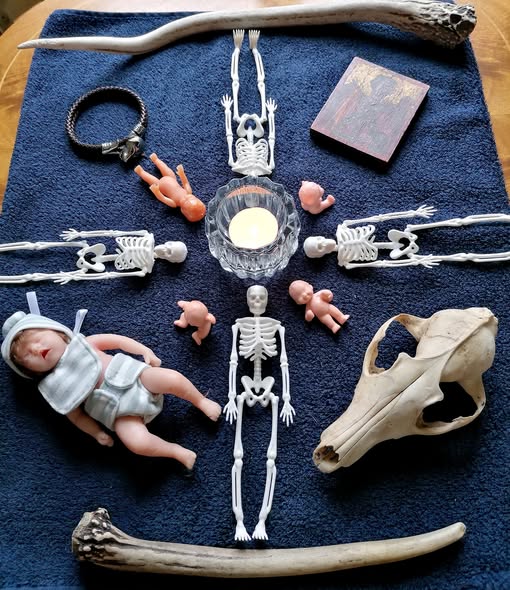
The Álfar are the male ancestors. The female ancestors (Dísir) have their own special day in the Yule period (Modranatt or Ancestral Mothers’ Night) as well as the Dísablót (Offering ritual to the female ancestors) in early Spring.
Some Practical Pointers
When night falls, make a fire, if you can. Light a candle, if that is safe. Even a battery-operated candle (or picture of a flame) will do. Intention is what matters.
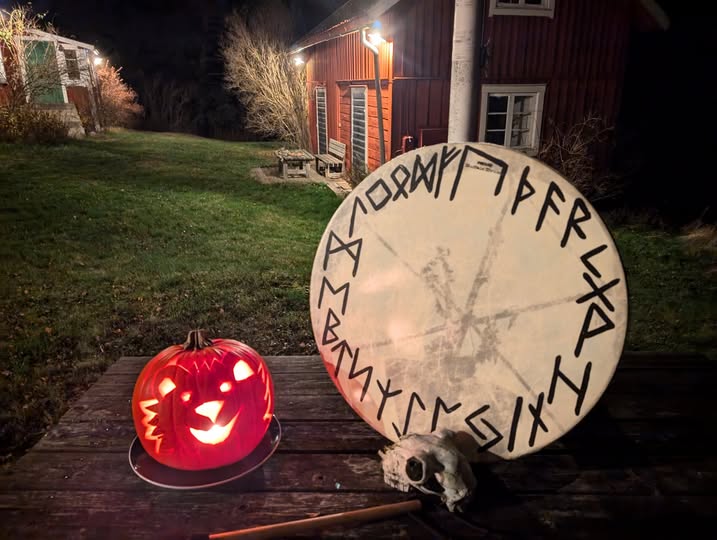
Make offerings to the ancestors and the spirits of place (ale and meat are traditional offerings, but they also appreciate good whiskey). I usually drum and chant the runes
Recite the known names of ancestors you have access to. Work your way back through the generations. It is a beautiful thing to say: I am the daughter of…. I am the granddaughter of…. And so forth. As a long-term married person, I will also say: I am the daughter-in-law of … etc.
Honour them and take a moment to acknowledge the hard lives they had, the children they lost. Do some apology work, if any is needed. Bless them and ask them to bless you (all of us, the living) in return.
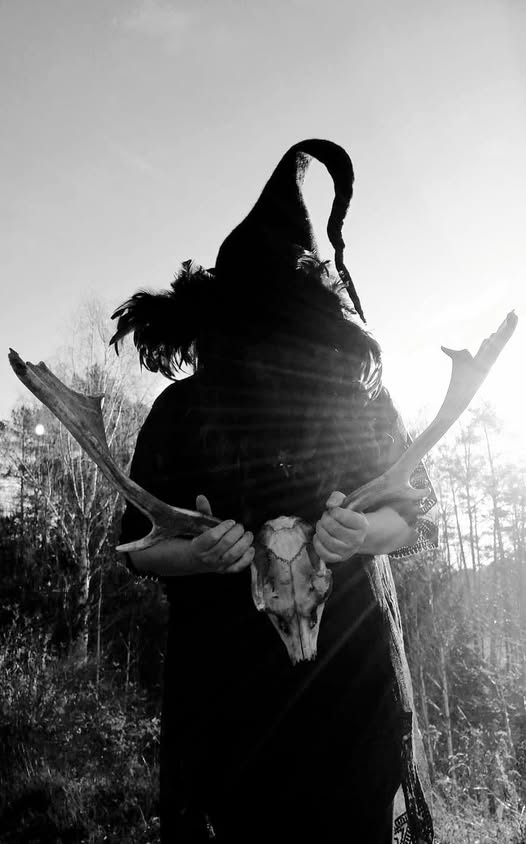
Odin’s name literally means “The Spirit” (Odr means Spirit/Frenzy/Poetry + the definite article “inn”) and he is associated with the wind, sacred breath and The Wild Hunt. Pray to all wind directions. Welcome the approaching Winds of Winter (or Summer if you are in the Southern Hemisphere).
For more details: https://www.collectiveinkbooks.com/moon-books/authors/imelda-almqvist
Imelda Almqvist is an international teacher of Sacred Art and Seidr/Old Norse Traditions (the ancestral wisdom teachings of Northern Europe). She has published three books: Natural Born Shamans: A Spiritual Toolkit for Life (Using shamanism creatively with young people of all ages) in 2016, Sacred Art: A Hollow Bone for Spirit (Where Art Meets Shamanism) in 2019 and Medicine of the Imagination – Dwelling in possibility (an impassioned plea for fearless imagination) in 2020. She has presented her work on both The Shift Network and Sounds True. She appears in a TV program, titled Ice Age Shaman, made for the Smithsonian Museum, in the series Mystic Britain, talking about Neolithic arctic deer shamanism. Her fourth book, about the pre-Christian spirituality of The Netherlands and Low Countries, has just gone into production. She has already started her fifth book: about the runes of the Futhark/Uthark. In response to the 2020 pandemic she has opened an on-line school, called Pregnant Hag Teachings, to make more of her classes available on-line. Website: www.shaman-healer-painter.co.uk
 The Pagan Collective
Leave a reply to Álfablót – ett nordiskt Samhain – Creating a Magical Place Cancel reply