

These Pagan Portals are all current works in progress, serialised here on the Pagan Collective blog with each chapter being open for comment. In due course the entire script will be published as a Pagan Portal book.

Not every hag stone is meant to be taken home. This is perhaps the first and most important lesson when foraging for them.
Once you begin working with hag stones, you will start seeing them everywhere – on beaches, riverbanks, woodland paths; tucked into walls like prizes, or staring up at you like eyes from muddy sockets. The world suddenly seems full of holes and hollows, as though the land has been trying to share these with you all along. It can be tempting, then, to greedily gather these up, pocketing every pierced pebble and stowing away each and every rock that rolls into vision.
But hag stones aren’t souvenirs. They are more than just ‘found objects’. Their properties are formed through a long process of relationship – by sea, tide, creature, weather, time. Some have waited decades, even centuries, to become what they are. To work with them magically asks something of us in return – our respect.
Finding a hag stone isn’t a form of shopping. It’s a meeting of two entities; two energies; two embodied sparks of spirit.
And, as with any such meeting, consent is a component when deciding what happens next. Because some stones want to accompany you on your journey. Others do not.
So how do we tell the difference?
Foraging With Intuition
People often ask me where to find hag stones, as though there might be a map or a hidden beach where they lie glittering in abundance, waiting to be claimed. There are practical answers, of course – tidal shores, river banks, estuaries, limestone coasts – places where water has long been in conversation with stone.
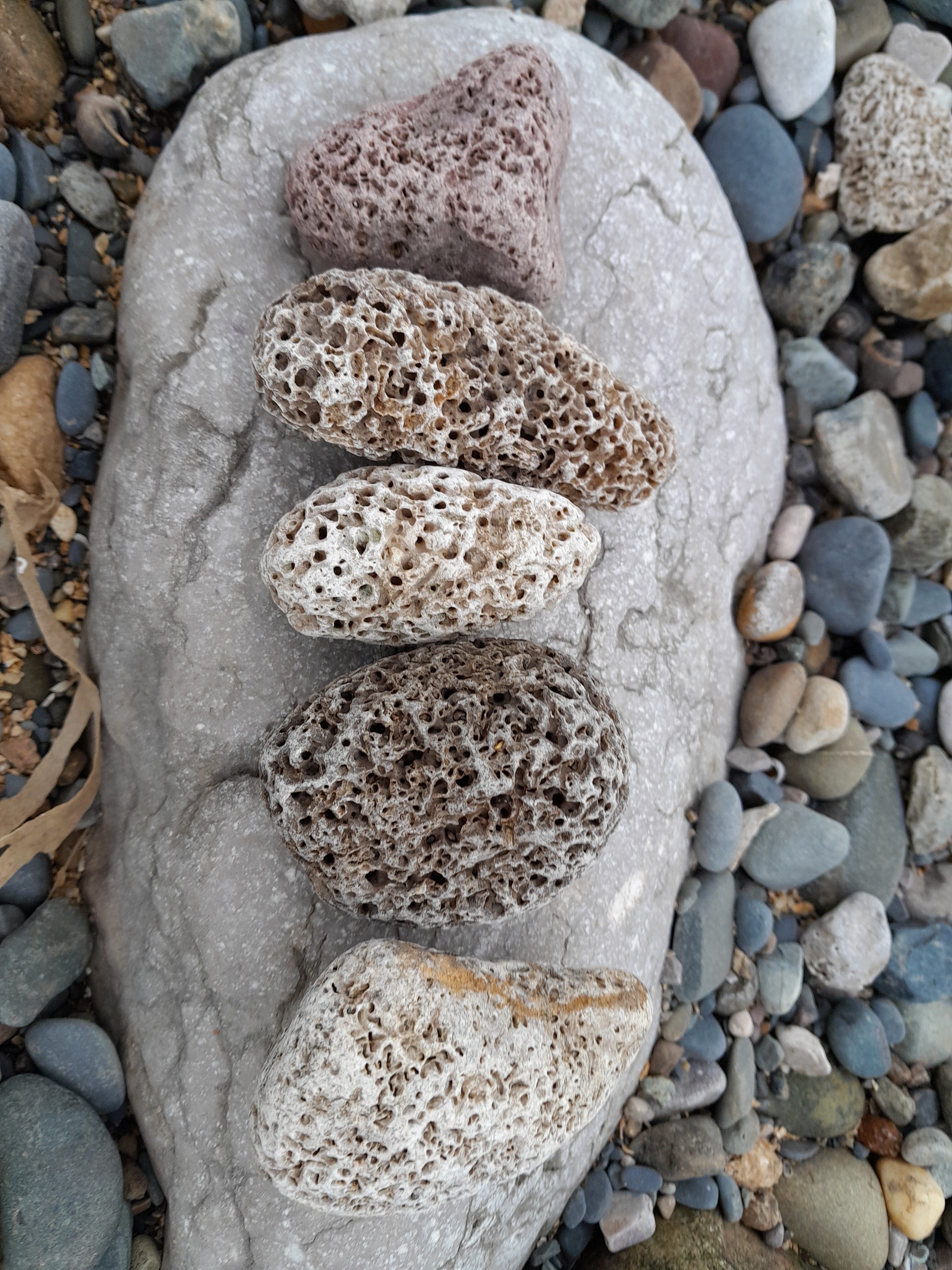
In South Wales, where I live, I find many along the coast, particularly where there are piddocks, and the rock is softer, shale-like. On the beach in Rhos-on-Sea, next to the northern coast, where my partner is from, there are again many hag stones, but of the type rendered through repeated meetings with sea and smaller rocks. You shake a stone here, and these smaller shards shake themselves out like talcum powder. So, some beaches are palpably rich with them, and if you know where to go, you find many in a single walk.
So the question is not always where to find a hag stone, because we can discern that quite easily. It’s how to choose one, and this is where intuition enters the picture.
Not every holed stone is meant for you. Not every hag stone wants to be your ally. You might stand on a shore scattered with rocky possibilities, and still only one will feel right in your palm. The job is less about searching frantically, finding, or gathering a collection, and more about learning how to work with respect, to recognise, and to only pick up when prompted.
In my case, I have collected many hag stones, but I believe this is because I also run many groups – as soon as most of these stones came into my care, they wanted to be off again. I have gifted them on walks, in workshops, to friends, to strangers, and more. Now I am called to write a book about them. But I haven’t felt the need to go actively foraging for over a year. So, I consider myself, at the current time, a kind of ‘stone keeper’. You must find your own way, through intuitive feeling, too.
Sometimes, when walking, a stone appears unexpectedly in a place where there aren’t usually any. These encounters often carry an invitation – the feeling that the stone has presented itself, deliberately putting itself in your path, and wants to return home with you.
At other times, you go hunting deliberately. And, in that case, ask. Try traversing the shoreline with purpose, holding a question in your mind – do you need protection, clarity, guidance, healing? Ask for what you want right now. You could even say it aloud: If there’s a stone for me today, let this ally come my way. Then listen, look, and watch for what the earth smiles your way, spitting up a stone like a tooth in a cheerful grin.
I’ve found hag stones both ways. Some arrived as a surprise; others came when called. The stone meets you where you are – right place, right time, right rock, essentially.
When out and about with an aim of foraging, do your best to slow down. Don’t scan the ground like it’s a list of items on Amazon. Don’t scroll. Walk differently; deliberately. Let yourself be drawn forward, here and there. Meandering, I like to call it. Notice where your body pauses without conscious instruction. Which stretch of shore feels strangely magnetic? Which pebble winks your way, asking to be turned over? Which stone feels warm, weighty, weird, or somehow familiar in your hand?
Be in your body as much as you can and ‘search’ through the eye of your soul.

Ritual of the Search
Finding a hag stone can become its own kind of ritual. This doesn’t need to be elaborate, prolonged, or dramatic. Magic doesn’t always require theatre; attention is, perhaps, the main thing. Sometimes my own preparation is as simple as clearing my bag before I leave the house, standing for a moment at the door, and setting my intention before I start out.
Some of you might prefer something more formal or formulaic. You might cleanse yourself beforehand with smoke or salt water; walk during a particular moon phase; carry an offering for the land; or approach the journey as if it’s a pilgrimage. There’s no single correct method. Listen to yourself, the land around you, and intuit your own way of finding.
I often like to bring something small to offer in place of the stone – a little water poured from my bottle or a few seeds scattered for whatever comes next. If I’m feeling it, then a bit of a poem, whispered into the wind, might seem right; but at other times, this might seem pretentious or presumptuous. Saying thank you is always apt, and if something is offered, then it’s not as a payment but always in the spirit of reciprocity and right exchange.
A hag stone search can quite easily morph into meditation. Walking and watching the tick of the tide. Noting, with wonder, how light licks wet stone. Listening to the gulls haggling and tongue-wagging next to the waves. Feeling the wind tousling your top-hairs. The entire landscape becomes its own spell in these moments, and is an integral element of the hag stone hunt, for me.
Sometimes, the stone becomes so secondary that I almost forget I am after one. And then it’s particularly wonderful when one flashes like a wink and is suddenly right there, before my feet. The mindful/mindless sense of ‘meandering’ is an enjoyable aspect of hag stone hunting and something I would encourage you to play with.
Ethical Sourcing and the Spirit of the Stone
Modern spirituality can sometimes look like another form of collecting. Crystals, feathers, bones and shells, all gathered up until reverence and accumulation look identical.
Hag stones are another ‘thing’ we might be tempted to add to our collections. And, because they are free, we might assume that this thinking is consequence-free. But free isn’t the same as not having a value. If every person walking a shoreline pockets twenty tiny stones, eventually the beach begins to lose part of its soul. If we add too many objects to our nests and get lost in consumerism, we lose our own.
Ethical sourcing begins with us internalising the concept of ‘enoughness’ and only taking what we need – and no more.
So, take one; take two. If you feel called, take twenty hag stones, but make sure that the call is true. Take only what you will genuinely work with. Leave enough for someone – for everyone – else, and for the place itself. Not every magical thing needs to be owned in order for it to be experienced. You might even work with a stone at the spot of its finding, and then replace it, for example.
Certain stones feel very rooted in their original environment. A hag stone sitting half-submerged inside a tidal pool, or long-embedded along a footpath, balancing like a compass in the roots of a tree, or resting at the threshold of a forgotten ruin, may not wish to leave. Some stones are still in conversation with their surroundings and want to remain so.
I have picked up stones that felt immediately wrong in my hand – heavy, flinty, cool, almost like they’re offended. Others feel bright, warm, eager, tactile. Even in the icy waters of Wales, I have felt ‘cold’ stones that were ‘warm’ to my psychic senses. Again, this is something to consider and to experiment with in your own foraging.
Choosing the Stone
Not every hag stone is asking to come home with you. Some, when we meet them, are unmistakably companions. They fit the hand as though shaped for it. They settle against the chest without feeling odd. When threaded onto cord, they seem to relax into place rather than protest; feel still instead of jumpy. These are often the stones that wish to travel with us; they desire to become pendants, pocket talismans, altar companions, ritual allies.
Try letting the stone tell you what it wants. Listen to it. Look with your inner sight. Hold it, and let it go if that feels right, too.
When you are back at home and choosing a stone to wear, notice your body’s response before your mind begins its commentary. Do you feel steadier holding it? Clearer? More protected? More awake? Does your breathing slow? Do your muscles soften? Are your hands warm around it? The body is a better diviner than the intellect, usually.
You might dowse with a pendulum over the stone to discern if it wants to be worn. A useful meditation is to sit quietly, holding the hag stone in both hands. Close your eyes if you’d like to. Breathe slowly. Ask inwardly: Do you wish to work with me? Then note any changes in the stone or through your senses as it answers.
Don’t expect a dramatic response from this little flint. The reply might arrive as a spurt of warmth; a sense of slight heaviness or ease; a feeling of resistance; a sudden certainty; or even the desire to put the stone down. Trust the first feeling before any mental doubt swoops in.
A stone for wearing should feel like a magical relationship, of course, not a mere accessory. I create hag stone pendants and charms not because they are decorative – though they are beautiful, and I believe that beauty is a kind of soul balm – but because adornment is one of the oldest magical technologies we have. What rests against the skin becomes part of the body’s outer boundary. It witnesses your moods, your manners, your ordinary days and your more extraordinary ones. It’s there for your heartaches, your backaches, your breakthroughs. Through resonance, it becomes part of you, and by wearing a hag stone, you let it become part of your life.
Then there are the stones that don’t wish to be touched, let alone taken. I feel that the energies of stones are subtle – less obvious than, say, crystals – so learning to discern is a part of the work with hag stones. I do also believe that leaving rocks where they are could be one of the most magical acts available to us right now. We live in a culture obsessed with possession – in thrall to it, perhaps. To see something beautiful, powerful, and sacred – and choose not to own it – is a radical and most magical (non-) act.
Try this as a little experiment. If you lift a stone and feel it should stay where it is, place it back exactly where you found it. Touch the earth around it with your fingers and thank the stone for letting you engage with it for a moment. Then, simply walk away. If anything rises in you – any sense of need, or fear of missing out – then that’s what you should be working with, instead of gathering right now.
Plus, a hag stone left where it is doesn’t need an altar, ribbon, or sanctifying words. It is already in ceremony by dint of its existence. Learning humility through this recognition – we ‘need’ stones; they don’t need us – is also part of the work.
Not every walk ends with finding a hag stone, though. Some days, certain beaches offer nothing. Perhaps the tide is in, everything eaten by sea. Or maybe sand has swallowed those usual pockets of rock. The day gives us only gulls, wet feet, and cold hands. And that’s okay too, because such an experience reminds us that this work isn’t a vending machine – insert intention, receive object. The Earth isn’t a shop, and neither nature nor spirit is obliged to perform on demand.
Patience is also something we are encouraged to learn in our hag stone hunt. Sometimes the lesson is not in finding, but in being willing to return, in humility and gratitude, until the land decides to answer.
A Small Blessing Before Taking
When you do find a stone that feels ready to travel with you, pause before slipping it into your pocket.
Touch it. Sense it. Speak aloud if you wish to. I often say something simple like:
If you are willing, give me your heart.
If you are not, now let us part.
Then I wait, trusting what I sense coming from the stone.
Before leaving, I offer my thanks. This small act matters because I feel it keeps the exchange polite, respectful, and honest. Remember, we are never really taking a hag stone – we are just being allowed to carry one for a while. One day, we won’t be here any longer, but that little holey rock will remain.
And this is a very different angle from which to approach our hag stone work.
For more details: https://www.collectiveinkbooks.com/moon-books/authors/mab-jones

Mab Jones is a “unique talent” (The Times) who has read her work all over the UK, in the US, France, Ireland and Japan. She is the winner of many awards and accolades, including the John Tripp Spoken Poetry Audience Award, the Word Factory Neil Gaiman Short Story competition, the Wolverhampton Literature Festival Poetry Prize, the Aurora Poetry Prize, the Rabbit Heart Poetry Film Festival Grand Jury Prize, and the Geoff Stevens Memorial Poetry Prize, amongst others.
Mab has made and presented several BBC radio programmes with a poetic theme, and has also appeared on BBC television. She has written for the New York Times, was coordinator of International Dylan Thomas Day, and was, for a time, the social media manager for world famous writer Wilbur Smith. As a poet, she is the author of three published collections and three pamphlets. She additionally runs two small presses, and has been publishing since she was a teenager.


Leave a Reply