

Imagine yourself in a clearing within a forest. On one side of the clearing is an enormous oak tree, far bigger than any of the others around you. Herne the Hunter steps out from the trunk of the oak tree and stands before you.
Now ask yourself an important question – who is Herne the Hunter to you?
What does he look like?
What is he wearing?
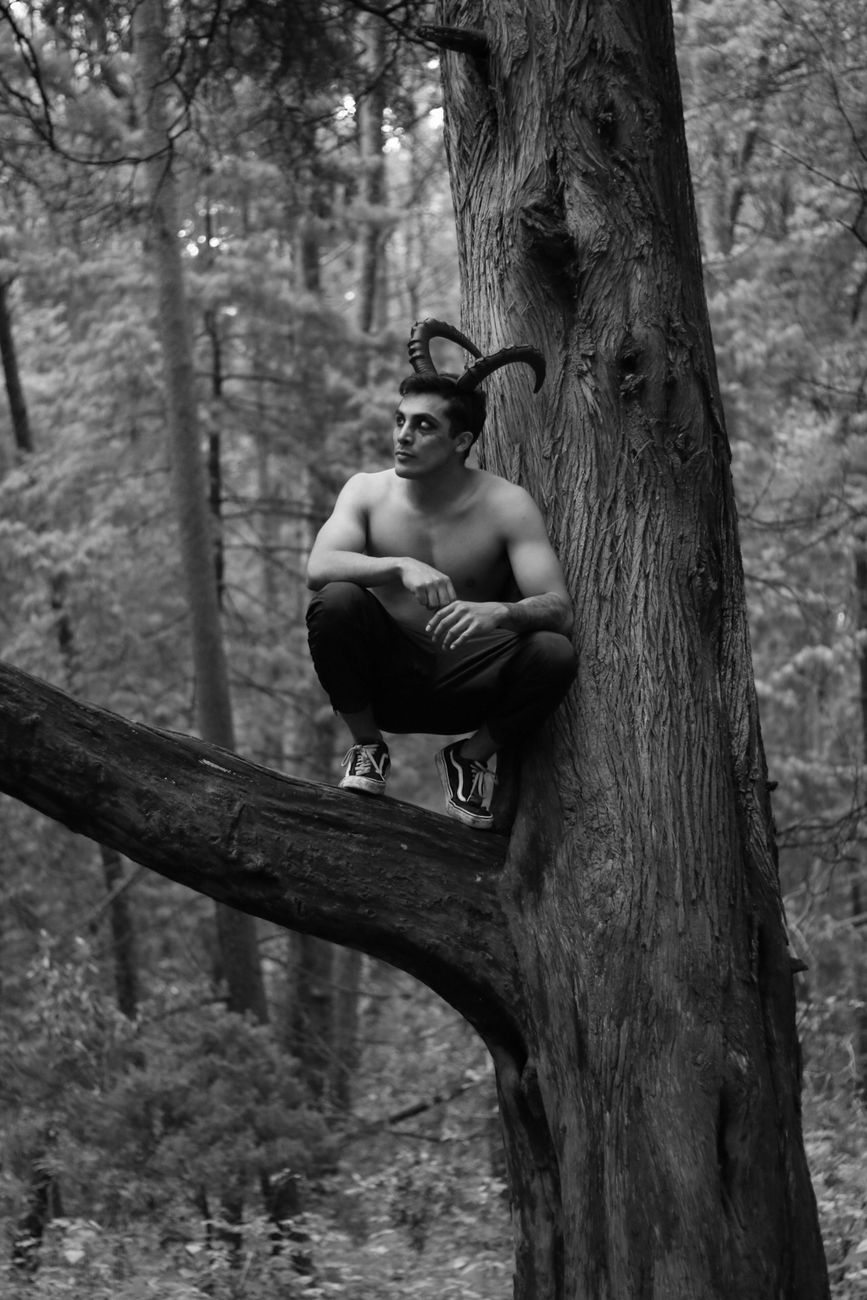
Does he have antlers on an otherwise human head or is his whole head that of a deer?
Is he carrying or holding anything?
The reason I asked you those questions is that Herne the Hunter is a very well-known deity of the English forest – and yet, the recorded history we have for him is not very old at all.

The first time the name of Herne the Hunter appears in print is in the 1602 quarto edition of William Shakespeare’s play The Merry Wives of Windsor. Although the play did not appear in print until the early 1600s, it is believed to have been written some years earlier, probably around 1597. The play involves one of Shakespeare’s most beloved characters, Sir John Falstaff, attempting to seduce the wives of two of Windsor’s most prominent citizens. As the play draws towards its close, the wives, Mistress Page and Mistress Ford, irritated by his unwelcome attention, decide to play a trick on Falstaff, persuading him to get dressed up as Herne the Hunter.
Mistress Page develops the plan by arranging for a number of small children, dressed up “like urchins, oafs, and fairies”, to jump out on the unsuspecting Falstaff and scare him into telling the truth about his seduction, therefore embarrassing him in front of the whole community.
And so, Falstaff appears in Act five with a pair of antlers strapped to his head and is roundly punished for his attempted deception.
However, the important question we need to ask here is whether Shakespeare was recording an actual piece of Windsor folklore in his presentation of Herne, or whether he created him just to nicely round off his play. A number of Shakespeareans think it is the latter, and that Herne was simply a creation of the playwright to give his play a satisfactory conclusion. Their case is strengthened by the fact that there is no recorded evidence of Herne predating the play at all.
That doesn’t mean they are right, however. Even within the play, the characters hint at an oral rather than written tradition for Herne, stating that: The superstitious idle-headed eld / Received and did deliver to our age / This tale of Herne the Hunter for a truth.” Just because no evidence of that oral tradition survives does not mean it did not once exist.
However, we do need to remember that Shakespeare was a playwright and not a folklorist, meaning that he only included things in his plays which aided their dramatic function. Therefore, much of what we are told about Herne within the play serves the action of the play and isn’t necessarily evidence of Herne’s actual folklore. For example, while we now see Herne as the regal embodiment of the forest, in Shakespeare’s play, Falstaff becomes bestial, and his language becomes incredibly bawdy, or rude, when he puts on a pair of antlers. For Shakespeare and others of his time, anything that blurred the line between humans and animals was seen as degrading. It reduced the individual to an animalistic, base version of themselves, rather than elevating them to something in touch with the natural world.
So, while Shakespeare’s play may be the first time we see Herne’s name in print, it’s actually very problematic in terms of what it tells us about the history of Herne himself.
Trying to trace Herne’s journey through the seventeenth and eighteenth centuries also shows that, for a long time, he struggled to escape the shadow of Shakespeare and his play. The first time we find a reference to the now famous Herne’s Oak is in 1742, with the publication of William Collier’s Plan of the Town of and Castle of Windsor and Little Park and Town and College of Eton. However, on this map, the tree is labelled as Falstaff’s Oak, rather than Herne’s Oak.
Later, in 1792, Shakespeare fanatic Samuel Ireland recounts the story of Herne and Herne’s Oak in his illustrated book Picturesque Views on the River Thames. However, Ireland was deeply unreliable – he is known to have fallen for many tricks and stories because of his almost blind adoration of Shakespeare. His son, for example, forged a number of documents about Shakespeare, including an entire play called Vortigern, which Ireland published as authentic! While Ireland expands upon Shakespeare’s description, telling us Herne was a forester who was hanged from a tree in Windsor Great Park, which he now haunts, he does not tell us where he got the information from.
It wasn’t until the 1842 romance novel Windsor Castle that Herne freed himself from Shakespeare’s influence. The novel is the story of Henry VIII’s relationship with Anne Boleyn, with the historical events overlaid with lashings of romance and gothic spectacle. Author William Harrison Ainsworth may not be well known today, but his novels were incredibly popular in the nineteenth century and actually outsold Charles Dickens. He shaped how the British saw such figures as Dick Turpin and Guy Fawkes, and created a devilishly wonderful version of Herne the Hunter for his avid Victorian readers.

For Ainsworth, Herne is no mere plot device. Instead, he emerges as the principal antagonist of the novel, involved in every plot and subplot, whether they be romantic or historical. Just when the action threatens to become dull, Herne appears with a flourish. He is clearly a supernatural figure, referred to variously as a “demon,” an “infernal spirit, a “false fiend,” and a “spectral huntsman.” His appearance often coincides with thunder and lightning, another sure sign of his infernal intent. He is so bold, so brash, he even stands up to the notoriously cantankerous figure of Henry VIII, saying: “Welcome to my domain, Harry of England. You are lord of the castle, but I am lord of the forest. Ha! Ha!” His self-proclaimed title as “lord of the forest” is one that would follow him into the twentieth century and beyond.
Ainsworth also shows Herne leading a version of the Wild Hunt, a role which was ascribed to him in 1835 by Jacob Grimm in his book Deutsche Mythologie. However, long before this had been translated into English, Ainsworth took Grimm’s idea that Herne is a leader of the Wild Hunt and developed it as a central part of his novel. His myriad readers would have found this to be one of the most compelling and exciting aspects of the story, which is possibly the reason why it became a central part of his mythos in the popular imagination. The novel is filled with adrenaline-fuelled chases around Windsor with a group of monstrous troupe following behind.
Herne’s “cavalcade” of followers is striking. In Shakespeare’s play, Herne is a lonely spirit who frightens other people away, not someone who gathers an entourage around him. Ainsworth’s novel is the first time we see references to him having “satellites.” Herne has a number of animals who accompany him in the novel, including “a large owl, and a couple of great black dogs”. We also find out that Herne has hounds called “Saturn and Dragon,” further indications of Herne’s fiery, hellish persona. It is not only animals which join Herne in hunting. Ainsworth tells us of “a number of wild figures in fantastic garbs, some mounted on swarthy steeds and accompanied by hounds, others on foot” who join the hunt, although some of these turn out to be less fantastical than described and are, in fact, very human characters who owe Herne a debt of service.
Ainsworth’s Herne is a thoroughly engaging character, although not one with as much depth as the other great Gothic villains from the nineteenth century, Dracula and Frankenstein’s Creature. Nevertheless, it is easy for us to underestimate the effect that Ainsworth’s portrayal has had on shaping our collective image of Herne. He uses details from Shakespeare’s play, preserved and augmented by Ireland, adapts the theoretical work of Grimm and binds it together with his own invention to create a character which resonated in his own time: and in ours.
The twentieth century saw Herne positioned back into the centre of British culture, with books such as Susan Cooper’s “The Dark is Rising” and John Masefield’s “The Box of Delights”, which was also turned into a TV series in 1984. These texts brought very different versions of Herne to their audience.
However, just as Ainsworth used the most popular media of his time, the novel, to popularise Herne the Hunter, the same happened at the end of the twentieth Century. Shown in the peak Saturday tea-time slot on ITV television between 1984 and 1986, Robin of Sherwood was a landmark piece of television that shaped a generation’s approach to the legendary characters of Sherwood Forest and Herne the Hunter. In the show, Herne was totally dislocated from Windsor Great Park and became a resident of Sherwood. Richard ‘Kip’ Carpenter, the creator and writer of Robin of Sherwood, gives no reason for such a move. There is no explanation as to why Herne is in Sherwood rather than Windsor. He just is.
What is also unique about Carpenter’s Herne is that he is human. He is not a spirit or a ghost haunting a tree; he is not a demon accompanied by thunder and lightning. Herne, played by actor John Abineri, is flesh and blood, although he has very potent magical powers. Carpenter reflected that the character was “a kind of semi-supernatural Merlin figure, … a sort of mentor, guide, speaker in riddles.” Carpenter evokes the figure of the shaman in his Herne, who can commune directly with the gods. The television series reenchants England’s forests, making them a place of magic and wonder. And it is Herne who is the central magical touchstone for the series.
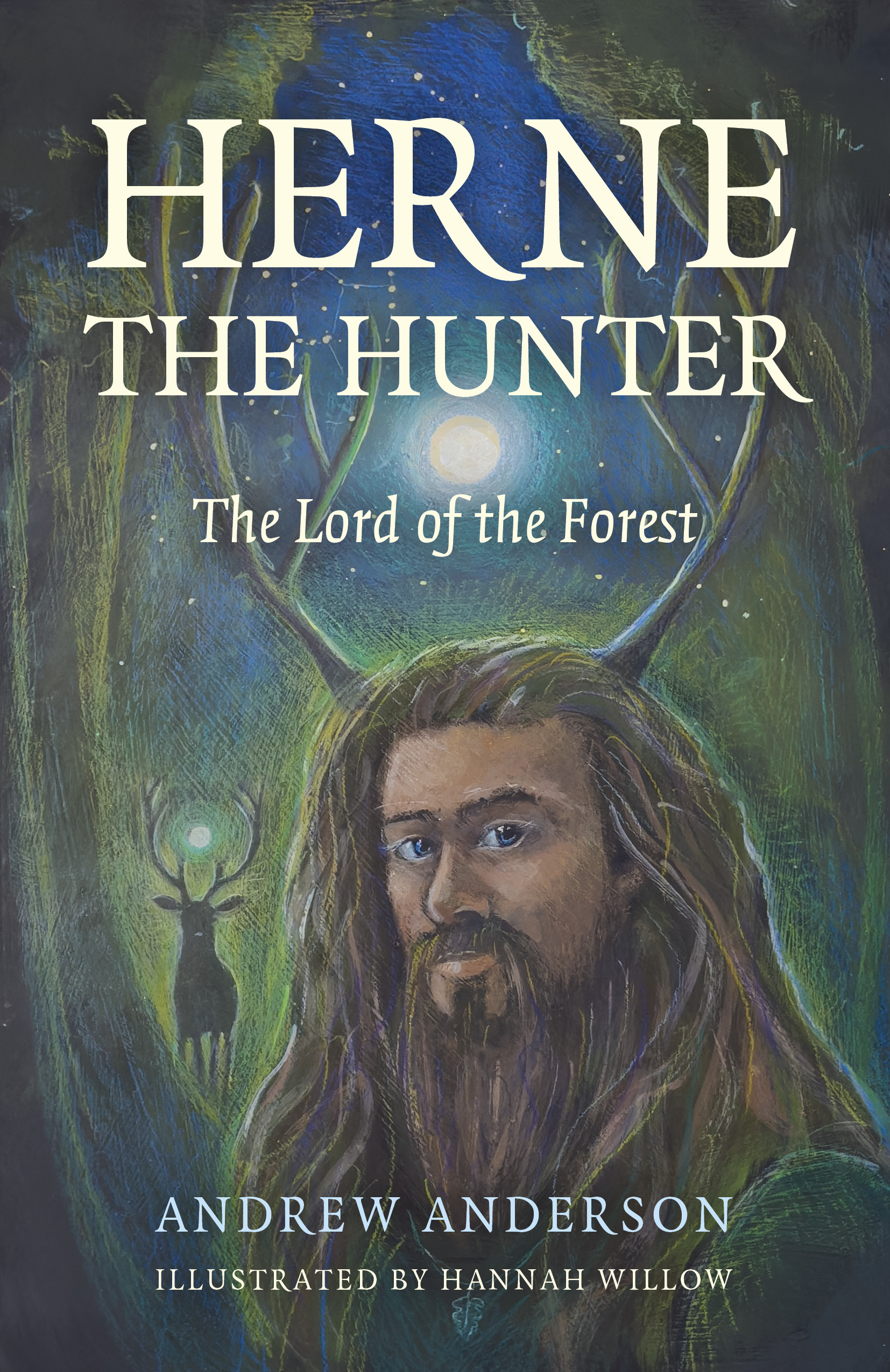
So who is Herne the Hunter? Well, his position among the pantheon of neo-pagan gods is secure for one simple reason: he is the Lord of the Forest because that is what we need him to be. We have created Herne the Hunter over the centuries because there is no one else in England quite like him.
History has seen him change from a human, hanged for a crime or out of shame, whose ghost haunts a tree, to a spirit which inhabits a tree, to a spirit which inhabits England’s woodland, to a deity who physically and emotionally embodies our forests. We hold that lineage, with all its contradictions, because Herne speaks to a deep need in the English psyche, for ghost stories, for a sense of connection to the landscape, for a magical edge to our everyday lives.
At a time when we have found ourselves disconnected from nature, Herne has become a key symbol for the potency of our woodlands and our relationship with them. Whether he is an ancient god or one we have created together, that does not stop him from being exactly what we need right now.
For more details: https://www.collectiveinkbooks.com/moon-books/our-books/herne-hunter-lord-forest



Leave a Reply