
What are the runes? What are the different rune rows, and which rune row does Imelda’s book discuss?
Today we are going to talk about the Runes and Imelda Almqvist’s new book: Portals, Patterns and Pathways: A Handbook for Rune Magicians, Star Gazers and Myth Makers.
The Greek philosopher Plato gave us the foundational “Theory of Forms (or Ideas)”. Plato concluded that our physical (or material) world is less “real” than these Forms. By this he means the non-physical, timeless, absolute and unchangeable essences of all things, of which objects in the physical world are merely imitations, or pale reflections of an Eternal or Timeless World.
In our own time, the French philologist and medievalist (and author) Claude Lecouteux refers to older ancestral concepts as resilient structures and enduring ideas. You could also view those patterns of knowledge as “cultural strands of DNA”!
What are runes? Are they mysterious glyphs or magical symbols? Or are they something else altogether?
The runes were the earliest form of writing that existed in Scandinavia. They were created as early as the first century CE. The Viking Age ran from roughly the year 800 – 1100 (when the Christianization of Europe occurred and the Latin script became the dominant script).
This means that by the time the famous rune stones of the (late) Viking Age were carved (and we still see them standing by the roadside in Sweden today!), the runes had already been in use for nearly a thousand years. That is an entire millennium!
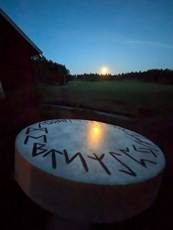
But today, in the 21st century, we also refer to small stones, bones or antler pieces with these letters carved (or painted) on them as runes, or a set of runes.

The Elder Futhark is the oldest rune row we have. Today we are going to talk about the Runes of the Elder Futhark. The first and last Runes are letters of an old Germanic script! Alphabet isn’t the right word for them, because the runes of the Elder Futhark appear in a unique and meaningful sequence (which is not ABCDE, etc.)
The Elder Futhark consists of 24 characters. Over time, it developed into several variations: the Younger Futhark (which has 16 letters), the Anglo-Saxon futhorc (which has 31 letters), the short-twig variations, Medieval Runes and cryptic runes.
The Anglo-Saxon Futhorc coexisted with the Northumbrian Runes and the Frisian runes. The (so-called) Dalecarlian Runes are a later version. Remarkably, they remained in use in the isolated Swedish province called Dalarna [DAH-LAHR-NA], well into the 20th century!
There was an Old English word “run” (not to be confused with jogging, sprinting or galloping – in modern English it would have become rown), but our word rune in English comes from the work of (later) Scandinavian scholars. In other words: the English language lost or dropped this word, and the word was re-imported from Scandinavia!
So, first and last, runes are LETTERS. They were used for writing! But many scripts and alphabets also have a magical dimension. In early cultures, speech and writing were often perceived as intrinsically magical acts, linked to the process of Creation itself. Just think of the opening words of the Gospel of St. John in the Bible: “In the beginning was the Word, and the Word was with God, and the Word was God”.
And now let’s compare those words with Odin’s words in Havamal [pronounced HOA-VAH-MOAL], as translated by Imelda:
Then I started to thrive in fertile space [pollinate]
And I became wise
I grew and so did my wellbeing
A word led to more words
Words led to a deed
Deeds led to more [greater] deeds
Odin’s words in Hávamál, Stanza 141
Common misperceptions about the runes
Are there things people often get wrong about the runes? Yes, here are some popular (or widespread) misconceptions about the runes!
There was a language spoken in Scandinavia even before Old Norse; we call it Proto-Norse, so Old Norse was actually the modern language of its own period! But the Elder Futhark is not well-suited to writing Old Norse (the vowel sounds don’t match up).
The main source material we have, which is two collections of poems titled the Poetic Edda and the Prose Edda, were never written in runes. The Roman alphabet was introduced in Scandinavia along with Christianity. The Poetic Edda and Prose Edda, sagas and other long texts were written in the Roman alphabet (and in ink). However, people continued using the runes for carving in stone and writing on leather or bark, etc. (following an old ancestral tradition).
We already learned that the runes were primarily used as letters. In other words: they represented sounds and spoken language!
Contrary to popular belief, the Vikings did not use the runes of the Elder Futhark (which belong to an earlier period), and Old Norse was not written in this script. The Vikings used the runes of Younger Futhark!
It is often claimed that the Christian Church actively suppressed the use of runes. The Church certainly introduced Latin, writing in ink and the Roman alphabet, but there is no evidence that they actively tried to eradicate the use of runes (but they definitely used rune stones as building blocks for churches; we see many rune stones cemented into walls of old churches in Sweden!)

One startling feature of rune stones (memorial stones) in Sweden is the large number of them featuring strikingly Christian motifs (such as crosses and inscriptions) mixed with invocations to, and the names of, Norse gods! There was a transitional period where Old Norse cosmology and Christianity coexisted. At her Forest School in Sweden, Imelda takes her students on field trips to see rune stones. The students are always baffled by this weird combination from two very different periods in time.
The Vikings were (probably) not covered in runic tattoos! There is not much support for the idea that they had tattoos at all, let alone that they sported the complex fancy bind runes and symbols we see on people today. Only one source, the author Ahmad Ibn Fadlan, mentions dark green “tattoos”, but apparently the same word, in Arabic, can also mean (body) paint. The idea (of abundant tattoos) is supported by neither the Poetic Edda, the sagas, nor by archaeological findings. It (apparently) is more of a modern Instagram Aesthetic!
A cool millennium (or almost) divides our era from (the end of) the Viking Age! The Vikings are so popular (and alive in our imagination) right now that many people project their own fantasies onto them and also onto the past. That is understandable and (arguably) it is even empowering, as long as we realise that this is the realm of make-believe, not historical accuracy.
Why another book about the runes (has everything not been said by now?)
OK, but why yet another book about the Runes? You are just telling me that they are old letters or glyphs. A millennium has passed since they were in daily use. Is there really anything new to say about the Runes?
Imelda’s perspective is that the Runes map a mythical or imaginal realm where cosmic blueprints share their stories and wisdom through archetypal figures, deities, personifications, alchemical images and symbols. Working with the runes, she found countless correspondences and wisdom teachings (portals, patterns and pathways, which gave her the title of handbook for rune magicians!)
There were three key insights which led to her developing this new body of material. They are based on her Rune Journals, where she keeps track of her observations and insights as they occur.
Years ago, she wrote in her Rune Journal that “Every liminal space between runes is a mystery school, and its curriculum is mythology!”
What that means, in plain English, is that the rune magicians before her had focused on the runes themselves (and their meanings). As a teacher of Seidr and Shamanism, she is extremely aware of “between-spaces”. A major example is the space between this world and the Other World or Spirit World, but the same principle can be applied to the runes. If we line the Runes of the Elder Futhark up in a Circle, what is happening in the spaces between the runes?
Well, that is where we find myths, archetypal themes and even deities (often with specialist knowledge or a specialist job)!
In other words: the runes do not only get a mention in some of the Norse myths, but we find many of those myths in the edgy but power-packed spaces between the runes!
The letter (or glyph) sequence of many early (ancient) alphabets appears to be connected to the night sky and star patterns. Does a similar correspondence exist for the runes?
Again, this may sound a bit abstract, but our ideas about the night sky did not come “out of nowhere”. There is a close connection between early alphabets (such as Phoenician, Archaic Hebrew and Egyptian Hieroglyphs) and the patterns we see in the night sky, until today. No matter whether you are a believer or not, the entire field of astrology is built on that foundational knowledge! And even though astrology and astronomy parted ways a long time ago (long story for another day), astronomy uses 88 officially recognised star constellations (as defined by the International Astronomical Union in 1922).
There is a chapter in Imelda’s book about Old Norse Astronomy, guided by astronomical numbers and references to celestial events described in the Poetic Edda. Some scholars think that the Poetic Edda is an astronomical text (but in the form of a collection of old poems, isn’t that an amazing idea?)
And talking of astronomy and astrology: last but not least, Imelda asked herself: What happens if I arrange the Runes of the Elder Futhark in a Circle and then look at that circle the way that an astrologer reads a natal (birth) chart?

There are a lot of correspondences (such as every rune having a special relationship with the rune situated exactly opposite, on the Wheel of the Runes). There are also many interesting “triads” (clusters of three runes) that carry very significant meanings. So significant that those clusters can even help us predict how world events are going to evolve. The sequence of the runes actually tells us something about Cosmic Cycles!
Not only that, ALL runes of the Elder Futhark have relationships with all other runes in the same tune row (or on the same rune wheel). She works with a concept she calls runic axes, which cast light on those relationships between the runes. It provides examples of archetypal and mythical themes that those axes anchor. This helps Rune Magicians add new dimensions of meaning to their rune readings and their rune workings.

What is the confusion or even controversy about the Futhark – Uthark Sequence?
If you have read (or listened) this far, you will now (hopefully!) have some sense of what the Runes of the Elder Futhark are. What you probably don’t know is that there is a controversial idea about their order or sequence.
Most rune magicians view the Runes of the Elder Futhark in a linear way. Imelda does not view the runes in a linear way. Instead, she perceives the runes (in this case, the Elder Futhark) as a wheel or circle. This means that, in some way, every single rune can pose the starting point for a journey (of learning and unfolding)!
Imelda was introduced to the runes by Scandinavian teachers and rune magicians. All rune magicians are aware that every single rune has both a “light side” and “dark side”. By this I mean that “the light side” refers to the life-giving processes of creation unfolding, beginnings and growth – while the dark side refers to death, endings and deconstruction in all its manifestations.
They are two halves of the same coin: Creation cannot exist without Destruction. In the perennial cycle of Life – Death – Rebirth (or Creation – Destruction – A New Construction), the very building blocks of Creation are freed up by the processes of death, dismemberment, deconstruction and decomposition.
“The Forces of Destruction are unfailingly in service to the Forces of Creation” – but to our human eyes it surely does not always appear that way!! – Imelda Almqvist
There is a theory (disputed and controversial, but underpinned by compelling arguments) that in a time after Scandinavia converted to Christianity – and eventually witch hunts occurred there (just as they did in other locations in Europe) – that teachers of esoteric material were forced to preserve powerful material by using cyphers or “hiding things in plain sight”.
Let’s briefly visit another period from history to explain the need for this.
During World War II, something called cryptography was used extensively because of the importance of radio communication and the ease of radio interception. The nations involved in the war used a plethora of code and cypher systems. Because of the heavy use of these systems, the theoretical and practical aspects of the art of cryptanalysis (in plain English: codebreaking) were developed to a very high degree. Most of the codes used in the war were eventually broken by the enemy, with a wide spectrum of consequences.
In our world of the 2020s, we still use encryption. Most of the platforms (and messaging apps) that we all rely on use encryption technology to guard our privacy as we share confidential information with someone (or an institution, say a school or hospital). I just ran a quick search and discovered that malware is often encrypted too. Cyber criminals use it to evade detection. In some ways, you could say that there is a “tech war” going on, where we are all trying to stay one step ahead of the game. (Can you see or feel the echo of encryption in World War II?) Not to mention modern phenomena such as “sexting”!
Anyway! In 21st-century language, Imelda often uses the word “dial” with students: a dial can be turned clockwise or anti-clockwise to activate a new setting or arrangement. Just think of your washing machine: are you dealing with lightly soiled coloured wash or a heavy-duty boil wash?
Following this metaphor of a dial, there is a belief that rune magicians deliberately “dialled” the wheel of the runes back by one position, meaning that the last rune (Fe, Feoh or Fehu, depending on which system and naming system you follow) became the first one.
Let us just look at the meaning of the runes involved:

FE, pronounced FAY, (or Fehu/Feoh), refers to mobile measured wealth in the form of cattle, meaning “tamed “ and domesticated cows. By extension, in our day, this commonly refers to material wealth as in money.
UR (or Uruz) is said to be the rune of Audhumbla (the primordial cow mother who was there at the same time as giant Ymir), and it refers to a great reservoir of untamed energies (or potential) that have not yet divided, polarised or taken a final definite form. We can engage and “dance” with this energy – but we cannot control or direct it.
We already explained before that the Wheel of the Runes (as do all alphabets!) tells the story of Creation. It seems unlikely (and the Eddas tell a different story!) that there were domesticated cattle and money at the beginning of the cosmic cycle we find ourselves in. Creation (the world as we know it) did not start with tamed cattle, money and mobile wealth. (The beginnings of those things are found in the Neolithic period in Europe).
Many authors have discussed the existence of the Uthark: some accept it, and others reject it. Those who work with the Uthark find profound correspondences and wisdom teachings with the “dial” set in this position.
We do not know exactly who put the runes in a certain order and when this occurred. We do not know either why it does not follow the “phonetic letter order” of nearly all European alphabets. The order of the runes in the Elder Futhark is based on ancient rune stones.
The Kylver stone on Gotland, dating from about 400 CE, is known for listing each of the runes of the Elder Futhark in specific order:

The field of numerology (and the study of ancient scripts and alphabets) tells us that every position has a unique meaning/frequency related to cosmology – so what position we allocate to the runes is not a random thing; it does actually matter!
Some practical suggestions for working with the runes
Runelore is a vast subject, and much has been written about the runes. There is no “right or wrong”, but instead we find an immense richness when we open ourselves to different possibilities and become willing to receive the ancient wisdom teachings inherent in that.
The runes are like portals or great gates: they continue to “open up” and reveal new dimensions of meaning all the time. Imelda does not believe that one can ever know the runes 100%. They tend to reveal as much as the student or apprentice rune magician is ready to absorb at a given time.
So if you already work with the Runes (or have just started exploring the Runes):
Keep a rune journal and write down all your insights, discoveries and even relevant dreams. Journals and sketches are a great tool! Human memory is not perfect after all. It is astounding how much we forget. So WRITE IT ALL DOWN!
Set dream intentions and ask to receive meaningful dreams about the runes (and keep a record of what happens.
Use family and friends as guinea pigs for rune readings (on burning questions of their choice)!
Runes are always appearing (spontaneously) in your own location! They can appear in twigs on the pavement, letters of car number plates, on logos and posters and so forth. Pay attention to them, interpret them!
Look for
- The shape of runes
- The names of runes
- How the meanings (themes, moods) of runes manifest in a given day (or even in world events). E.g. are you having a joyful and peaceful day, or a day of conflicts?
The runes definitely teach us that to gain Divine knowledge we must make sacrifices, as Odin did (by hanging on the windswept tree for nine days and sacrificing one eye). To call back old gods, we must honour them and give them wild spaces as dedicated sanctuaries and outdoor temples.
This book was written to offer material for both complete beginners and experienced rune magicians. It is meant to be used in a practical everyday way: pull some runes and look up what which forces, stories or blueprints play out on a given axis. Weave that into your rune reading or rune working (either for yourself or for others) to add dimensions of meaning or symbolism.
Any questions?
If that leaves you with any questions, please leave them in the comments, and we will pass them on to Imelda. She might pick out the best questions and answer them in a short video on the Moon Books feed! SO STAY TUNED!

https://www.collectiveinkbooks.com/moon-books/authors/imelda-almqvist

Leave a Reply