

About Tricksters, Runes and Reversals
Today we continue our exploration of ancient traditions from the Nordic Region!
For decades I have been fascinated by the fact that all over Europe we see feast days and celebrations around October 31st (give or take a few days or even weeks – and of course other times of year). It seems to me that when the key features of those celebrations show distinct similarities, we touch upon ancestral traditions from Europe in pre-Christian times.
Kekri (also Köyri) is often described as “the native Finnish version of Hallowe’en”. The word kekri is derived from a Finno-Ugric word, kekraj, which means circle or wheel (yes, as a rune magician I immediately think of Rune NAUD or NAUTHIZ!)

RUNE NAUD OR NAUTHIZ
The name for the month November in Finnish is Marraskuu, literally the dying month (or moon) or the moon/month of dying. Kekri was part of a period called Jako-aika, which means Dividing Time. It divides the dark time of year from the light time of year.
For comparison: the Old Norse people knew only two seasons: the Bright or Light Days and the Darkness Days). The new year starts with the six Summer months (Nattleysi – “Light at Night”). The year ends with the six Winter months (Skammdegi – “Short Days”).
During the Jako-aika period Finnish people believed that the souls of the dead mixed with the living and visited the homes of their family. It was important to give them a warm welcome and briefly allow them their place by the fire (as well as food and drink). SOURCE
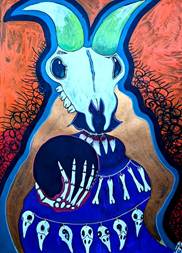
There was a reversal of the everyday norms. For a brief interval many things were flipped upside down (or inside out, or back-to-front). Both men and women engaged in cross dressing. Children wore costumes that made them look like old people (the ancestors). Goat costumes were popular. This is linked to the figure of the ‘Joulupukki’ which literally means a Yule Bock. In Sweden we put a Yule Bock (made from straw) under the Christmas tree but in Finland Joulupukki became a Santa Claus or Father Christmas figure. People would wear masks and go door-to-door, requesting food and drink or else…. (nasty things would happen!) It reminds of the Trick or Treat customs of Hallowe’en. KEKRI 2025

THE YULE BOCK
Children went calling at all houses disguised as “villains”. A slightly scarier version of this tradition involves so called “villain dolls”, whose noses are twisted to the point of being crooked. Those “doll visitors” require a lot of patience and tolerance. If that was not forthcoming, they would tear open the oven – or at least threaten to do so. Usually they are welcomed in, and the doll visitors then perform tricks and dances. SOURCE
I am currently writing a book about Inuit Deities and traditions and I have even found evidence of reversal festivals in the far north, isn’t that fascinating? It must meet a core need in the human psyche! Examples of such feasts further south (in Europe!) are Saturnalia and Bacchanalia and the tradition of appointing a Boy Bishop, sanctioned by the Church. For just one day a choir boy was elected as the Boy Bishop and the real Bishop stepped down. Predictably this soon derailed into boys messing around big time: scandalous ditties sung in Church and pranks played all over time. This is Trickster energy rampaging big time!
Why did the Church do this? Well, because “reversal festivals” act as a safety valve or circuit breaker. By allowing slaves (in Old Rome) to boss their owners around, or children to impose chaos or naughty behaviour on adults, there was a sudden and immense drop in societal pressure. This meant that another year of law and “the proper social order” could unfold soon after, without too much interruption. By inviting the Trickster in, for a visit of limited time duration, it was hoped that the Trickster and Forces of Chaos would be kept at bay for the rest of the year!
In Russia the sauna is also called the House of the Ancestors. Not only that, the sauna was the place where women gave birth. On a practical level hot water was at hand, it was often warmer there (because of the fire burning) than in other buildings on a homestead or large farm. But there was a spiritual dimension to this as well:
Our Ancestors believed that at the time of birth, portals between the worlds (our world and the world of the Ancestors) opened, allowing the soul of the child safe passage from one realm into another. In some ways the mother-in-labour becomes the crossroads, with her legs wide open (and I definitely remember moving my arms a lot during the pushing stage, in some ways I became “a human cross” and my head – usually in charge of my life – felt like the least significant part of me during that primal process). READ MORE

RUNE GIFU
This is rune GIFU (the rune of gifts, reciprocity and the sacred marriage): in English we say “GIVE birth” for good reason!
A lot of magic was practiced to ease the process: windows were opened, no one was allowed to wear a belt, curtains were untied etc. Symbolically speaking the environment (and everyone who participated in the event of birthing new life) focussed on being “open” and securing a smooth passage for both baby and mother.
To my (personal) mind there is also a direct link between chaos and fertility (birthing something new). Just look at the mayhem that sexuality creates in our society: infidelity and cheating on partners, unwanted pregnancies, STD’s… I think of human sexuality as a Trickster. Here it may be worth pointing out that Norse god Loki (the notorious Trickster) is the only male god who gives birth.
Here is a summary of the story:
After the Norse gods had created Midgard, they hired an unnamed builder to erect a wall around their domain (as protection from the “giants”). Loki was heavily involved in the negotiations and it was agreed that if this builder completed the work in one winter (with the help of his horse Svaðilfari), he would be given Freyja, the Sun, and the Moon. This promise was made because no one believed the word could be done in one winter! However, the builder and Svaðilfari made excellent progress. Three days before the deadline (the start of summer), the work was almost complete.
The Norse gods threatened Loki with severe repercussions if he did not “do something” right away! That night a beautiful mare (Loki in disguise) appeared and distracted Svaðilfari, who chased the mare into the woods. With two horse running amok, the project was not finished on time. The builder flew into a rage (and revealed his true identity: he was a mountain giant, not a regular builder!) The Æsir asked Thor to slay him. the builder’s identity, they disregarded their previous oaths with the builder and with his magical hammer Mjöllnir. Due to his wild night with Svaðilfari, Loki became pregnant and later gave birth to the eight legged horse Sleipnir, who became Odin’s trusted horse, forever riding safely in all worlds and visiting all realms (including our human world).

Please remember that there is a Horse Rune (EH or Ehwaz) which is also the rune of Twins, Partnership and Soul Conductors (psychopomps). And the Norse psychopomps are extremely busy around this time of year, helping the souls of this year’s deceased cross over and make their final transition. The Harvest is in, the hay is stacked in the barn and the owners of farms need to go and personally feed their horses (even if they usually employ staff to perform such daily tasks).
The harvest food must be offered to all who arrive and sit at the table, both family and strangers. Our Ancestors understood that generosity brings good fortune to a farm. (This is the connection between Rune GIFU and Harvest Rune JARA or Jera. In my book I call this meaningful link a Rune Axis!)
My final observation for today is that there also seems to be reversal (or inversion) on a larger level. When the Church gained control over Europe, the souls of the dead visiting at Kekri/Hallowe’en or the time of the Álfablót were turned into harmless children wearing masks and playing pranks if they did not receive sweets (originally: food offerings for the Ancestors). And Sinterklaas (the Dutch version of St Nicholas, see Chapter 11 in my book North Sea Water In My Veins) became a Saint delivering presents for children, covering up the fact that in the older version of the past was a Psycho Pomp or Soul Conductor, who came to collect the souls of people who had died that year. His big burlap sack originally held souls, not gifts for children…

https://www.collectiveinkbooks.com/moon-books/authors/imelda-almqvist


Leave a Reply